
The man at the microphone is adjusting something that does not seem to need it, his hands quivering. Around him, a couple of test flashes go off, and the journalists open their notebooks with a watchful care. Very little happens in this scene. Somehow, it becomes one of the heaviest things in the film. That weight has a name, of course, and the documentary is more explicit about it than my first response perhaps allowed. 80 Angry Journalists follows the crisis surrounding Index.hu, once Hungary’s largest independent news outlet, as political and institutional pressure culminates in the dismantling of its editorial autonomy.
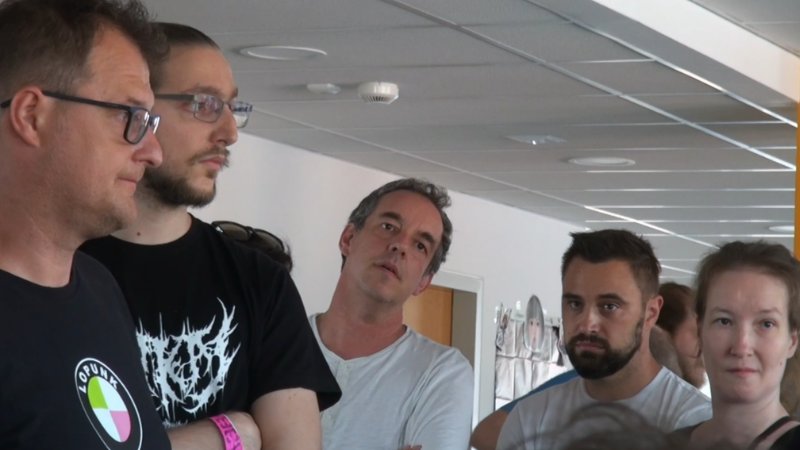
The film makes that arc legible from early on. Increasing government interference with the paper culminates in the dismissal of the editor-in-chief, Szabolcs Dull. Unmistakably, the crisis at Index came through restructuring, managerial decisions, and the gradual narrowing of what could still be considered editorial independence. No spectacular act of censorship. By the time Dull is removed, the debate in the newsroom reaches beyond political influence to whether the institution can still function without being fundamentally compromised.
The film moves through this crisis largely from inside the newsroom. It gives us journalists, editors, photographers, legal and managerial figures, each trying to describe where professional responsibility ends and accommodation begins. That question becomes especially charged in the figure of László Bodolai, the lawyer and chairman of Index’s board, who occupies an uneasy position between the newsroom and the institutional structure bearing down on it. He is framed as a key agent in the paper’s transformation, and the ambiguity of his role adds some of the film’s sharpest tension. Opposite him, Vera Munk comes forth as one of the central faces of the newsroom’s attempt to imagine continuity after collapse. The institutional confusion remains visible.
A young investigative reporter calls a government office to request procurement documents. The exchange is terse, the official is well-mannered and entirely unhelpful. She hangs up and immediately starts drafting a formal appeal, just as if it had been built into the request from the beginning. The documentary is full of scenes like this, sitting within a clearer narrative structure: they are textures of professional exhaustion, and, simultaneously, part of a larger process by which journalism is made slower, more brittle, more difficult to sustain. One journalist recalls the day advertisers started disappearing one by one; another describes anonymous calls after publishing a corruption story, then shifting almost casually to something else.
The pressure here is different from the sort most documentaries about journalism depend on.
Telex.hu
The journalists protest Dull’s dismissal and publicly call for his reinstatement. When that effort fails, around eighty members of the Index staff resign together. A potential internal crisis now turns into a collective political gesture, a walkout presented as a climactic threshold. Leaving becomes the only way to preserve a professional ethic that the institution itself can no longer protect. In one of 80 Angry Journalists most important movements, it continues with the attempt to construct something after the collapse of the Index. Then, the next chapter is the founding of Telex.hu. It is less triumphant than necessary, way less redemptive than practical. Accordingly, the film records institution-building under pressure. It is one thing to walk out and another to begin again, reconstructing credibility and public address from almost nothing. Many of the departing journalists remain together in this new, reader-funded outlet, which the documentary presents less as a victory than as the difficult maintenance of independent work by other means.
This is where the film becomes more than a chronicle of media repression in Hungary. The pressure here is different from the sort most documentaries about journalism depend on. Instead of a violent manifestation, it comes from delay and obstruction. Uncertainty and juridical ambiguity are permanently mixed with managerial intervention. One journalist says she keeps asking questions she knows will not be answered. «Sometimes the question itself becomes the story.» It is a strong line. The repetition gives it force, as we begin to understand the futility and the cost of continuing anyway.
Unspectacular damage
Near the end, after the institutional damage has fully declared itself, the documentary arrives at something close to its real subject. Not simply censorship. Not even a simple media capture. The spectacle of democracy lingers while one of its organs is quietly being stripped of function. What it understands, quietly, is that the real damage in a system like this is often not spectacular; fatigue and futility stop arriving as interruptions and start looking like the job itself.