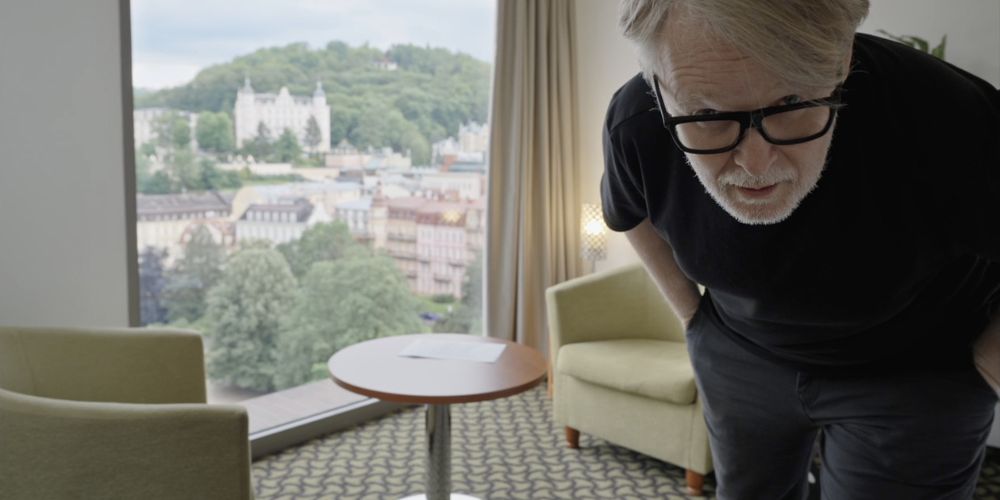
During the 1982 Cannes Film Festival, German director #Wim Wenders# set up a static camera in a hotel room and invited filmmakers, including Steven Spielberg, Jean-Luc Godard and Rainer Werner Fassbinder, to briefly offer their reflections on whether cinema is an art that has a future or a language that is about to die. He edited this footage into the documentary Room 666. Fast-forward forty-three years, and two Czech film producers decided to adapt this undertaking in collaboration with the #Karlovy Vary# International Film Festival. During last year’s festival, they set up a camera in a room with a view over the very distinctive pastel historical facades and forested hills of the spa town in the west of Bohemia, then asked a few dozen local filmmakers to enter and provide their thoughts on the state of cinema, putting a markedly national spin on the original survey by Wenders with a question they themselves are often asked as producers: «What is Czech in Czech cinema?» The result is a fascinating snapshot not only of one central European nation’s film industry but also of its attempt to define its own identity at one point in the modern era as part of a tumultuously changing and territorially fluctuating continent — and of its comical and self-aware inability to come up with a grandiose narrative for its current incarnation.
The everyperson
One has to first define what is Czech in order to go about finding it in films, as several of the participants, including director Martin Dusek, say. And the point that stands out as an attribute of being Czech that most of them agree upon is, ironically, that Czechs try not to stand out. To be really Czech today is to be unremarkable; to cut oneself off from one’s emotions and passions and never lose control, so as not to be frowned upon as too much or too loud. This perceived mildness was deemed a shortcoming, rather than a quality, especially when it comes to cinema; a «curse of detachment» or «yoke of averageness» from which a kind of madness or dramatic intensity was missing. Stories tend to be pulled from everyday life and presented with irony, rather than self-satisfaction. There is a lack of heroes and little national pride in characters who lose and fail more than they triumph — a tendency that one director (Bohdan Sláma) even attributed in a compelling argument to the landscape and weather conditions, a yearning for safety encouraged by the Bohemia Basin, away from the stirring tumult of open plain winds.
Whatever the reason, the everyperson, avoiding big themes and grand stories, is rife on the contemporary Czech screen, in picaresque depictions of life in the countryside. Aside from the numerous films escaping into the past, referencing the celebrated Czechoslovak New Wave as if it were the only era of artistic significance, or dealing with the normalisation period of the #communist era, when the liberalising reforms of the #Prague Spring# were crushed in a hardline crackdown after the #Warsaw Pact# invasion of 1968. Still thriving, it is claimed with more than a few misgivings, is Švejkism — the mindset and habits of the kind of simple-minded, passive bumbler that is at the heart of Jaroslav Hašek’s defining, darkly satirical 1920s novel The Good Soldier Švejk, the most-translated work of Czech literature, about a man and self-professed idiot serving Austria-Hungary and following orders with apparent enthusiasm in the illogical conflict of the First World War. Director Jiří Mádl decries the lack of sex appeal of Švejkism, saying he even avoids bars where the boisterous, beer-swilling little man is pictured on the wall.
There is a lack of heroes and little national pride in characters who lose and fail more than they triumph
Humour
This is all related with more than a dash of self-deprecating wit. After all, humour is the other defining trait of Czechs, which they are quick to name. Even this comes with regrets: Czechs are experts at mocking but cursed to never take anything seriously; their jokes used to open up critical thinking and resistance, but most Czech comedy now is superficial and mainstream; and perhaps worst of all, Czechs «used to be funny, but now even the Germans are funnier.»
Amid the vivid variations in mannerisms, philosophy and modes of expression of the room callers in The Czech Film Project, which together show that the Czech film industry is by no means a monolith of creative clones, the shared threads that run through these reflections on national identity offer much food for thought for us all, whether we are filmmakers or not. Because beyond the screen, the stories we tell ourselves about who we are become the glue that holds us together as a people and also the limits by which we box ourselves in — even if we are all too aware of their constructed and mythical nature. Is modesty an antidote for fanaticism? Or has an allergy to #propaganda from a history of oppression made us addicted, as these directors hint, to dreaming small? Every country has its running themes, contradictions and blind spots. But, as Romania-born producer Cristina Grosan says in her session, Czechs think mainly of local audiences and don’t yearn for much validation from the West. Besides, identity remains an elusive, evolving mystery, which can never be described once and for all.