Produced for Czech TV, #Communism and the Net or The End of Representative Democracy# is a bold, authorial statement on the philosophical nature of current social phenomena observable in Czechia. #Karel Vachek# – ex-boss of the documentary department of the prestigious Czech Film School, FAMU – constructs an ambitious narrative encompassing ages of European culture and history, in an attempt to present the roots of Czechia’s political problems within a postmodernist context. Fragments of his earlier films: meetings of various intellectual circles, parts of his lectures, and archival footage, folk music, visual metaphors, animated inscriptions, and even pantomime, form a tissue of loose individual reflections, meandering from the times of the 1st Czech Republic, through the trauma of 1968 Prague Spring, up to now. Unstructured, multi-layered, based on deep individual knowledge of events and people, devoid of introductory accounts makes the work a rather hermetic experience for outsiders who are left with a possibility of observing this film-series as a cultural form testifying to the «effects of ecology – […] reflections [of] the external circumstances to which actors must accommodate themselves» as Frederic Barth, a renowned anthropologist proposed in 1969.

Post WW2
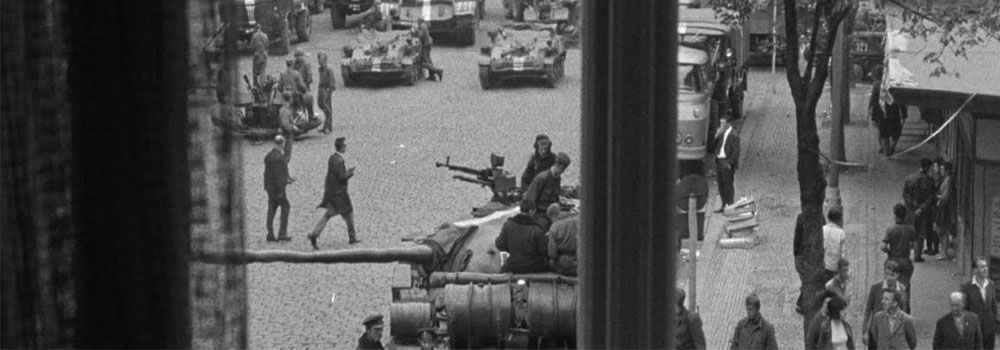
Each of the film essay’s parts begins with shots of Karel Vachek’s painting Vacheck – a collage of scenes and colours from various points of life and different perspectives put side by side, in an equal manner, in one, big picture with no distinctive center or hierarchy. This concept of a simultaneous panorama looks at the multitude of events and layers of existence order the entire narrative of the series. Part 1 starts with a glimpse of Czech painters and sculptors after WW2, whose work and thoughts are embedded in references to numerous philosophical systems (Leibnitz, Angelus Silesius, and Buddha along with Confucius, Socrates, Marx, and Giordano Bruno, amongst many others), literature (from Rabelais and Shakespeare to Goethe, Brecht or Karl May), film (D.W. Griffith, Chaplin, Tati, Visconti), and art (Rodin, Warhol, Bacon side by side with Debussy, Bach, Salieri, and Pavarotti). The news snippets on corruption scandals among Czech and Slovak major political figures that have taken place in recent years are intercut with archival footage, for example of Stalinist processes of after-the-war dissidents like Milada Horavkova, a politician executed by hanging in 1950. Biographical notes on father-figures of the 1st Czech Republic, Masaryk, Beneš, Stur, Stefanik lead to observations, repeating many times, of the importance of Dubček, the Prague Spring and 1968 as an early, idealistic attempt of reforming the communist system, crushed by cruel military intervention of the Soviets and the Warsaw Pact.
Innovativeness and open-mindedness of early Communist Czech activists led to their inescapable clash with the Soviet orthodoxy.
Innovativeness and open-mindedness of early Communist Czech activists led to their inescapable clash with the Soviet orthodoxy. Marie Švermová and Gustáv Husák were imprisoned in harsh conditions; Dubček was deeply frightened and later died in suspicious, unexplained circumstances. Their stories find semblance in nowadays-young crypto-anarchists claiming the death of parliamentary democracy that for them now proves to be a «tyranny of a populistically manipulated majority over a minority». Crypto-currency, robotization and automatization will change, once again, the political and social spectrum of democratic order. Oligarchs will use killing drones for liquidating superfluous workers and soldiers, constant surveillance of every activity can solidify hierarchical consolidation of power, the foregoing systemic political restricting the role and reach of journalism and economic disenfranchisement may lead to re-establishment of gulags. In Harrington’s words, dedicated to Cromwell: «a person whose own wealth doesn’t sustain him must remain a servant». In a deeply corrupted society, in which the 1989 Velvet Revolution brought about wild capitalism and opened possibilities for stealing state resources by small numbers of the most vicious individuals, the embezzled money gives an opportunity of cementing social structure based on dishonourable, unethical actions – the situation rewards crime.
In its own space
Multi-culturalism is not, however, a perspective advisable for Karel Vachek, who opts for every culture developing in its own space, strongly associated with language and philosophical perspective. He connects nationhood with language (forgetting about Switzerland, among many other observable examples of the different organization toward the concept of a nation) and prefers sporadic exchanges to tight mixture. Such statements stir deep disagreement of his interlocutors, especially those coming from multicultural backgrounds, to which he responds in Part 2 explaining his artistic method as necessitating controversy in order to achieve engagement of a viewer.
Bitter disillusionment
Part 3 and 4 form continuation of earlier motives freely interlacing past and present with numerous metaphorical crosscuts framed within philosophical questions. These range from the post-modernist notion of truth to Leibnitz’s concept of the human monad. The closing remarks show a bitter disillusionment with the Czech parliamentary democracy and hope in a net that can replace representative democracy by the people voting every-week on particular issues, hence ruling through referendum. The end brings a classical citation from Plato delineating the possible evolution of political systems from democracy through tyranny, monarchy to oligarchy. Vachek opposes branding the current state of global politics as «representative advertocracy», which – according to him – is always threatened by dictatorship.
The future looks grim and full of dangers but there is still hope in young people and in the proper use of democratizing technologies
The future looks grim and full of dangers but there is still hope in young people and in the proper use of democratizing technologies giving chance to take back power and materialize the rule of law according to the old revolutionary ideas: Liberte, Egalite, Fraternite.