Since the early 2010s, Turkey’s defence industry has undergone a remarkable transformation, culminating in an increasingly prominent role on the global stage. This is especially true after the regime change in 2017, which marked the transition from a parliamentary #democracy to a super-presidential system. This transformation has been a key pillar of the ruling Justice and Development Party (AKP) regime, which has ruled #Turkey since 2002. While the increase in export volumes and the rise of Turkish defence companies is significant, the underlying dynamics of this development and its geopolitical ramifications require a more nuanced account.
Militaristic techno-nationalism
The roots of Turkey’s modern defence industry can be traced back to the 1970s, but the more powerful development began in 2004. That’s when the highest authorities in the Turkish defence sector decided to reject the prevailing model of foreign joint ventures in favour of a strategy of in-house production. This shift marked the beginning of a new era and led Turkey towards self-sufficient defence production.
The defence industry was leveraged to promote #techno-nationalism, securing support from the country’s nationalist voter base. Techno-nationalism has strengthened Turkey’s proactive foreign policy, promoted national pride and reinforced the image of a powerful state. For #Erdoğan, techno-nationalism is not a nationalism rooted in past grievances or threats but one that emphasises progress and independence. For example, it serves as a strategic initiative to unite Turkey’s conservative right, counteract political polarisation and promote development, modernisation and security. This narrative, which emphasises national pride and military strength, has particularly resonated with Turkey’s youth.
This narrative, which emphasises national pride and military strength, has particularly resonated with Turkey’s youth.
Economic and geopolitical drivers
The other key driver behind the rise of Turkey’s defence industry is the need for a new model of capital accumulation. In the 2000s, Turkey’s strategy of growth based on domestic demand and a model of capital accumulation based on construction faced challenges, particularly in the second half of the 2010s, with falling growth rates and an increasing need for foreign direct investment. The depreciation of the Turkish lira and a growing export capacity gave rise to yet another new export-oriented growth strategy (Turkey has had much in the past). The defence industry became a key part of this model, with government support and incentives driving pro-government companies to enter the sector. This shift led to a dramatic expansion in defence projects.
Foreign policy considerations are the third major driver of the defence industry’s growth. In the wake of the Syrian #civil war #(2011) and the rise of the #YPG in northern Syria, Turkish foreign policy underwent a profound shift. The ‘zero problems with neighbours’ paradigm that characterised Turkish foreign policy in the 2000s was abandoned in favour of a more interventionist approach under the doctrine of ‘security at all costs’. This has guided Turkey’s foreign relations since 2015. This shift has manifested itself in cross-border operations in Syria, escalating tensions with the EU over drilling rights in the eastern Mediterranean and Turkey’s direct involvement in the conflicts in Libya and Nagorno-Karabakh.
The increasing military engagement since 2015, combined with cross-border operations, has led to US and EU arms embargoes and deteriorated diplomatic relations. In response, the Erdoğan administration has stepped up efforts to develop its own defence industry, in line with Turkey’s more aggressive foreign policy stance. The active use of BAYKAR’s combat drones against the #PKK and YPG led to an externalisation of armed conflicts and dramatically limited the PKK’s ability to act within Turkey’s borders. The Turkish government demonstrated the effectiveness of its defence industry products by using them against the YPG in Syria, contributing to national support by harmonising the military-industrial complex to fight ‘terrorism’.
The government’s adherence to militarist-nationalist rhetoric, combined with a state-centric model of capital accumulation similar to the strategies seen in #Russia, has been key to the defence industry’s growth. This shift also reflects Turkey’s desire for greater autonomy in foreign relations and to reduce dependence on foreign military technology and influence. The resulting synergy between a nationalist, militaristic discourse and the defence industry has cemented the sector’s role as a central part of Turkey’s authoritarian regime.

The growth
In 2002, the total volume of defence industry projects was a modest USD 5.5 billion. By 2023, this figure had risen to over USD 96 billion. In addition, the number of defence projects, which stood at 62 in 2002, has now surpassed 1,000 by 2024, according to Turkey’s Presidency of the Defence Industry (SSB). The volume of defence exports also illustrates this increase: In 2023, Turkey’s defence exports reached $5.5 billion, with a target of $7 billion by the end of the year. Turkish-made TB2 drones played a key role in the conflict between Azerbaijan and Armenia, marking a turning point in the country’s defence exports. According to the Stockholm International Peace Research Institute (SIPRI), Turkey became the world’s 11th largest defence exporter in 2023.
The most impressive growth has been in revenues, with the defence and aerospace sector increasing from USD 1 billion in 2002 to an estimated USD 15 billion in 2024. In addition, five Turkish companies are listed on Defense News’ “Top 100” list today, reflecting the growing global demand for Turkish defence products.

New projects and future ambitions
Going forward, Turkey’s defence industry will concentrate on three major projects: the domestic fifth-generation fighter aircraft KAAN, the Steel Dome air defence system, and an aircraft carrier. After being excluded from the F-35 programme due to the purchase of the Russian S-400 system, Turkey has accelerated its efforts to develop its own fifth-generation fighter. The KAAN, which began flight testing earlier this year, is expected to enter service by 2028. However, dependence on foreign components remains a significant challenge for the Turkish defence industry.
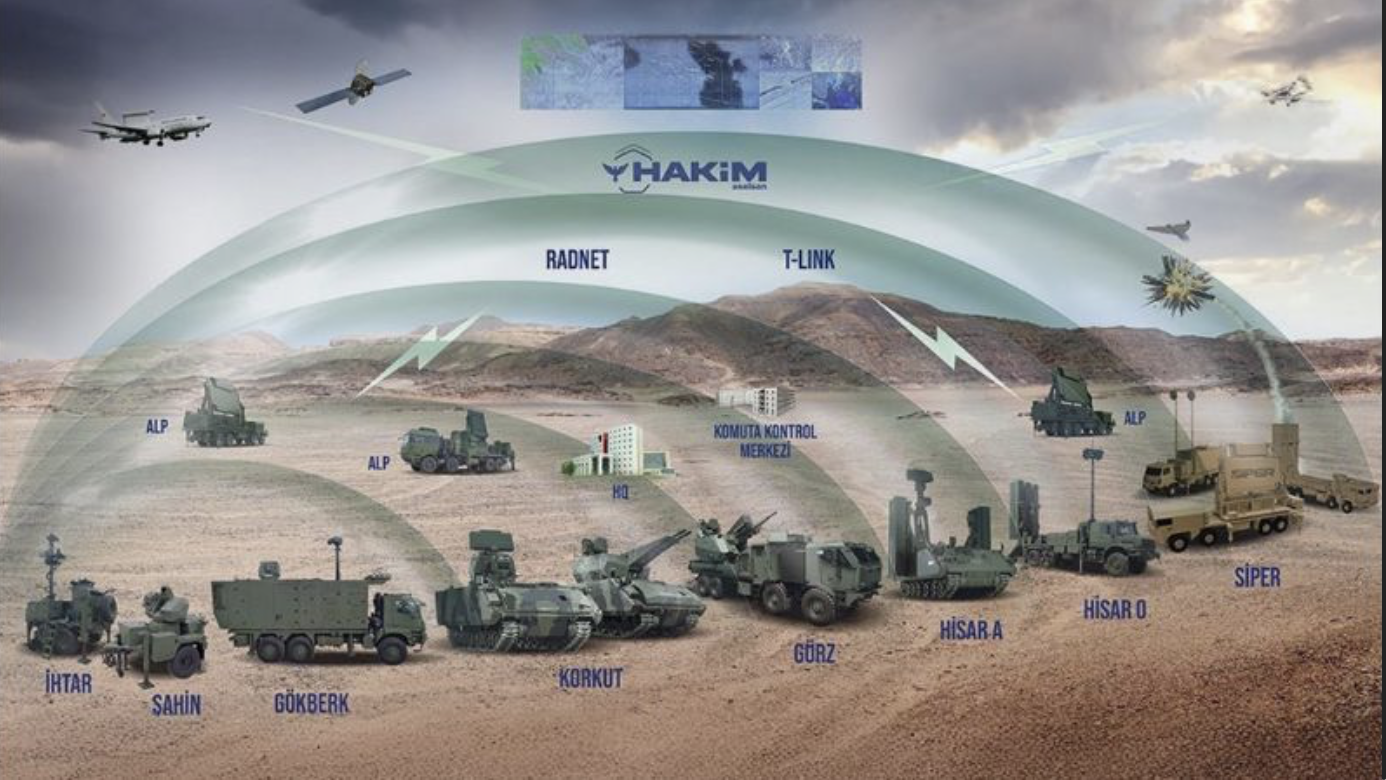
Another ambitious project has been the #Steel Dome# air defence system, Turkey’s answer to Israel’s Iron Dome. The government has sought to position it as a response to growing regional security threats, including air strikes against #Syria and #Iran. President Recep Tayyip Erdoğan even declared that ‘hopefully we will complete our Iron Dome project with all its components. If they (Israel) have the Iron Dome, we will also have the Steel Dome’. However, the financial strain caused by the project has resulted in tax increases in order to increase funding for defence.
President Erdoğan recently announced that the Turkish Navy will develop a national aircraft carrier. This is part of a broader expansionist and interventionist foreign policy strategy, emphasising naval power, oil drilling in the eastern Mediterranean and the establishment of military bases along the coasts of Africa.
In addition, President Erdoğan recently announced that the Turkish Navy will develop a national aircraft carrier. This is part of a broader expansionist and interventionist foreign policy strategy, emphasising naval power, oil drilling in the eastern #Mediterranean, and establishing military bases along Africa’s coasts, particularly in #Somalia. These initiatives are central to Turkey’s ambition to strengthen its naval capabilities and expand its power projection globally. In this context, the development of a dedicated aircraft carrier is considered a crucial step.
Turkey’s defence industry is likely to continue growing, driven by a combination of internal political dynamics, economic challenges, and an aggressive foreign policy. The ongoing economic crisis, combined with rising nationalism and militarism, will likely contribute to further expansion in the defence sector. However, the deepening economic crisis poses significant challenges, especially when financing projects like the Steel Dome.
Despite these challenges, the government’s emphasis on military expansion remains significant, particularly in light of the ongoing conflicts with the PKK and YPG in northern #Iraq and Syria. The PKK’s terrorist attack on Turkey’s national airline, TUSAŞ, and the ongoing military operations in Syria strengthens the government’s efforts to finalise new projects such as KAAN – and channel additional resources to the industry.
The popularity of the defence industry remains high, giving the Erdoğan administration the political support it needs to continue investing in defence projects. Ultimately, the development of Turkey’s military-industrial complex is deeply intertwined with the country’s broader authoritarian agenda. The defence sector plays a pivotal role in reinforcing Turkey’s status as an emerging regional power.