When a group of children are asked who Kwame Nkrumah was, one of them answers that he was Ghana’s first president; that, of course, is a good starting point, but is that all there is to him? On the question of Nkrumah’s legacy, opinions differ: a revolutionary leader, an authoritarian—depending on what part of his story the responder is acquainted with; yet history reveals the inadequacy of such simple conclusions.

Nkrumah through Hesse
The Eyes of Ghana, the second feature by two-time Oscar winner Ben Proudfoot—executive produced by Barack & Michelle Obama—recounts the life of Kwame Nkrumah through the eyes of Ghanaian film pioneer Chris Hesse. Kwame Nkrumah led Ghana to independence in 1957, making Ghana the first sub-Saharan African nation to gain independence. A central figure in Pan-Africanism, who advocated for the political unity and liberation of Africa from colonial control. During this period, Hesse served as Nkrumah’s personal cinematographer, travelling the world with him, documenting his meetings with world leaders and speeches, accumulating hundreds of hours of footage. Hesse recounts that Nkrumah noticed how America had carved out an appealing identity for itself through cinema, and he wanted to do the same for Ghana. This prompted him to restructure the film industry, building a cinema ecosystem, the best in Africa, as Hesse notes.
Though, along the lines, Nkrumah implemented authoritarian tactics such as jailing people with dissenting views and a constitutional amendment that would make his party the only legal one, and him president for life; eventually leading to a coup that not only forced him out of power, but destroyed statues, documents, records and the films Hesse made during this period. They were considered to be representative of Nkrumah’s authoritarianism. Unknowingly to them, the negatives are safely kept in London. Though Proudfoot’s film hardly interacts with these conflicts.
The Eyes of Ghana is the archive of an archive—a document of history and the human vessel preserving it.
A new era
The film opens with a montage over which we hear the voice of Nkrumah, ending with the words, «the dawn of a new era.” Hesse, now in the evening of his life, as he puts it, doesn’t seem to be in the evening of his hopes. Diagnosed with Glaucoma, he refuses to accept it, not out of denial, but out of courage. This same courage is evident in supporting characters: Anita, a documentary filmmaker whose interest for Ghana’s film history led her to Hesse; and Mr. Addo, a projectionist at the now defunct Rex Cinema who sacrificed familial obligations—«I abandoned them, they too have abandoned me»—to protect the cinema, hoping to resuscitate it, and, in turn, show films there again.
Hesse narrates his experiences with zest (one reserved only for nostalgic memories) and with deep reverence for Nkrumah. Evidently, Nkrumah was not only his boss but also a father figure; he recalls how Nkrumah would often refer to him as «my son» and how they developed a means of communication through Nkrumah’s walking stick—how Nkrumah would signal to him what he wanted him to film and what not to film. Yet Hesse is not exactly interested in the enshrinement or vilification of Nkrumah; he is more concerned with showing this history, leaving judgment to the viewers. When asked by a film student about Nkrumah’s complicated legacy, he says, «I filmed his life. It is for you to watch and judge.»
Guided by a belief in cinema as a tool for liberation, as well as Nkrumah’s prophetic final words to him: «The whole African continent will sink into the soil, but out of the ashes, a new Africa will grow. Don’t be afraid. Keep filming.» Hesse spent 21 years trying to convince the Ghanaian government to digitise the film archive; even at over 90 years, when he cannot keep filming, he is busy equipping the younger generation to film.
Hesse, who is responsible for the capturing of post-colonial classics like Kwaw Ansah’s Love Brewed in the African Pot (1980) and Heritage Africa (1989), notes that cinematography is «not a question of pointing the camera at things, but getting the best side of a person.» From the few minutes of Hesse’s work shown in the film, we understand that what he implies by «best side» is not cinematographic beautification, but rather showing subjects as individuals, rather than as spectacular objects. This quality is mostly absent in The Eyes of Ghana.

Close-up
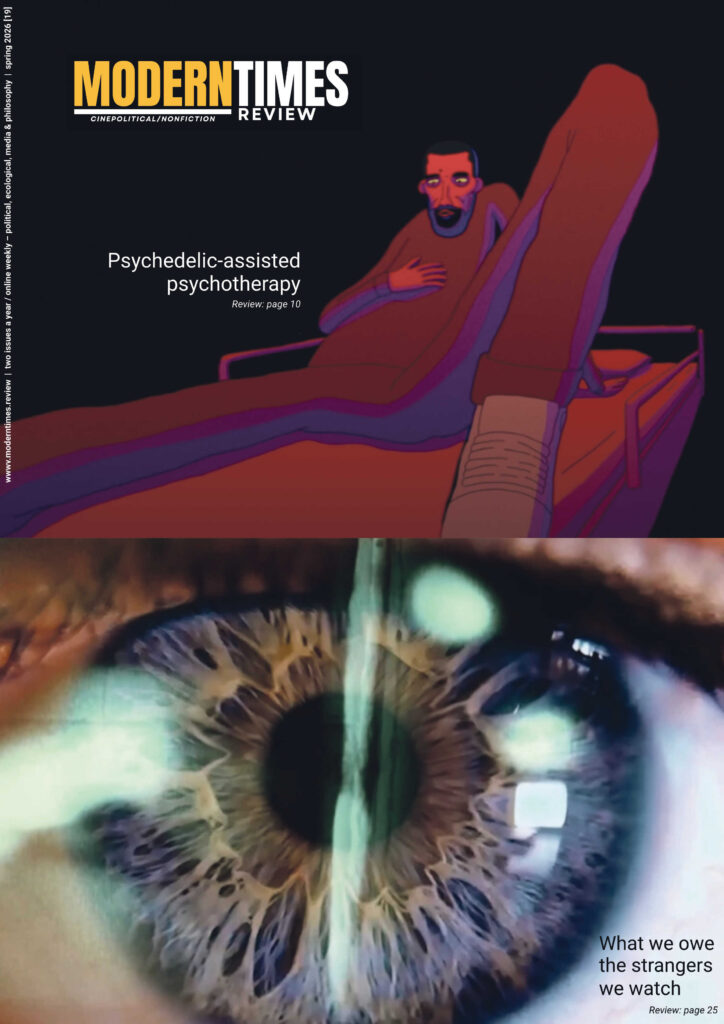
Visually, Prodfoot’s film mistakes proximity—an extensive use of close ups/extreme close ups—for intimacy, reducing its subjects to exotic images. A didactic approach that overdetermines the symbolism of Hesse as «the eye» by hyper-emphasising his literal eye, highlighting his features as though they are forensic evidence for us to examine and learn more about Nkrumah. This repeated reliance on close-ups, though a formal consistency across Proudfoot’s films, does not often yield strong results; it serves more as a stylistic blanket. The music complements this penchant for spectacle; its blockbuster-esque score often stands out rather than complements the narrative’s inherent introspective nature. Hesse’s discerning and charismatic presence, complemented by Anita’s curiosity and Mr Addo’s sacrifice, is what holds the film together.
Ultimately, The Eyes of Ghana is the archive of an archive—a document of history and the human vessel preserving it. Chris Hesse’s resilience and indefatigable courage serve as a beacon of hope; his success is the substance of futurity for a new Ghana, one that understands its history and the nuances therein, where «…we’ll know how we started, where we started and how far we’ve gone on the journey of life.»
This review emanates from the Talent Press programme, an initiative of Talents Durban in collaboration with the Durban FilmMart Institute and FIPRESCI. The opinions expressed in this article are those of the author (Elijah Oluwanisola) and cannot be considered as constituting an official position of the organisers.