A year before the Israeli author #Amos Oz# died, he called his good friend Nurith Gertz and asked her for one last request. Already ill with #cancer he asked her to write his biography – should he die before her. Amos Oz passed away in 2018, and Nurith Gertz, a professor and longtime friend of Oz, set out to write an acclaimed book that has so far only been published in #Hebrew. At the same time, Israeli filmmaker Yair Qedar made an insightful documentary on the subject.
Amos Oz wanted Gertz to paint the whole picture. He did not want her to write only the good things. He wanted to be presented as a spoiled person. A man who pursues honour, a man who loves the sound of his own voice too much.
In the beginning of the film, we hear the telephone conversation between Oz and Gertz, and for Yair Qedar that has been the source of a highly intelligent filmic portrait of the writer and the dark thoughts behind all the apparent fame and glory. As the filmmaker puts it, Amos Oz spent his whole life with a black hole inside, and nothing to fill it.

Wounded soul
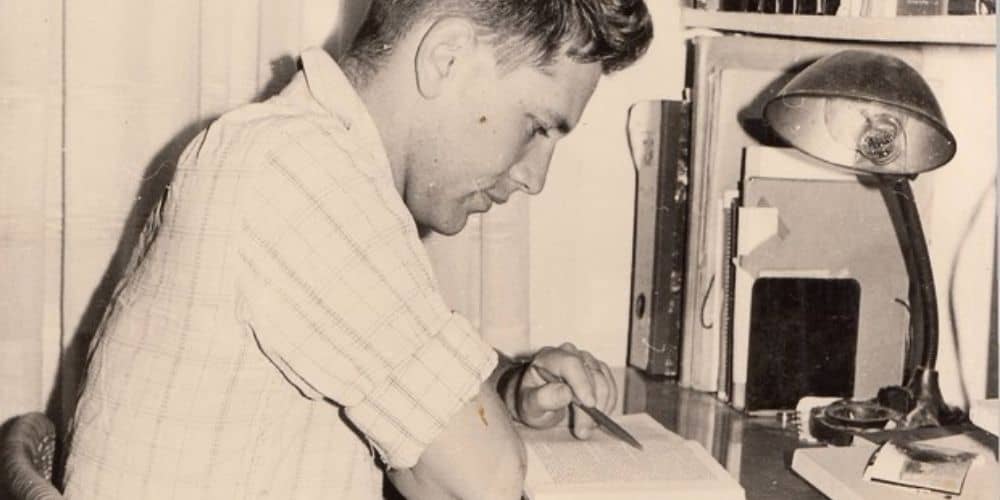
Amos Oz was born in #Jerusalem in 193. When he was 12, his mother committed suicide. His father, a true intellectual, was incapable to handle the loss, and after a couple of years the boy rebelled. He moved to kibbutz Hulda, changed his family name from Klausner to Oz (meaning Strength) and tried to fulfil his dream of becoming a pioneer. In his own words, he killed Jerusalem and became a tractor driver in the kibbutz fields.
But the woman that meant most to him, his mother, had left him and slammed the door, leaving a deep wound in his soul. All there is in a galaxy, could not fill that hole, and that created a lifelong feeling of not being worthy.
On an old film clip we hear Oz explain, that if a person becomes an author, it’s because he was wounded when he was a child. Not everyone that was wounded as a child becomes an author, someone who was wounded might become a murderer, or a saint, or a man of wonders. But without a wound, there is no author.
That is a plausible explanation for his brilliant writing in 30 books, and his resulting world fame. But when he started writing as a young kibbutznik he first tried to come to terms with his own loss. On several occasions he claimed that a family, any family, is the most mysterious phenomenon in the world. More than kingdoms, countries, parties, and movements.
without a wound, there is no author
Like a tragedy by Sophocles
A concurrent theme in his novels is the family. Or rather the unhappy family. That gave him an urgent need to find acceptance. The film shows how he loved being in touch with leaders, and was sought after. As #Natalie Portman# puts it: «Amos was like a rockstar. He had this charisma, was so handsome, it was like being at dinner with Paul Newman».
He put enormous pressure on himself to be constantly good and moral, constantly just, to be a leader, to be an artist. He was so busy being good. There is no question, that he was a moral person and believed in his own political #activism, being an important voice of the Israeli left, talking about peace and co-existence. But as the film portrays him, all these good traits could also be seen as part of his own urge to heal some deep wounds.
Over the years he forgave his parents. This is clearly expressed in his autobiography A Tale of Love and Darkness (2003), but in this case it was his own decision to mend past mistakes. Beyond his control was the relationship to one of his daughters, Galia, who blamed him for violence and abuse. In his version, he never hit her – at least not more than a couple of times – but he took her for granted and never understood that her happiness in the communal kibbutz education was fake. In his later years, Amos Oz desperately tried to reach out and come to talking terms with Galia, but never succeeded.
This film gives us an intimate picture of the guilt-ridden person behind the literary fame. His life is told as a deep tragedy, that could have been written by Sophocles. At age 12 he lost his mother and everything. His mother left him, and all his life he fought in order for this not to happen to him again, and here it happens again. He tried to avoid anybody to feel miserable, and his own daughter felt miserable.