The opening scene of an 8-year-old girl filming people in an airport terminal while waiting for a plane to the Sahara Desert compellingly binds the documentary’s narrative viewpoint with the audience’s. Carolina De Lillo Magliulo, that’s the girl’s name, is about to discover a world different from her own, and the viewer is about to discover the Sahrawi people who have been gradually and invisibly erased from the earth map and transported to the realm of the legends. The director, Elisabetta Giannini, is Carolina’s sister, and she recently found recordings of this trip to the Sahara from the 1990s in the family archives. She decided to return with her sister, now grown up, to the same places and people and confront the future the 8-year-old imagined 30 years ago with the present. The revelation that none of the expectations have come true is disappointing; the parallel between Sahrawis and Palestinians is painfully obvious. However, The Legend of the Desert, which premiered at the Days of the Authors program of the Venice Film Festival 2026, turns this into a strong urge not to give up. This is primarily because Giannini introduced a new type of documentary.
Contrary to the look from above, so dear to documentarians and nowadays supported by the technology of drones, it looks at the world from the ground. She allows the audience to share, as she does, the protagonists’ view, transcending categories such as observational or participatory. The film’s first shot, which makes us look at the shoes of people walking around, is a perfect example of this.
A distant miracle
The Sahrawis have lived in Western Sahara, which lies between Morocco, Algeria, and Mauritania, for more than one thousand years. The region, which holds some of the world’s largest phosphate deposits, was under Spanish colonial rule. During decolonisation, Sahrawis organised into the Polisario Front and demanded an independent Sahrawi Arab Democratic Republic (SADR). Spain promised to hold an independence referendum, but in 1975 they transferred administrative control of Western Sahara to Morocco and Mauritania instead. The Sahrawis, led by the Polisario Front, resisted the occupation, and the Western Sahara War broke out. Most of the Sahrawis had fled the violence and found refuge in camps near Tindouf in Algeria. Mauritania withdrew and formally recognised the SADR, but the conflict between Morocco and the Polisario Front continued until 1991, when the UN established a mission to monitor peace and organise a referendum on self-determination.
After the promise of the referendum, Antonietta De Lillo, the mother of Elisabetta and Carolina and the producer of The Legend of the Desert, and a couple of colleagues created a political documentary on the same topic (Sahrawi, Voices Distant from the Sea, 1997). The trip to the Sahara with Carolina was part of the research. While the child sees the referendum as a bright future, the grown-up Carolina can only confirm that it never took place. In the words of Elena Grillone, who co-wrote the script, it turned into a distant miracle.
Commercial and political interests, like a sandstorm in the Sahara, block the Sahrawi people’s right to a home of their own.
Where is a home
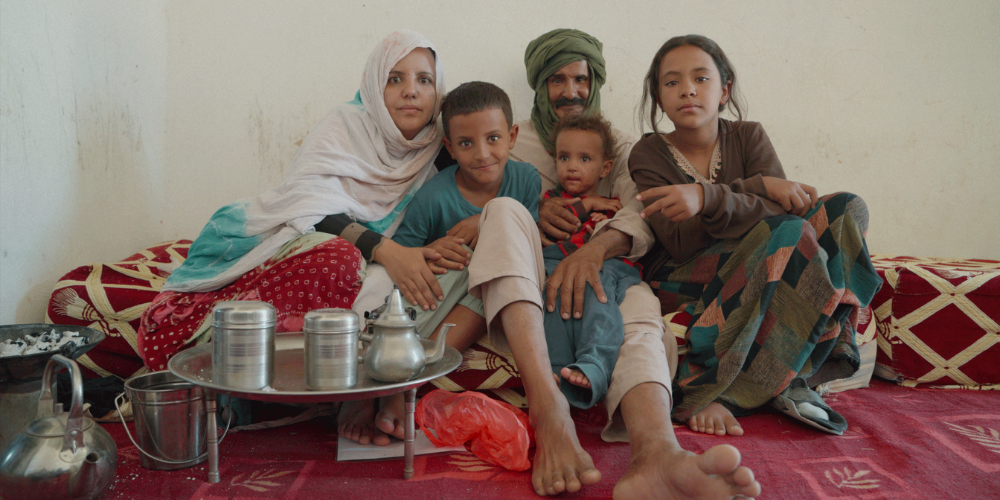
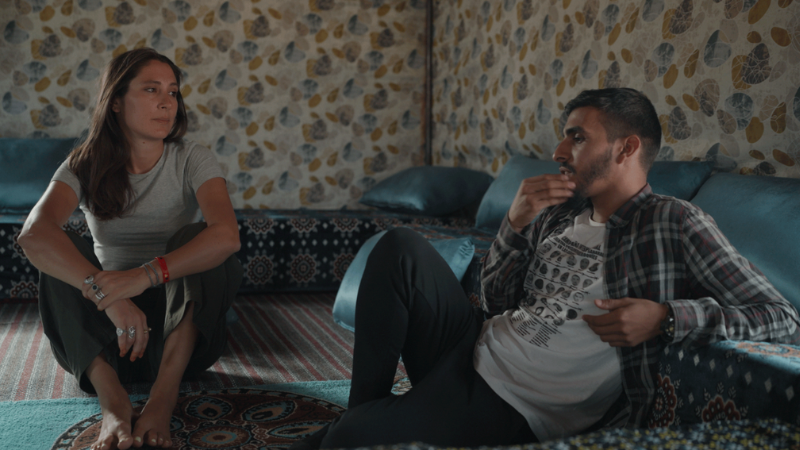
This injustice is at the heart of The Legend of the Desert, and the audience can see firsthand how Sahrawis live it day by day. Not that the political aspect is left out completely – Fatima Mahfud, the Polisario representative in Italy, participated in the preparation of the film, and we also see her at the airport when Carolina is leaving for the Sahara for the first time. The child’s attempts to define where Fatima comes from – from Algeria, from the camps, are the camps her home? – introduce the personal aspect of The Question of Western Sahara. A longing for home. Home is a central theme and the film’s main visual trait. The home-movie approach of the material from the 1990s prevails to the end; the point of view is always attached to a person, and the camera remains at the same level as the people being filmed. Frequent shots of Carolina taking photos further emphasise the home-movie atmosphere. Family portraits, beautiful, symmetrically composed shots of the numerous members of the families encountered through the film testify to the collective nature of Sahrawi identity. «I can’t leave my family and everyone behind and live a better life alone; that’s selfish,» says one of them. Framed, these stunning portraits resemble family pictures that adorned European homes and, together with TV sets, formed centres of families’ emotional life throughout modernity, again evoking the injustice. Where do you put these if you live in a refugee camp? The vintage look of these photos is another reminder that, while the world has changed, the situation for people from Western Sahara has not.
The camera’s position is similarly polysemous. The point of view that replicates the position of the eyes, a child’s eyes, indicates equality and reciprocity. It facilitates identification and empathy with the subjects, and leads to a dialogue in which Caroline not only asks questions and receives information, but also responds to her Sahrawi interlocutor about her experience of the Sahara and their camps. Parallel to her experience, we meet Sahrawi children who recount their time in Naples as part of a solidarity initiative in which Italian regional associations and the city council of Naples host them every year.
Never Forget
These close relationships create an atmosphere of trust and bring hidden nuances to the forefront. Commercial and political interests, like a sandstorm in the Sahara, block the Sahrawi people’s right to a home of their own. The hope that followed the promise of the referendum in 1991 is fading, and more disturbing feelings take its place. Caroline is consumed by the fear that one day she, too, might be among those who forget. Among the Sahrawis, a desperate and extreme idea is gradually gaining ground: that to resort to war might be the only way to reclaim their land. But the sense of connection created within The Legend of the Desert indicates that a much better solution is possible too – that enough of us don’t forget, and Sahrawis receive what they were promised.