For Swiss documentary filmmaker, author and producer Edgar Hagen, the cinematic form is both a channel for socio-political engagement and an exacting challenge. From unconventional approaches to modern psychiatry in Someone Beside You (2007) to the buried tons of nuclear waste in Journey to the Safest Place on Earth (2013), his filmography has consistently sought out the questions that often go unasked. His new film, The Roots of Madness, may be his most arduous yet. It sets out to reckon with how the West fuelled the very radicalism in the Middle East it vowed to combat, and then evaded responsibility for the refugee crises that followed.
Repeating the obvious
The Roots of Madness opens with a productively broad reflection via Hagen’s voiceover. In the West’s global consciousness, the refugee has become shorthand for an irritant, but what are the actual reasons people trade a beloved homeland for the unknown and unwelcoming? The answer may seem too obvious, and yet the privileged societies still seem to have little genuine grasp that «you can’t destroy a continent and stop people from immigrating.» The line, delivered as part of a speech on Swiss National Day, belongs to Ulrich Tilgner—a legendary German television reporter who spent 40 years covering the Middle East. The camera lingers on a loosely to ignorantly listening audience against a cheerful civic backdrop, which sets a brutal juxtaposition with everything the doc follows next. Hagen and Tilgner (now 78 and retired) embark on a big voyage across some of the country’s most ravaged by the so-called «war on terror».
Their first stop is present-day Kabul, where the American invasion sought to dislodge Taliban rule after 9/11. Today, the very same Taliban is prevailing and terrorising, and as a direct result, women are now given as many rights as animals. «The devastation must be shown relentlessly», sounds from the screen, becoming the film’s working tenet. Though not the kind conventionally associated with graphic exposure. Instead, the film bears down on how the nature of these wars has been framed, and how that very framing has hardened into something irreversible and eternal. That is quite a relentlessly uncomfortable truth to face. Across cities, houses, secret activist cabinets, street encampments and even prisons, Hagen and Tilgner film above all the eyes, and the memory behind them. As they collect witnesses, the same diagnosis surfaces across different geographies and dialects, where The Roots of Madness earns its bottom-line claim: that the West wages war, exports weapons, partners with dictators when convenient, and that many would flee the moment they could.
«you can’t destroy a continent and stop people from immigrating.»
Reclaiming the authority
Throughout, Tilgner mostly listens silently, leaving the editing to answer for him. Hagen, armed with hundreds of hours of Tilgner’s archive, draws from both the pivotal moments covered live and the people he interviewed in between, and his montage sometimes cuts with the precision of a rhyme. At the Palestine Hotel in the centre of Baghdad, Tilgner steps into almost the same spot he once reported from, when Saddam Hussein’s monument fell to a thinly cheerful crowd wary of what would come next.
That bitter suspicion, now rendered through the grinding experience of past decades, finds its most apt formulation in the hotel manager. Acknowledging the long-buried flicker of hope sparked when American officers once promised him a better future, he now reflects that the support extended to rebuild Germany and Japan was never offered to the Middle East, owing, he believes, to an American hostility rooted largely in religion. The camera cuts back to Tilgner, who responds only with a deep breath. For him, a German born into the ruins of the Second World War, the reference cuts deep. This is also where the film most succeeds – by threading past and present through Tilgner’s perspective, it renders everything else all the more disconcerting.
Historically, there is little new in these conclusions and parallels for anyone who has followed the «war on terror” through the now-overwhelming body of journalism, (non)fiction, and scholarship. Even so, The Roots of Madness functions as a solid textbook, thanks to the restraint of Hagen’s voiceover, which surfaces mainly to lay out the basic historical facts and subtle nuances for a wider audience. That the film nevertheless avoids collapsing into a series of surface-level statements owes much to its sustained focus on people. By casting them as a collective voice of sobriety amid devastation, it grants them an intellectual authority and a simple trust. In other words, it reclaims exactly what the West has so consistently expunged.
The déjà vu
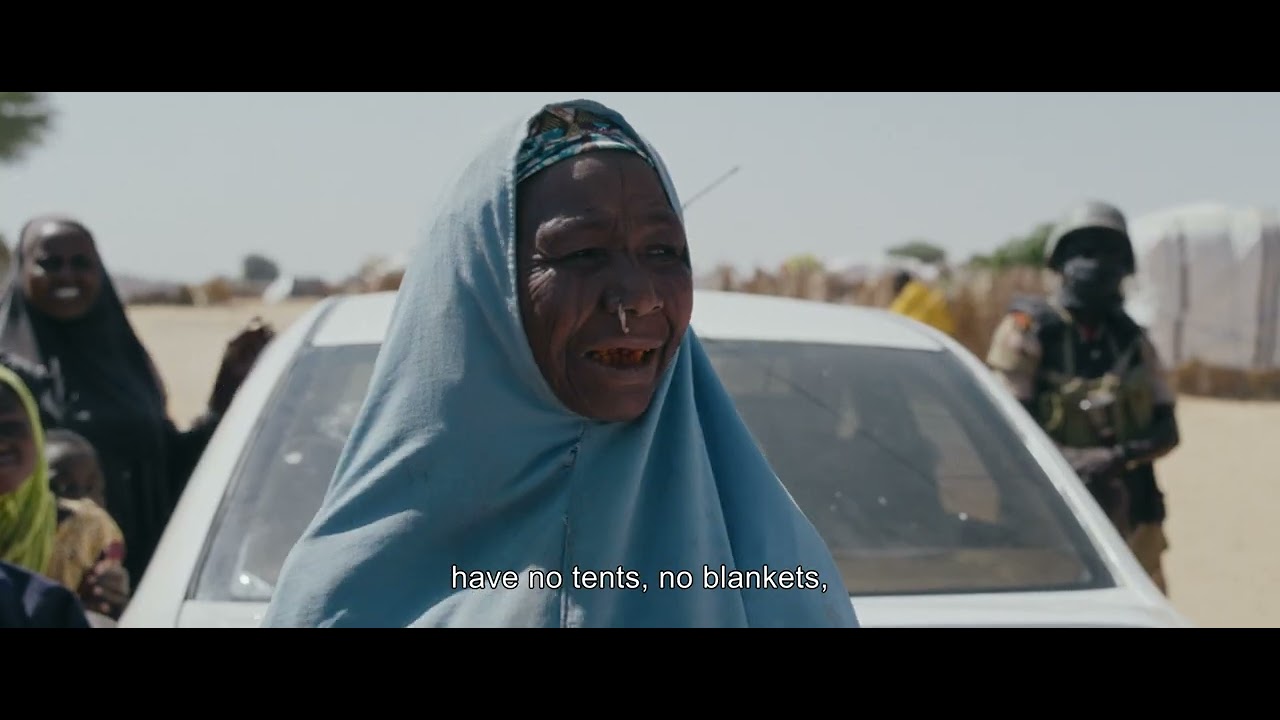
Divided into a Prologue, chapters for each country visited, and an Epilogue that also serves as a kind of Déjà vu, the film closes by gesturing toward the very repetition it has been tracing. By that point, the cross-cultural and cross-geographical scope has already been earned, even if the Niger sequence brings its own undeniable testimonies. A cut from uneasy archival footage of Clinton celebrating the fall of the Libyan regime as an easy win brings Hagen and Tilgner into Niger, where people living under Boko Haram find themselves trapped in a loop of fear and poverty.
Yet the epilogue’s sense of genuine déjà vu operates at a level that the film could not have deliberately achieved. In a grim irony of timing, it arrives just as the United States is once again fuelling another war on radicalism in yet another oil-rich region. The Roots of Madness may inadvertently become a troubling manual for what could already be unfolding in America’s next strategic theatre.