If he knew a little Arabic, the taxi driver would immediately understand that the man who’s just got in, a man who looks like a workman, all dusty, uptight, and wearing a yarmulke, but who is now on the phone and no longer speaks Hebrew, is simply looking for a child who went missing. He is simply looking for his son. There is nothing strange. Nothing suspicious. Nothing dangerous. He is not about to blow himself up.
He is not a terrorist.
But he speaks Arabic. He speaks impenetrably. And he is just scary.

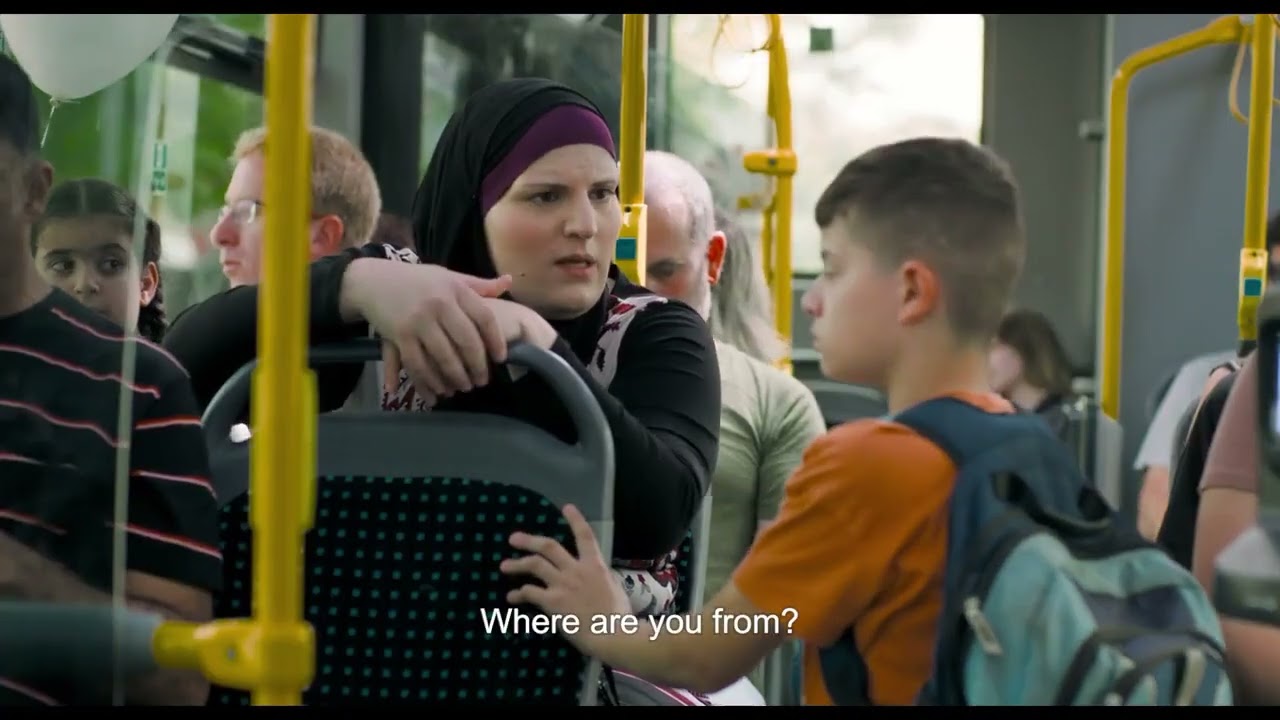
Khaled is 12 years old and lives near Ramallah. On the day of the school trip, a trip to the beach, the beach of Tel Aviv, he is stopped at a checkpoint, the only one among his classmates, and forced to turn back. With no explanation. Determined to see the sea, a sea he’s never seen, one night, on the sly, he crosses the Wall with illegal workers, workers like his dad, who works illegally in Israel, without authorisation, and finds himself alone in a Tel Aviv that is not only a different city: it is a different world. The steel and glass towers, the hustle and bustle, a tattooed boy, a kissing couple. The central station. With its many floors. And many soldiers are walking around in uniform, carrying M16S. But in a T-shirt and a backpack, he persists. Stubborn. With a piece of paper in his pocket on which he’s written: «Slicha, eifo ha-yam?», in Hebrew, «Excuse me, where is the sea?», he asks passersby the way, block after block, and knows only one thing: he will arrive.
In his mind, there is only the sea: the sea, the sea.
The goal.
With all the innocence of his twelve years.
Without calculations. Without fear.
And there is more resistance in this child than in all of October 7th.
In that crumpled piece of paper, there is more resistance than in all possible weapons.
In that crumpled piece of paper, there is more resistance than in all possible weapons.
There are so many films about Israelis and Palestinians. And many are wonderful. But usually, they are documentaries. About the settlers, the IDF, Hamas, the Wall, 1948. The Intifada. The Sea, instead, technically, is a movie. It does not document, it does not describe, it does not record, it is cinema, it is something else: its power is the ancient power of stories. It does not denounce. It thinks. What it conveys is both authentic and precise because the checkpoints, the workers, the demonstrations, the roundups, and the searches are exactly like that, yet it also goes beyond reality. With all the power of imagination. Pro-Pal supporters will object that learning Arabic is not enough. That for Israelis and Palestinians, it is not about drinking a tea together, about getting to know each other better, because they know each other perfectly, they have known each other forever, they will object that it is a matter of justice. The problem is the Occupation. And that’s true. But language, here, with the constant, recurring misunderstandings between the characters, unable to communicate, and so, impervious to one another, is a metaphor for a deeper understanding: comprehending the other. Their life, their background. Their concerns. Their vulnerability. Their reasons. And also their flaws. Their mistakes. Their contradictions.
Their complexity.
Because between Israelis and Palestinians, nothing is black and white. And in The Sea, there is all that pro-Palestinians and pro-Israelis often overlook on both sides of the Wall. Fatah and Hamas are not even mentioned, as if they did not exist: Palestinians are Khaled’s father, they are Palestinians trying to get by, and that’s it, left to their own devices, without even a police force to turn to if a child disappears, and with the demonstrations having no impact anymore, merely a means to make money from YouTube videos. While the IDF soldier at the checkpoint epitomises today’s Israel, he has no clue why Khaled must be stopped; he only knows that he is blacklisted and that he must be stopped: he does not feel responsible. He says, «I’m just following orders.» And then, above all, there is the failed love between Khaled’s father and a Jew named Sara. A bond broken by the opposition of the families.
Not because of what Arabs and Jews are, but because of what they are asked to be.
Wanted for being an infiltrator, Khaled will be arrested as soon as he sees the sea. That he finally watches out of the window of a police car, silently, with intense eyes: intense, and indecipherable. What is he thinking? How will he process all this?
What will remain inside him?
Who will he become?
It is hard to say. But, no, unlike you might think, The Sea is not a Palestinian movie: it is an Israeli movie. Funded, moreover, by the Israel Film Foundation. And the winner of the Ophir Awards. Israel’s Oscars.
And perhaps that already says a lot.