Bearing the weight of human history, walking a razor-thin line between witness and voyeur, war journalists carry the haunting privilege of making the world look at what it would rather ignore. Yet, «war reporters are conditioned to keep from talking about themselves. They only take care of the victims,» said Hernán Zin, the director of the 2018 harrowing documentary Dying to Tell. Eight years later, Maciek Nabrdalik and Piotr Małecki also explore trauma, fear, and the psychological toll of war journalism in a moving study of one of the 20th century’s most influential photographers.
If the name Christopher Morris doesn’t ring a bell for you, his photographs definitely would. He lived many creative lives. During «the aughts,» he reimagined the language of political photography while covering the White House for Time Magazine. Instead of the traditional, polite access photography, he introduced a gritty, cinematic, and often almost claustrophobic visual style. Later on, he did fashion photography with the same unorthodox approach. However, Morris is held in the highest regard as one of the most celebrated visual chroniclers of war, having covered 28 wars and documented conflict and despair around the world. Nabrdalik and Małecki’s Tickling the Devil sits in the shadows of that time.

Home front
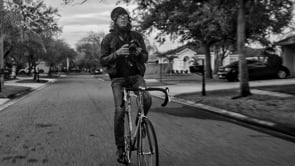
Contrary to the sad reality Hernán Zin describes, Morris finds himself on the other side of the camera, confronting his demons. Or at least he tries to by dropping stories here and there, as he never said as much to his own family. The film follows him at his home in Florida, where he tries to lead a peaceful life with his two daughters and wife, Vesna, in whom he invariably finds solace. At home yet always on the go, as he seems unable to sit still. Unsurprisingly, he stresses he’s not retired. In between housework, he captures contemporary America, observing rallies, protests, and gun expos. Filmed right after the lockdowns and during the Trump 2024 presidential campaign, Morris’s own homeland increasingly becomes yet another battleground.
The film also draws subtle parallels between the conflicts Morris once covered and the US’s escalating political violence and polarisation. While these parallels are intriguing, the film stops short of fully interrogating them. Still, Morris repeatedly jokes that he looks like Antifa, but admits he is, as he’s anti-fascist. Diving deep into the memories, he recalls his father, who fought in Vietnam, and shows a photo of an elite pilot, his father knew, displayed on a wall as a reminder of where he came from – a profound resentment towards the US army and what it represents. But it was the vivid press imagery of the Vietnam War that also sparked his decision to pursue a career as a documentary conflict photographer.
Filmed right after the lockdowns and during the Trump 2024 presidential campaign, Morris’s own homeland increasingly becomes yet another battleground.
The weight of memory
It’s not a biography. The documentary quietly observes Morris searching for a mental refuge. Watching the state of the current-day America, while battling PTSD, is clearly not easy for him. He doesn’t go to therapy and self-medicates with medical marijuana. Underneath it all, there’s also a story of dealing with one’s mortality. Morris says he used to thoroughly clean his apartment every time he left for work, so his mother wouldn’t find anything problematic, as he was painfully aware he might not come back. It is post-COVID, though, that he decides to go through his life’s work so his family wouldn’t be left with it when he dies.
Formerly barricaded from his archive, Morris sets out on a mission of methodological archival work. As his daughters are there to help him, it’s interesting to hear how, at that moment, he refers to himself as «your father». «Your father witnessed horrible things.» He does use such a phrase in other situations, too, so perhaps this is just how he talks. Nevertheless, the confrontation with the past doesn’t come easy, and there are layers upon layers of unresolved trauma. The filmmakers simply let him share the bits he’s willing to discuss when choking up, focusing on Morris’s inner world.
Trauma without spectacle
They don’t resort to graphic war footage, either. There’s a relatively short montage of Morris’s photos in the film’s second half, and some negatives are shown during the archive scene. Some viewers may wish for a deeper engagement with Morris’s photographic legacy, yet the filmmakers deliberately privilege the man behind the images over the images themselves. Although the images are witnesses to horrifying crimes, it is what Morris says that paints a whole, truly traumatic picture.
When it comes to the cinematography, it’s obvious that photographers also make the film. The decision to shoot in black and white feels fitting, almost as if the filmmakers were setting photography into motion. The tasteful, monochrome frames reinforce the film’s intimacy and gravity, resulting in a poignant psychological exploration. The sparse soundtrack further enhances its immersive quality.
«Be safe and be good,» Morris’s mother tells him. «I’m always good,» he replies. In a 2015 interview, he said: «If I had to describe myself in one word, I would say I’m kind.» The documentary shows that kindness is what compels him to care and worry – the very quality that gives his work its power and leaves him restless.
What is the cost of bearing witness? Immense, Tickling the Devil proves. Although Nabrdalik has known and admired Morris for years, he and Małecki avoid the kind of hero narrative so often attached to stories of war. Instead, they offer a portrait of an icon who remains profoundly human.