The blonde with shorts and a giant smile, who cheekily tears a photo of one of the hostages off the wall, is what we would call a pro-Palestinian activist. But really? And what, exactly, does she do for Palestine?
And the guy giving the middle finger, has he ever been to Palestine?
What does it mean to support Palestine today?
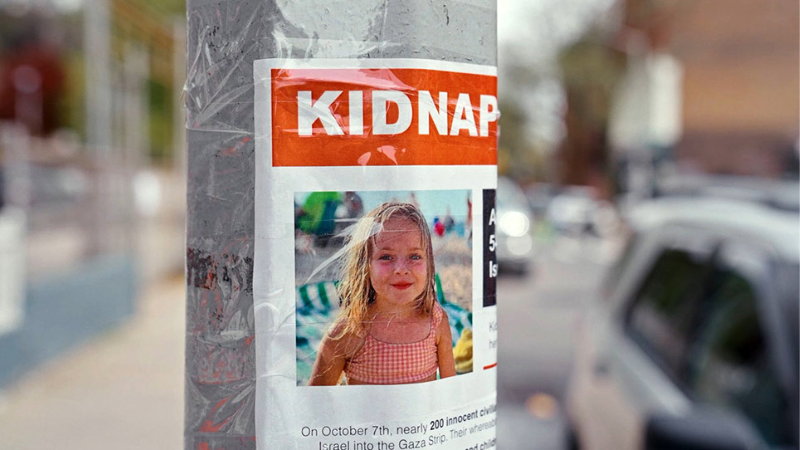
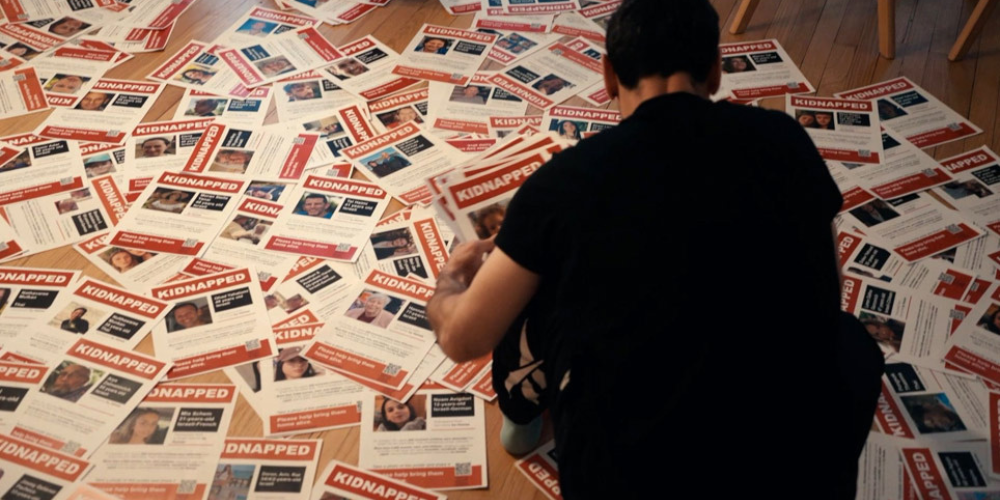
On October 7th, Nitzan Mintz and Dede Bandaid, two Israeli street artists who have just arrived in New York, inspired by the American milk cartons of the 1980s, featuring photos of missing children, designed the posters that have turned into a worldwide symbol of the Hamas attack, with the photos of the 251 hostages under a red band: «Kidnapped.» They start being affixed everywhere, and not just in New York, and immediately after, everywhere, they start being torn down in a war in the shadow of the real one. This film is not about October 7th, but about all of us, neither Arabs nor Jews, who since October 7th have talked about nothing else, but instead of trying to resolve the conflict, we end up replicating it, and radicalising it, poisoning it even more.
Arsonists, instead of firefighters
«But why don’t you also print posters of the children of Gaza, instead of tearing ours down?» says Alana Zeitchik, who has six family members among the 251, when she is told that no one thinks of the Palestinians: that the Palestinians are the victims. Because in the film, there is no shortage of images of Gaza, and there are plenty of them, nothing is omitted, or overlooked, and that’s actually why Torn: The Israel-Palestine Poster War on NYC Streets must be seen: it is based on Jews quite different from those who usually appear in the international media. From the IDF soldiers who take a selfie among the ruins, from the fanatics who block aid trucks. From the settlers who are already on the border, planning their new home on Jabalia beach. They exist, of course. Just as on the other side, Hamas exists. But much more exists, too. There are those who demand a larger space. A space large enough to accommodate everyone’s suffering, and trauma, and fears, and everyone’s needs, and even everyone’s mistakes, and flaws: otherwise, says writer Nina Mogilnik, we will keep repeating the same things over and over, always getting the same results, and is not that the definition of insanity?, she says. And of the Middle East?
But the pro-Palestinian activists pass by and spit.
«You assholes,» they hiss. And they keep going.
If the other person is a problem, you just delete them.
Many are beyond suspicion. One is a dentist. He is identified through surveillance cameras, with a knife, dressed like a thug, and he is fired, but the Jews themselves defend him. «I am not on the same page as him, obviously. But firing him is too much. Everyone has the right to be obnoxious: it is the privilege of being human,» says Nina Mogilnik. Every time she faces criticism, she tries to reflect. To understand. For example, when she is told that these hostage photos might make sense in Tel Aviv, to get Netanyahu to listen, to influence the war, but not in New York, where their only effect is to appeal to the emotions of Americans, and push the Congress to send more weapons to Israel. But often, there is no reasoning, she says. Like when they tell you that the photos are actually intended to induce Arabs to tear them up: to arrest them. What do you say to someone like that?
With someone like that, what kind of conversation is even possible?
Many do not even say their name. Or, like the dentist says, «Those videos are out of context.» They deny their actions. And words. They even deny themselves. And so, there is no discussion. There is nothing. Only insults. But because, after all, this is the social media generation, says artist Julia Simon. Discussion is no longer necessary. «If I don’t like someone, I just unfollow them,» she says. «And I don’t see it anymore.»
If the other person is a problem, you just delete them.
The only people who ask Alana Zeitchik, «How are you doing?» are the Palestinians.
From Palestine. From the real war. Where the only priority is for the war to end.
«Here, instead, all is black and white, all is polarised,» says Rabbi Yehuda Sarna. «There is nothing left in between. There is no grey anymore. You have the coloniser and the colonised. The victim and the perpetrator. While these faces challenge this binary logic,» he says, because they put people back at the heart of everything. In all their complexity. By erasing the other, you do not generate change, he says. You only generate resentment. And indeed, Julia Simon, who will never see her childhood friend Omar Neutra again, returned from Gaza in a coffin and assembled the remains of torn posters into a painting of thick brushstrokes. Red and black. Lumps of colour. And of rage. She is advised to lighten it. To rather express hope. «But that’s the truth,” she says. «That’s what’s left.»
What does it mean, today, to truly fight for peace? For freedom and justice?
Is a flag enough? A keffiyeh around your neck?
What impact does our mobilisation have? Positive? Negative?
We are not able to share the same wall, the same pole, says photographer Elisha Fine, collecting pieces of posters: and we want Israelis and Palestinians to share the same land?