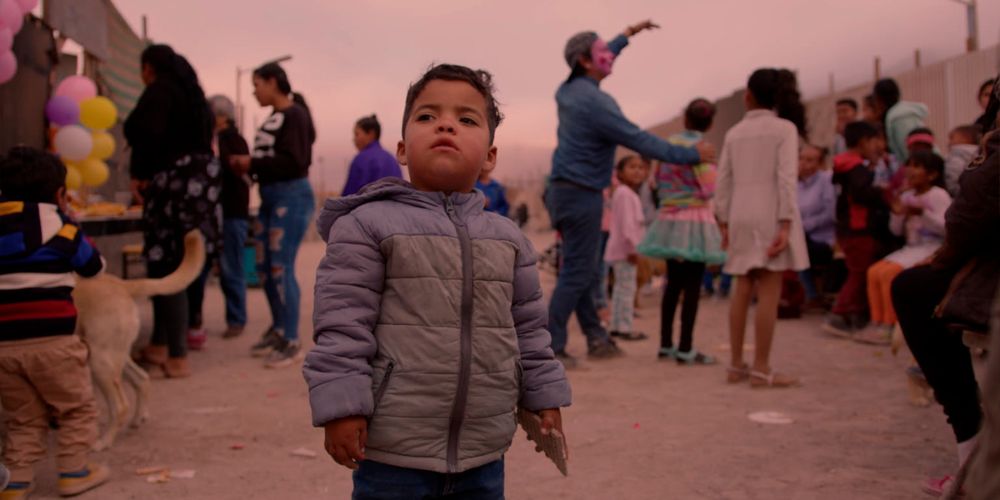
In recent years, #Venezuela, despite its oil wealth, has rather become associated with sorrow. Mired in overlapping economic, political, and, consequently, social crises, the country has seen one of the largest waves of emigration in modern times, displacing almost eight million people in search of a better life. Its collapse coincided with the #COVID-19 pandemic in 2021, scattering Venezuelans across #Latin America#. At one point, the President of Colombia encouraged Venezuelans to seek refuge in Chile, where the primary point of entry became the town of Colchane, perched at 3,700 meters above sea level on Chile’s vertical border with Bolivia.
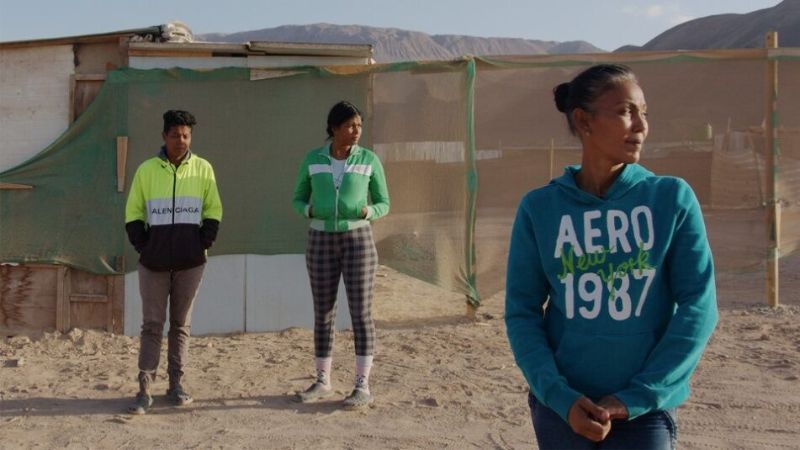
Colchane serves as the central location of Unwelcomed, though its narrative extends across various regions of Chile, beginning with those whose precarious status is starkly reflected in the film’s title. A vast number of these migrants dared to embark on an exhausting journey southward, clinging to the hopeful idea they would be transferred to #Santiago, as the news had promised. In reality, however, Colchane becomes a living nightmare – migrants, stranded in desert plains, face obstacles from lurky Chilean figures who extort exorbitant sums for border passage at best and engage in human trafficking and extermination at worst. Devastated families with small children set up roadside camps, relying on international humanitarian aid as their only source of drinking water and food.
After a visual excursion to makeshift shelters, the film shifts to the second social category in this tragedy, to those who refuse to welcome migrants. Outraged Chileans, whom the directors introduce just 20 minutes into the film, express their anger directly to the camera. Their main grievances revolve around the arguments that immigrants bring increased crime, claiming that locals are being robbed and killed. Yet the most aggressive rhetoric is reserved for the government, accused of releasing control of the situation, and for humanitarian missions, which clearly lack any strategy. Yet, there is a faint trace of empathy toward the Venezuelans – surfacing, perhaps, in the admission of one protester that it is «fear that makes people violent.»
Disembodied Places and Voices
The mediator between the unwelcomed and the unwelcoming is the nature of the location itself, which the film highlights with special attention. Spectacular and durational shots from levitating drones capturing the Andean Highlands, the Atacama Desert, and the Coastal Cliffs present the desolate beauty of Latin America’s mountain slopes, sunsets, and seascapes. These shots offer not only aesthetic relief from the horror on the ground but also serve a clever semiotic function. The drone’s dispassionate, inhuman vantage point lands on the epicentre of the crisis, where the story unfolds through the grounded, humanist vérité camera, listening to those who rush forward to testify about the injustice they endure.
These haunting and depopulated drone shots also echo the film’s audiovisual narration. Much of the testimony is deliberately separated from its visual context: off-screen voices from both sides of the crisis recount their suffering while the camera captures the landscapes. The disembodied voice, on one hand, imbues the film with a sense of collective tragedy; yet on the other, it limits the film’s emotional immediacy and narrows its narrative scope.
Devastated families with small children set up roadside camps, relying on international humanitarian aid as their only source of drinking water and food.
«We need to break the circle»
The film reveals no new facts beyond what can be found in news reports or humanitarian briefings. Rather, it preserves an underrepresented tragedy and embeds it within the broader conversation of global migration documentaries. «We need to break the circle,» says one of the film’s protagonists—echoing the sentiment of many caught in the brutal cycles of migration, both migrants and locals alike, though with no clear sense of how that might be done.
Unwelcomed is undeniably a skilled piece of journalistic reporting, following the classical tenets of migration-crisis documentary and wrapped in cinematic imagery befitting the visual identity of the region. However, the film’s global scope and its intent to portray both sides limit its ability to deliver a focused argument, oscillating instead between shocking provocation and distant observation. Still, the filmmakers’ ambition, especially for a debut, is noteworthy. In a cinematic landscape still struggling to articulate the scale and complexity of ongoing humanitarian disasters, Unwelcomed stands as a meaningful addition to the evolving body of work documenting the global migration crisis. The film closes with a contemporary remark in its credits: current estimates suggest that roughly 300,000 undocumented migrants reside in Chile. The Venezuelan diaspora now stands as the largest displacement crisis in recent history, following only those of Ukraine and Syria.