La Espera
Remember the Migrant Caravan? For several months in 2018 the semi-organised exodus of several thousand from #Honduras, #Guatemala, #Nicaragua, and #El Salvador#, slowly heading north with the intention of crossing the border into the United States, was a regular feature in worldwide news headlines. Especially in the #USA, where the supposed «threat» from the Caravan played a major role in early November’s mid-term elections.
As polling day approached, reports in the country’s right-wing media outlets became increasingly dominated by scare-mongering hyperbole. But then, as soon as the polls closed and it became apparent that Donald Trump‘s Republican Party had performed below expectations, the entire story seemed to mysteriously vanish into the ether…
More than a year later, Danilo do Carmo and Jakob Krese’s poetic reportage La Espera (The Wait) now seeks –over the course of some 14 low-key minutes capturing glimpses of a single twenty-four-hour period – to show the faces and voices of the ordinary, patient, poor, and desperate people who made up the Caravan.
Amid the beauty of a rural Mexican sunset, campfires and tents are alive to the hubbub of conversation and the laughter of children. Faces are illuminated by the flickering, thin flames, cast into stark, expressive silhouette; the headlights of cars and trucks whizz by in the distance, blurred to abstraction.
the supposed «threat» from the Caravan played a major role in early November’s mid-term elections.
Scraps of dialogue are intermittently audible amid the whirring of insects, sketching the situation in a few economic words: «People are so persistent… »; «We won’t be happy anywhere until we’ve reached our destination… »; «As long as Donald Trump is around, there won’t be any refuge for us… »; «We are just a step away from the border… »; «Going back is not an option, I guess.»
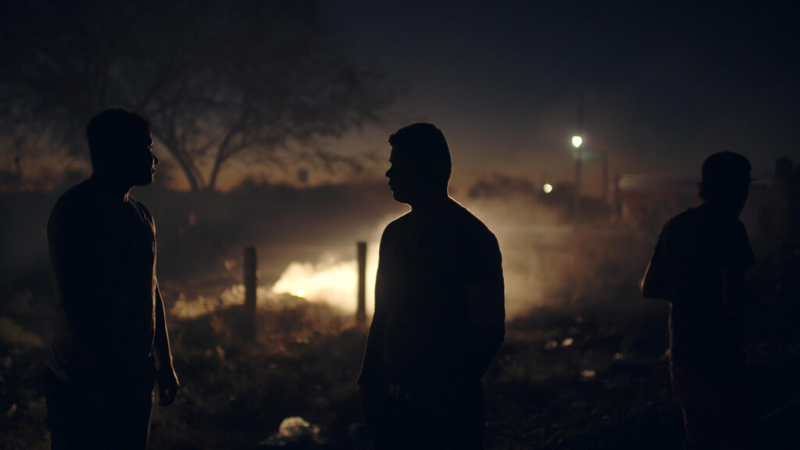
Tales are told by the speakers, sometimes recollections of own experiences and sometimes accounts of others whose exploits and misfortunes have become part of an oral tradition: the hazardousness of northward migration is repeatedly emphasised. All fear the terrible violence associated with of «the beast,» i.e. the freight trains which many of them will try to «hop.»
One such train is glimpsed in the final minutes, with nearly every inch of its available resting-places covered with exhausted but optimistic examples of resilient humanity: a migrant sleeps mere inches away from the tracks hurtling past below. It’s a remarkable image, both poetic and concrete, condensing a complex geopolitical story into a few fleeting, indelible seconds. Emotion ahead, emotion behind but, for a brief while, tranquillity.
The Lost Procession
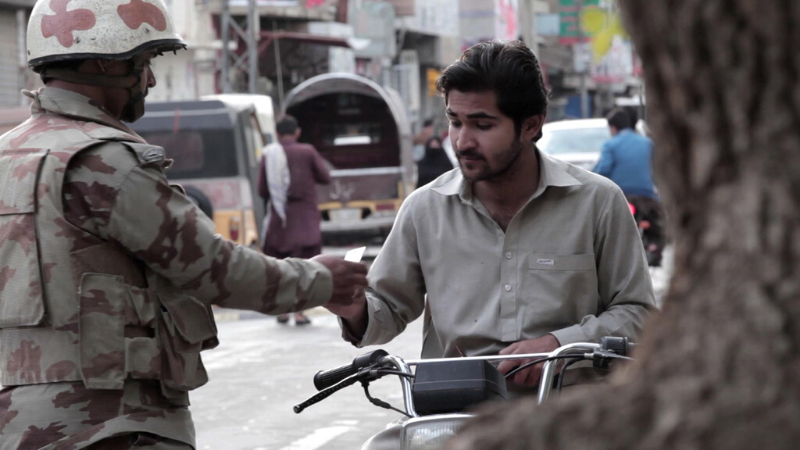
«United in faith but at odds with each other culturally»: this is how artist/filmmaker Bani Abidi describes the Shi’te Muslim men she encounters ritually and energetically observing the Ashura holiday — which marks the death in battle of Husayn Ibn Ali, grandson of the Prophet, on a #Berlin street, and is traditionally the occasion of pilgrimages among the devout.
Herself from a mixed Punjabi-Hazari background based now in Berlin and #Karachi, Abidi takes the encounter with Berlin’s pared-down version of the Ashura festivities as the starting point for a journey that will take her thousands of miles to Quetta in northern #Pakistan, and the «ghettoes» inhabited by the large but persecuted Hazara Shi’ite minority in this mainly #Sunni area.
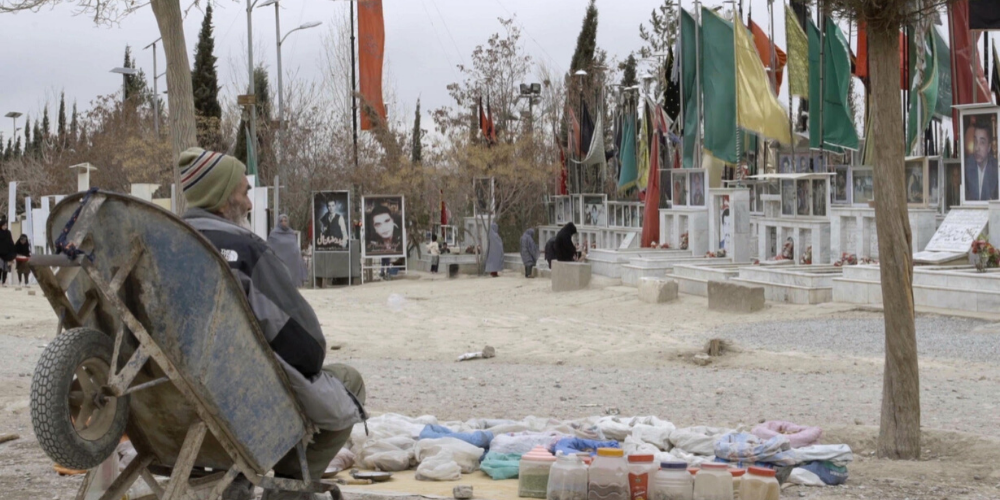
These ghettoes, specifically one cemetery where many victims of violence are revered as martyrs (more than 2000 have been killed in the present century) are the focus of Abidi’s 14-minute film The Lost Procession, a fragmentary and impressionistic immersion into areas long considered no-goes for outsiders.
A 2013 #BBC report dubbed these enclaves «hell on earth,» at a period when suicide bombings were exacting a heavy toll. More than half a decade later, an uncertain kind of peace reigns: the Quetta skyline is a hazy brown landscape of low-rise buildings, the only splashes of colour provided by blue plastic water-barrels on the roofs.
Abidi, who provides salient information via her own voice-over, is drawn to local photographer Asef Ali Mohammad, whose work empathetically chronicles the daily realities faced by the Hazari Shi’ites here. A second, quieter protagonist is black-shawled Nargis Bibi, a bereaved relative of one of the cemetery’s martyrs — as commemorated in fading colour photographs proudly displayed, each of them male, most of them teenagers or slightly older.
A wild-card element of punctuation is provided by the acrobatic teenagers who perform solo «#parkour» stunts against the dusty walls of the settlements. These lithe youths have become something of a social media sensation in the last couple of years, their buoyant enthusiasm an implicit rebuke to the hostile environment in which they find themselves.
A 2013 BBC report dubbed these enclaves «hell on earth,» at a period when suicide bombings were exacting a heavy toll.
Abidi’s film likewise emphasises positivity and the possibility of hope; her camera dutifully records the pain of exile and the hassles of staying put, the problems of the ” «left behind». Her miniature provides privileged access to a place which now seldom intrudes upon the global consciousness: quotidian scenes in areas and populations formed and forged in violent upheaval both natural and bloodily man-made.
These two films both had their world premieres at the International Film Festival, Rotterdam (#IFFR), The Netherlands, 22 January – 2 February 2020.
Featured Image: The Lost Procession, a film by Bani Abidi