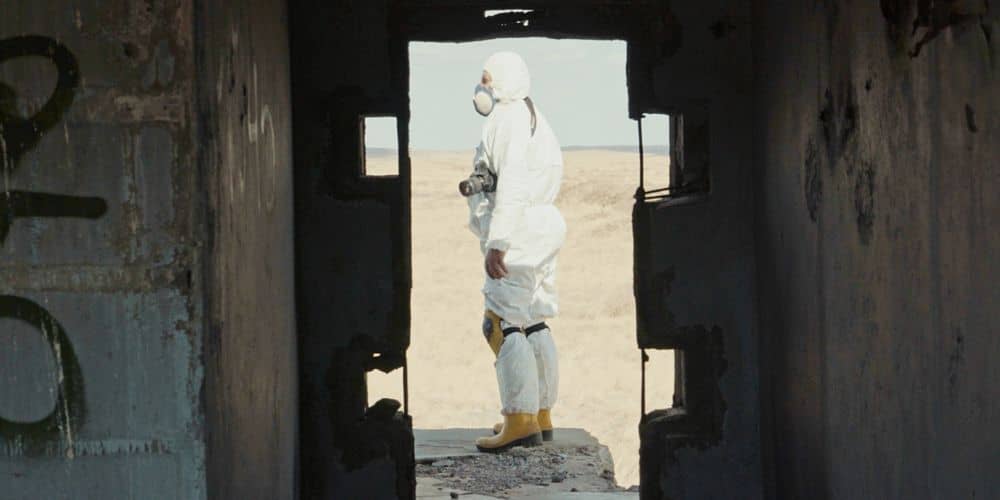
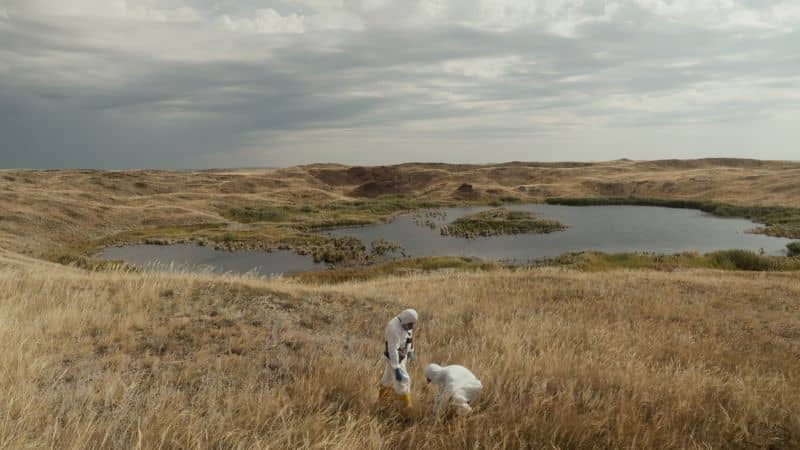
An aerial view reveals a vast landscape. Two men in white hazmat suits tread through the swaying reeds. An inconspicuous lake stretches before them. Formed by a nuclear blast, it fills the oddly elongated crater with radioactive water. The wind persists. Gusts now shift and lift black-and-white photographs strewn across the parched earth. In one, a family of three is captured; in another, two boys grin at the camera, one with his arm draped over the other.
Post-apocalypse</h2
We Live Here by Kazakh director Zhanana Kurmasheva opens with eerie imagery that suggests a post-apocalyptic world. Yet, this expectation soon dissipates as we learn that the story unfolds at the disused #Semipalatinsk (Semey) nuclear test site in present-day #Kazakhstan. Established by the #Soviet Union# in 1949 and known locally as the Polygon, the site served as one of its key grounds for nuclear testing amid mounting #Cold War# tensions (some 456 nuclear tests were carried out on the 18,000-square-kilometre site between 1949 and 1989, exposing over 1.5 million people to fallout and rendering swaths of land in the area virtually uninhabitable). During its years of operation, isolated initiatives arose to study the environmental and human toll of nuclear testing. In the 1950s, Professor Bahiya Atchabarov and his colleagues provided evidence of its detrimental effects on humans and the environment. However, these findings were met with hostility and suppression by the Soviet state. By the late 1980s, public concern over the site had soared. Spearheaded by activists like Olzhas Suleimenov, the discontent coalesced into the Nevada-Semipalatinsk anti-nuclear movement, rallying broad support for the closure of the Polygon. The site was finally shut down in 1991, coinciding with the fall of the Soviet Union. With this move, Kazakhstan also relinquished its inherited stockpile of nuclear weapons.
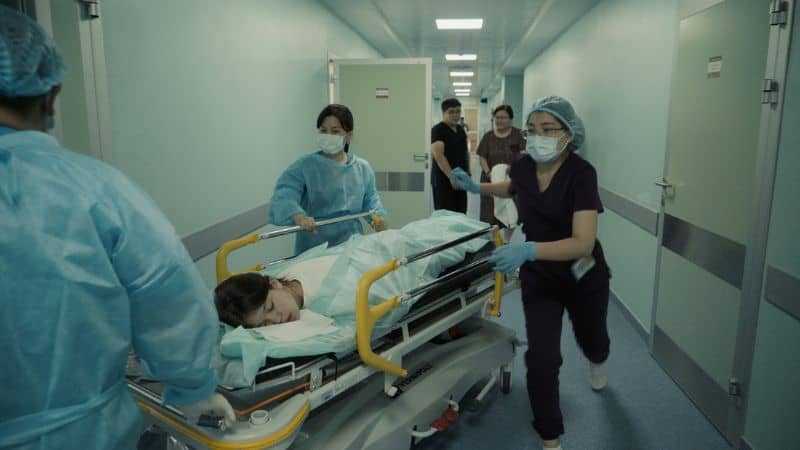
Though the Semipalatinsk test site ceased its activities 34 years ago, its effects endure. To relegate it solely to a matter of the past would reflect a myopic view of its persisting impact—an opinion evidently shared by Kurmasheva, as observed in her film. Against this grim historical backdrop, the film portrays a family from the nearby village of Sarzhal, spanning four generations, all affected by nuclear testing in the northeast steppe. The grandfather, Bolatbek Baltabek, was born in 1959 to a family of herders, a decade after nuclear tests officially began in the area. His birthplace, the Aqsheke camp, lay on the sprawling test site, and his parents recalled celebrating his birth alongside soldiers. In the early days of nuclear testing, many were unaware of the devastation the explosions would cause. The ground would tremble violently, and upon entering their homes, they would discover wrecked furniture and dishware. At some point, nuclear tests took place with disconcerting regularity—at times as often as «once or twice a month.» One such blast claimed the life of Bolatbek’s older sister, who was «crushed by a falling brick» as the tremors tore through their home. Over the years, Bolatbek witnessed dozens of deaths, including his eldest son, who died by suicide—a mental health outcome also related to #radiation exposure. Now in his 60s, his life remains marked by the aftermath of nuclear testing as he pens a book about its lasting harm and gathers signatures for a petition to revise the test site law. His son, Nurbol, is also consumed by the fight. He is pushing for an amendment to a decree that excludes his daughter’s disease—aplastic anaemia—from being recognised as a condition linked to radiation exposure for the fourth generation. Authorities explain its exclusion due to a lack of such research, and physicians argue that there may be no direct connection, as the nuclear tests ended long before the girl’s birth.
In the early days of nuclear testing, many were unaware of the devastation the explosions would cause.
Generations
The documentary ties the past, present, and future through the narrative threads of three generations. Visually, it depicts this connection through associative montage, flowing through observational scenes. One such sequence intercuts images of horses charging across the present-day land with blue-hued archival footage of a mushroom cloud and milk from livestock spilling onto the ground. This juxtaposition of visual motifs binds the memories of the past with the anxieties of the present and future. «We wanted to express our shared sense of foreboding and anxiety about our fragile world—one still struggling to recover from the nuclear tests of the past while also facing the looming threat of wars,» notes Kurmasheva in a press kit interview. These montage scenes also mirror the stages of a nuclear explosion and escalation, from preparation to detonation and fallout, culminating in nuclear winter, where smoke and debris obscure the sunlight. This creative decision was made by Kurmasheva and editor Aidan Serik, reflecting on the #Doomsday Clock# and the threat of global catastrophe. «For me, the core feeling here is premonition—a sense of worry and concern about our future, coupled with reflections on the past. That’s why I chose to use these associative edits, blending archival material with live footage,» explains the filmmaker in the interview.
The long-term effects of radiation exposure sustain the film’s urgency. However, the documentary is also pertinent for another reason: while some warning signs and levels of security are present in some dedicated areas, there is no comprehensive perimeter fence around the site, with parts of it still accessible to people and livestock. When the Polygon was closed in 1991, many in Kazakhstan grappled with the dire economic situation and unemployment following the collapse of the Soviet Union. With nuclear testing halted and the site abandoned, struggling locals rushed to collect scrap metal. Some scavenged debris once used in bomb construction—iron scraps, copper, and aluminium—scattered across the area. Others ventured into deserted mines, retrieving fragments of metal. Nearly four decades later, not much appears to have changed, with some areas remaining largely unguarded. According to the Nuclear Threat Initiative information, coal, gold, and beryllium are extracted on the site, and table salt is harvested from a lake near the primary test field. Villages that are home to a total of more than 10,000 residents can still be found within 30 to 60 kilometres from the former Polygon, according to the film. Those in the vicinity of the area who rely on horses and livestock may also be exposed to radiation indirectly, as their animals could roam and graze on contaminated land (radioactive substances can linger in the soil for years; for instance, as noted in a title card, Americium-241 present in the soil takes some 432 years to decay, while Plutonium-239 requires an astounding 24,400 years). As a result, local residents unknowingly consume radioactive meat and milk. This interconnectedness is particularly important in Kazakhstan, where the people’s deep ties to the land and their age-old traditions of horse and cattle breeding shape their way of life. The film conveys this interconnectedness by linking seemingly disparate shots through emotive visual and thematic connections. For example, images of ecologists cutting through grass to collect soil samples from the wasteland shift to a hay baler in a nearby area, compressing grass into bales for livestock feed.
Through its focus on the former nuclear test site in Kazakhstan, the film not only highlights the need for long-overdue changes—such as properly fencing off the entire area, resettling some people, and «acknowledging the inadmissibility of human habitation»—but also raises greater concerns that extend far beyond Kazakhstan. The film asks an unsettling question: What if this is not just our past, but a potential future? If humanity continues down this path, it risks turning the entire Earth into a global nuclear test site, as the film alludes. One of the protagonists, Kazakhstani ecologist Dmitry Kalmykov, who mapped radioactive contamination at the former Polygon, stresses the gravity of the issue. In light of today’s «unpredictable and dreadful» geopolitical climate, he warns that the temptation to wield such «a terrible last resort» is a frightening prospect.