In his latest documentary, The Kiev Trial, which premiered out of competition at the Venice International Film Festival this month, Ukrainian director Sergei Loznitsa once again turns to archive material to portray historic – and still highly relevant – events from the previous century.
Only a few months earlier, at the #Cannes festival, the productive filmmaker premiered The Natural History of Destruction, an examination of the bombing of both British and German cities during World War II. Last year, he released Babi Yar. Context, another archive-based documentary depicting events from the same era. His 2019 doc State Funeral about Joseph Stalin’s funeral (and the personality cult surrounding it) in the #Soviet Union# in 1953 was also made with a similar approach to archive material, letting it in many respects speak for itself.
Masterful recreation
Through previously unseen footage Loznitsa found during his work on Babi Yar. Context, some of it also used in that film, The Kiev Trial is a reconstruction of the process in January 1946 known as the «Kiev Nuremberg» or «Ukrainian Nuremberg», where 15 #Nazi officers stood trial after the war’s end in the city of the same name in Soviet Ukraine. All of them pleaded guilty, at least to most of the charges they were accused of.
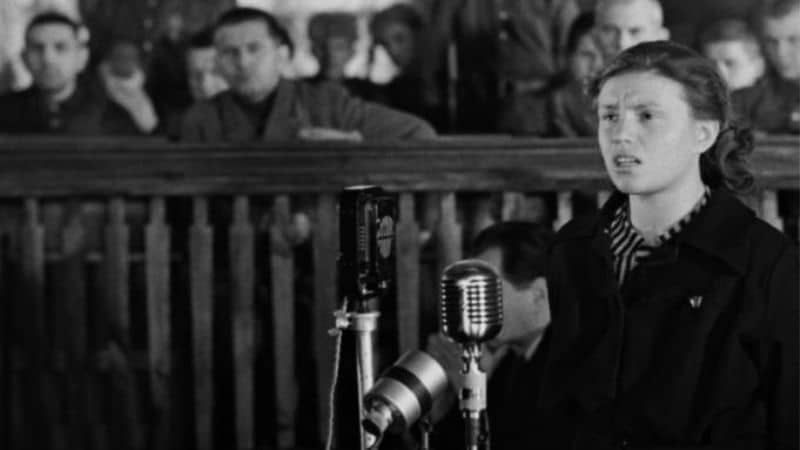
The trial was originally filmed by a production team from the Moscow Central Documentary Studio but, for some reason, never completed and released during the Soviet era. Although its purpose originally was of a more propagandistic nature, this is not particularly visible in Loznitsa’s presentation. The film starts with the accused Germans’ own descriptions and explanations, followed by the testimonies of eyewitnesses and victims. The only added commentaries are brief informational texts, for the most part providing the names and ranks of those who are speaking in the courtroom and which specific events they are addressing.
The restoration and reconstruction of the archive material is masterful and creates an experience close to actually witnessing this historic legal process – together with the large audience that were present in the courtroom.
The truly devastating part is, of course, the victims’ and witnesses’ accounts.
Detailed atrocities
The trial covers atrocities carried out in several Ukrainian cities and villages, including the massacre of almost 34,000 Jews in Babi Yar. We hear in detail about partisans or those suspected to be so hanged in public. Executions of large groups of people lined up in front of pits. Systematic murders of patients from a psychiatric hospital. Children being killed just because they ran around in their village. Entire villages being exterminated, with more or less all the inhabitants killed. In addition, a huge number were sent to the concentration camps.
The accounts of the accused German officers are sober and matter-of-factly. Some of them admit to having taken part in executions. Others claim not to have seen the killings themselves but knew what was happening. Some have given the orders. They also refer to orders they received from higher authorities and the potential consequences of not following these. The testimonies awaken Hannah Arendt’s term «the banality of evil» – but the impression one is left with when watching the film is also one of disturbing complexity.
It is unpleasant to watch the composed and often eloquent officers describe and explain what they have been part of. Not least the youngest of them, perhaps only in his early twenties – which he argues to be considered in the sentencing. Still, the truly devastating part is, of course, the victims’ and witnesses’ accounts. Among the many heartbreaking testimonies is an especially strong recollection from a woman who survived a group execution in Babi Yar by playing dead among the killed and wounded in a mass grave, which she managed to escape while it was being buried in soil.
The film’s final part leaves an unsettling ambivalence.
Lessons learned?
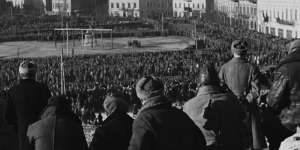
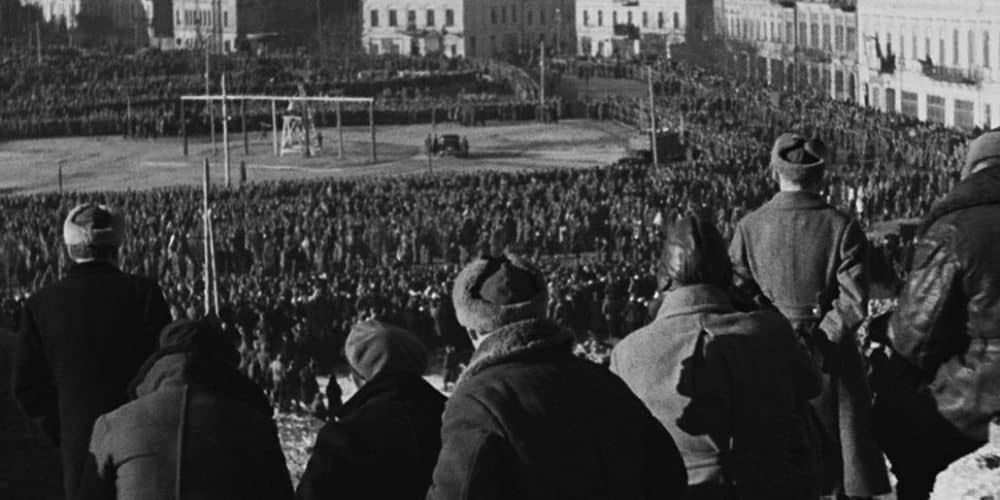
All 15 officers on trial were sentenced to death by hanging, to which the attending public in the courtroom responded with long and loud applause. It is hard to imagine any other outcome, although the film’s final part leaves an unsettling ambivalence. The executions were carried out at a square in the Ukrainian capital in front of an enormous crowd of people and was also filmed. Loznitsa has chosen to include this in what I’m tempted to call barbaric detail, making us reflect on what, after all, was learned – or is even learned today.
The director has said that he did not foresee the Russian invasion of his own nation, at least not in its actual scale nor all the bloodshed and destruction that followed, when he was working on this film. But even if the documentary had not been completed before February this year, he would not have changed it. And why should he? The Kiev Trial nonetheless makes it nearly impossible not to reflect on the #war crimes# presently being revealed and examined in the same country as this trial took place. So many crimes of horrendous proportions were committed against the Ukrainian population during the Soviet period, without leading to trials like the one documented in this film. And we still have no guarantee that the aggressors of the ongoing war will be held accountable for their crimes.