How can a citizen revere a black #Jesus carved from wood, yet fear any man made of flesh and blood that’s not white who may appear in their town? The paradox is a central feature of life in Siculiana, a small and devout #Catholic town in #Sicily. This question is taken up by director Luca Lucchesi (and co-writer Hella Wenders) in the documentary A Black Jesus to shed light on the absurdly irrational, propagandistic nature of racial prejudice and the way it is weaponised to prop up selfish interests and fear-based notions of identity.
Legend
The contradiction impresses itself upon Edward, a 19-year old migrant from #Ghana, and many of the other #refugees and #asylum seekers# who arrive to a frosty reception in Siculiana after a perilous trip across the Mediterranean. The townsfolk have for centuries venerated a varnished oak statue of a black, crucified Christ, which hangs in the church and every year is carried through the streets on the shoulders of chosen devotees in a procession watched by local crowds; a ritualistic tradition commemorating the uncovering of the statue within a fortress and its return into the light, before a day of grace and feast in a medieval manor. Many of the inhabitants, so full of devotion for the statue, refuse to even speak to the migrants, so Edward — also a believer in miracles — lobbies with the help of his Italian teacher to carry the crucifix in the next May 3rd celebration, as a potent symbolic gesture toward healing Siculiana’s divisions and acknowledgment of a religious spirit of brotherhood between all humans.
Popular legend has it that the holy statue was being transported somewhere in medieval times, or slightly after, when its carriers made a stop at an inn in a hamlet near Siculiana. A blind person sat by chance on the chest containing the statue and was promptly cured. Astonished, the people of Siculiana decided the crucifix would end its journey there, and carried it to the castle. Edward and his friends respect this local belief — after all, faith in miracles has sustained them during their dangerous sea crossing, not to mention horrors and hardships at home. «If it wasn’t for God, I’d have been dead a long time ago,» says one.
Many of the inhabitants, so full of devotion for the statue, refuse to even speak to the migrants
A society of emigrants
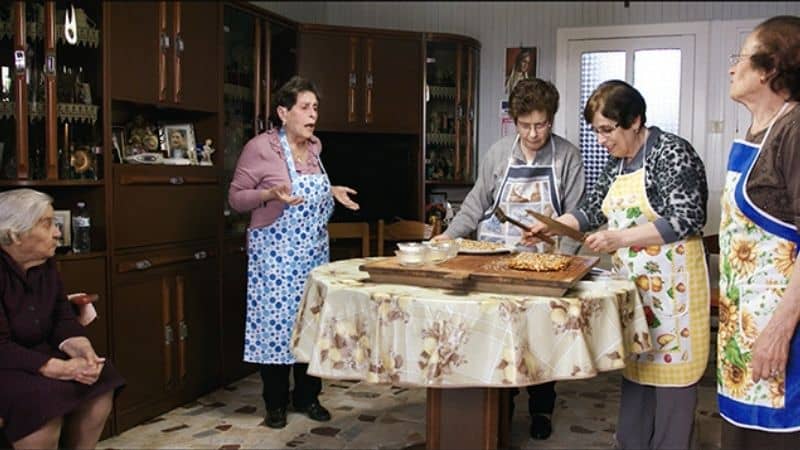
Even broadly shared religious faith has not been enough to warm the majority of locals to the incoming strangers, however, as fear of otherness holds sway. Many of the elderly discuss their fear and discomfort openly, and the middle-aged seem little more open (overt protests against refugee «invasion» have even taken place in the streets.) The migrants’ language teacher is a staunch, pro-active advocate for his students’ rights in the town, struggles against sluggish and reluctant bureaucracy so they can become documented to work legally (rather than instrumentalised for organised crime), and for better integration. His questioning of locals on how they square their less than charitable attitudes with religious tenets falls on deaf ears. A centre for asylum seekers, the Villa Sikania, has been operating in a former hotel since 2014, but its potential closure looms over its residents, adding to their sense of fate’s unpredictability, at the time of filming (its doors were eventually shut in 2019). «We are in the hands of a madman,» says the teacher, referring to anti-immigration government hardliner #Matteo Salvini#, making explicit the political dimension of influential right-wing power structures in stoking and solidifying hostility towards refugees in #Italy.
That the Siculianesi have always been a population of emigrants (many have, for decades, escaped the struggling economy to work in #Germany, not returning) does not register as hypocrisy among more prejudiced locals. «I’m not a fascist,» declares one, recalling how many people were killed in Italy under #fascism. But he insists, in the same breath, his children must eat first, before any aid is offered to others, denying the ideological dimension to the government’s leveraging of local #poverty or the logical chain that connects a refusal of basic equal rights to dehumanisation and state-sanctioned deaths.
The right side of history
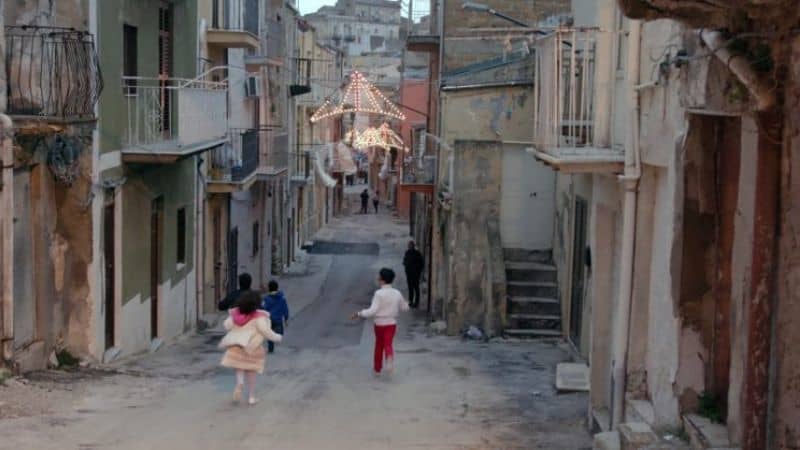
Even more than the success of Edward and his friends in donning the red neck-scarves of ceremonial belonging and hoisting up the crucifix as part of the procession, hope comes through bright and strong in the form of Siculiana’s students. One girl says she’d like to get to know the strangers, but fears others’ inevitable judgment. But in a visit by migrants to a class for an informal question session, adolescents overtly disavow the «backwards» mentality of their elders and opt for a curious, open exchange to end the bigotry that stems from ignorance. While generational divides underpin stark differences of attitude in the town, its youth are eager to ensure they’re on the right side of history.