When chess champion #Garry Kasparov# lost a widely publicised match to IBM’s supercomputer #Deep Blue# in 1997, spectators around the globe were captivated by the seeming evidence that technology could mimic, and even outsmart, the brainiest of human brains. The Russian grandmaster became rattled not by the brilliance of the machine’s programming, but a move Deep Blue made that had no strategic logic and seemed an emotional reflex — an unnerving suggestion of life in a constructed mind. The error was attributed, later, to a glitch.

Rivalry and skepticism
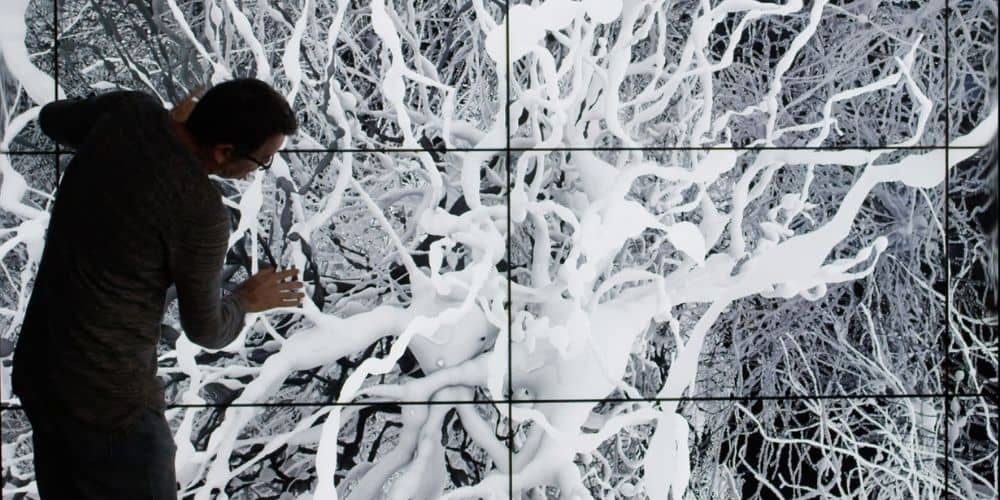
The description of the chess showdown is one of several intriguing digressions in Noah Hutton’s multi-layered and free-ranging documentary In Silico, in which the #chaos and mistakes of systems are of central concern. The self-referential film traces not only the grand ambition of one man, #Henry Markram#, to digitally map the human brain, but also the director’s determination to complete his documentary on the journey, as the project’s ten-year window is shifted. This is, refreshingly and candidly, a musing on the petty limits of the human ego and capitalist bureaucracy, as much as it is about the explorative frontiers of scientific possibility. We’re immersed into a world where scientific innovation is less about the pure moment of inspiration when an apple might fall on one’s head, and more about the canny sell in Ted talks and slick funder events, where allegiances can be forged, and purse strings loosened, to support a long-haul of trial and error. Audacious belief faces colleague rivalry and skepticism — and the unpredictability of a universe that will always defy our attempts to work it out once and for all.
This is…a musing on the petty limits of the human ego and capitalist bureaucracy, as much as it is about the explorative frontiers of scientific possibility.
Hubris
Renowned Israeli neuroscientist Markram may be a gifted visionary, or a deluded control freak gripped by hubris: the documentary entertains numerous perceptions of him, without settling on one. He operates in a crowded, competitive field. Prominent neuroscientists chime in on the limits of knowledge; that we don’t know how much we don’t know, despite deductions that life probably began deep in the sea, from a rare confluence of mutations. Makram is not one to be humbled by the universe’s mysterious uncertainties, and has, when Hutton first begins filming him in 2009, declared that he is going to build a realistic digital simulation of the #human brain# in all its complexity, after first mapping the brain of a mouse. The project started as the Swiss-government-funded Blue Brain Project in a research institute in #Lausanne and took on a higher profile when, as the Human Brain Project, the #European Union# got on board in 2013 to the tune of over a billion euros. An open letter from over a hundred members of the European science community underscored the simmering tensions around this mammoth allocation of funds, which some believed skewed support towards technology over other areas, and over the aggressive, top-down leadership style of Markram, a man who refutes that consensus can change the world.
Aside from suggesting the #autism of Markram’s son Kai was a motivating factor in his quest to learn more about the brain, the film delves little into the scientist’s personal backstory to give us much sense of his mentality, though the paradigm of the idiosyncratic and single-minded creator with over-the-top ideas is one we are all familiar with. This is a neuroscientist who is adamant his work will be more significant than the moon landing, after all, and is little disposed to skeptical feedback. But when it comes to vocal critics, he certainly has many, among scientists who do not believe any brain model can be relied on to inform us of the real thing with all its complex variables. You can simulate a rainstorm, but it is never going to be wet inside a computer, they insist, even as Markram asserts he is not building a model, but no less than biology itself. And no matter how brain-like a simulation glimmering with activity is, how to analyse it, if it is as mysterious as the brain itself?

The unknowable
These fundamental doubts arise even before questions of any garnered knowledge use (the interest of the military raises alarm around the prospect of heightened tools for surveillance and control, rather than cures). Markram is adept at packaging his ideas to harness enthusiasm and support («If there could be a Richter scale for this kind of talk, nine would be the minimum», we hear of one presentation set to woo the conference circuit.) But by 2019, after Markram’s authority had been reduced, and many setbacks occurred, two key figures had left the project, and Hutton, keen to at last wrap his film, quit not long on their heels. As there is much that is unknowable about the human brain, so too, is there much that is messy and unpredictable in human relations — and that is the point on which dreams bloom, or founder.