My first and only encounter with the legendary theatre inventor #Jerzy Grotowski# was at ISTA (International School of Theatre Anthropology) in Copenhagen in 1996. ISTA was founded by another theatre legend #Eugenio Barba#, who introduced Grotowski’s work to Scandinavia after he had studied with him for three years in Wroclaw. The meeting with Grotowski was scheduled for the night. By his side, he had his apprentice #Thomas Richards#. Already at that time, the famous theatre director was a legend, a mystical and mythical character.
I was a very young actor at that time and attended the four days at ISTA with my teacher and colleague Anne-Sophie Erichsen. I was her apprentice At Grenland Friteater, where we worked, I had done my share of physical training inspired by Grotowski, and I was familiar with his notion of the «Poor Theatre» from his period at the theatre laboratories in Polen. He had left the theatre to work with his «paratheatre» and «theatre of source» in the seventies and eighties, looking for ways to find transcendence within theatre, and experimenting and developing his view on the actor-spectator relationship, going from full involvement with the audience to preferably none. In 1986 he arrived at #Ponteredera in Italy and founded the «Grotowksi Workcente» and continued his research in what was to be called «art as a vehicle.» The aim was now to transform the reality of the performer. No audience was needed: «We live in a post-theatrical epoch. What will follow is not a new wave of theatre, but something that will replace it» (The Grotowski Sourcebook: Wolford, Schechner). His workcenter was surrounded by mystery and shrouded in myth. The work was controversial. What did they do? How was it inside? Why did no one speak openly about it?

The workcenter
Aniela Gabryel’s new documentary Radical Move starts with a meeting with Grotowski, similar to that I had with him in 1996. Thomas Richards is by his side translating what the master says, just as he did when I saw them in 1996. That same year the workcenter changed its name to «the workcenter of Jerzy Grotowksi and Thomas Richard.» The apprentice was no longer the apprentice but an equal, and in the fringe theatre world, we all wondered: Who is this guy really? When Grotowski passed away in 1999, Thomas Richards was the artistic leader of the workcenter.
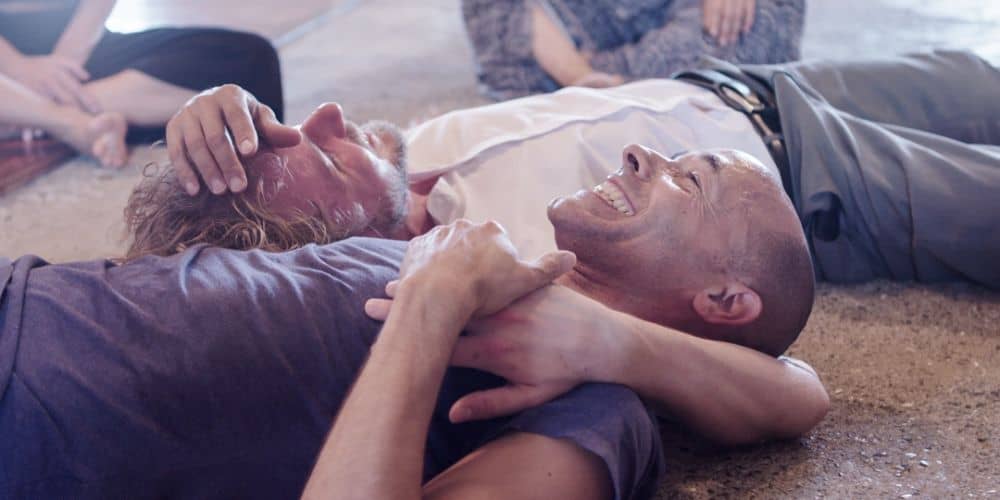
In Radical Move, Gabryel, who was born in Wroclaw, has managed to be invited inside this closed, controversial world to document the work. For the first time, participants of the workcenter speak out. The movie is both a portrait of Thomas Richards’ work and the legacy of Grotowksi’s and is also a deep dive into the actors’ secret personal work and life. The work is song based and highly physical, and rigorous. They have continued the laboratory tradition of working and training in their underwear.
His workcenter was surrounded by mystery and shrouded in myth.
Theatre or cult
The documentary cleverly shows the thin line between theatre and cult, art and violence, making me both fascinated and disgusted. Seeing Richards’ work, I am reminded of another Polish theatre director #Tadeusz Kantor#, who staged the actors by moving them as puppets on stage. Richards’s work on «his» actors resembles a puppeteer’s. In rehearsals, he is continuously present by their sides, or behind them, even on top of them and in front of them, changing their gaze, the position of a finger, of a torso, or their expression, second after second. As ancient songs and the art of expression through singing are vital to this work, we hear him singing as well. Always present with a radiant look in his eyes, as if the energy is infinite, he is there with the ensemble, encouraging or forcing or pushing them beyond limits. About the work, Richards declares when being interviewed for the film: «The work is about using art as a means to transcend the finite. The body is finite. It will end. So, inside the human being, there is hidden a desire. This desire is to transcend the body.»
The actors are entering liminal states of trance, they look blissful, but there are moments of real outburst from the director when they don’t do what he demands. There are guru vibes all over the place. I find myself a bit provoked to see Richards in such proximity with the younger actors almost naked, even though I am aware of the historical use of underwear in this kind of physical theatre work.
Storytelling images
Is it theatre or cult? Is it art or #violence? Gabryel suggests that the answer very well is both. Radical Move is an intelligently constructed and well-photographed film. The director doesn’t stand in the way with her questions and presence. In rehearsals, the camera is like a mosquito, so present I can’t almost believe the actors accepted it to be so close. We get to know the «chosen one» during rehearsals and glimpses from performances and in small interview sessions. The images are the primary storytellers, and it’s certainly a powerful and important story to be told. What the film does is show the intricate psychological workings of a closed group, how the joys and horrors overlap, and how important it is to be bold enough to leave when you start to feel that you lose yourself within a group of this kind.
In 2022 Thomas Richards closed the doors of the workcenter and entered a new area with a project called «Theatre no theatre.» I think Grotowski would have approved that name.