With a rapidly increasing threat to the international rules-based order as countries including #Russia and the #USA seek to return to the era of great power «might is right» politics – the role of the #United Nations# is under growing scrutiny.
What is the point of the United Nations? How can it continue to function as the arbitrator – and brake – on #genocide and unprovoked attacks on ethnic groups, countries, or regions if its resolutions are increasingly ignored or vetoed by its very own Security Council? These are some of the crucial questions director Tim Slade asks in his elegant and incisive The Veto.
Simmering frustration
A film about the UN General Assembly and the five permanent members of its #Security Council# – China, France, Russia, the United Kingdom and the US – may not naturally lend itself to compulsive viewing. But despite the limitations of the subject, Slade makes The Veto work by pulling together a tight group of eloquent and expert figures from within the New York-based organisation itself.
By giving former and current serving members of the UN General Assembly, including Jordan’s Prince Zeid Ra’ad Al-Hussein, Larry Johnson, former Assistant Attorney-General for Legal Affairs at the UN, and Kenya’s Martin Kimani, a chance to air their concerns over the use of the veto by the Security Council, Slade pulls the viewer into the internal dynamics of a decision-making body rarely seen.
Their arguments may seem a little dry at times, but there are genuine frustrations simmering below the polite exteriors about the extent to which the UN’s ability to prevent the needless death and suffering of thousands in conflict zones is so often frustrated by big power politics wielded through the veto.
What is the point of the United Nations?
Better to have it
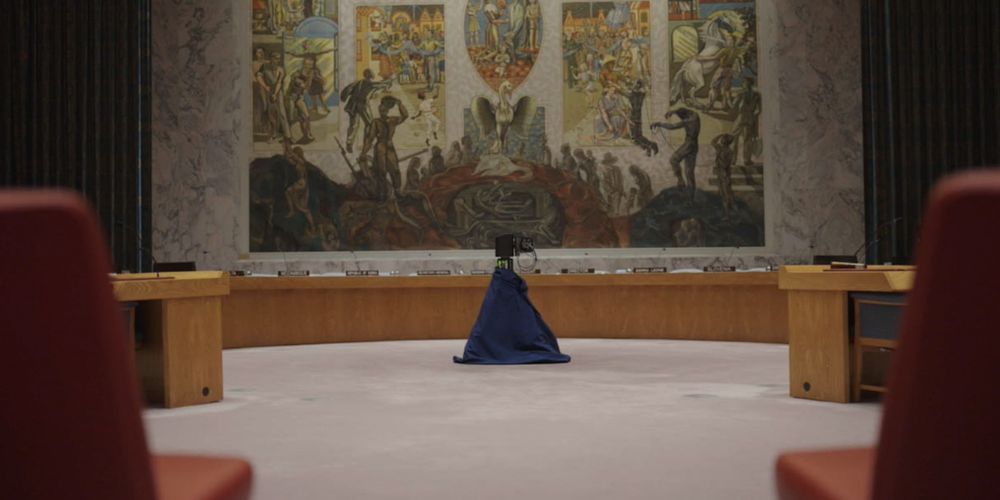
Slade was given access to the floor of the General Assembly when it was empty – and used it to great effect, shooting a beautiful B-roll that he artfully uses throughout this short (57 minutes) film. In this way, as the experts go over their arguments that the veto should not be used by countries directly involved in conflicts themselves or with great vested interests, focusing on disrupted decision-making over violence in #Sudan, Russia’s attack on #Ukraine, Israel’s war on #Hamas and the wholescale destruction of #Gaza, we find ourselves in the centre of the frustration of international attempts at peacekeeping.
The film boils down to an impassioned argument for reform of the UN – reform that is becoming ever more urgent as #Donald Trump# joins #Vladimir Putin# in ripping up the international post-war order.
The ways the General Assembly is increasingly acting to push back against veto – the mere threat of which often kills UN resolutions before they are even drafted – seeking an International Court of Justice opinion on the abuse of the veto, or holding votes in the General Assembly after a veto that embarrass those who have wielded it (for example, after the failure of the resolution condemning the February 24, 2022, Russian invasion of Ukraine, vetoed by Russia), which resulted in a big majority against Russia—show ways forward.
At a time when the very future of the UN is now part of the international conversation, despite its imperfections, as one interviewee notes – it is still better to have the body than not.