Watching Can’t Look Away: The Case Against Social Media confirmed my worst fears: the danger of #social media# is far greater, more calculated, and more systemic than I had imagined.
Exploit the young
This summer, my teenage daughters (17 and 19) told me—almost casually—that they’d seen #Instagram videos showing real people dying, by #suicide or accident. I was stunned. Isn’t that illegal? I asked. They shrugged. For them, it was just part of being online. Considering the hours they spend on social media from morning to night—TikTok running continuously like background radio (I despise it)—I have no real grasp of what they’re exposed to. Where did I fail as a parent? Why do I feel so helpless in my struggle to limit my children’s time on social media?
In the face of overwhelming digital innovation, Can’t Look Away arrives as a necessary, urgent conclusion. Social media companies must take responsibility for the design of their products. Directed by Emmy-winning filmmakers Matthew O’Neill and Perri Peltz, the documentary steps into the heart of a public health crisis—one that has already devastated thousands of families. Through emotional testimony, powerful courtroom drama, and disturbing whistleblower accounts, the film makes a searing case: social media is not simply a neutral tool misused by a few; it is a product engineered to exploit its youngest users.
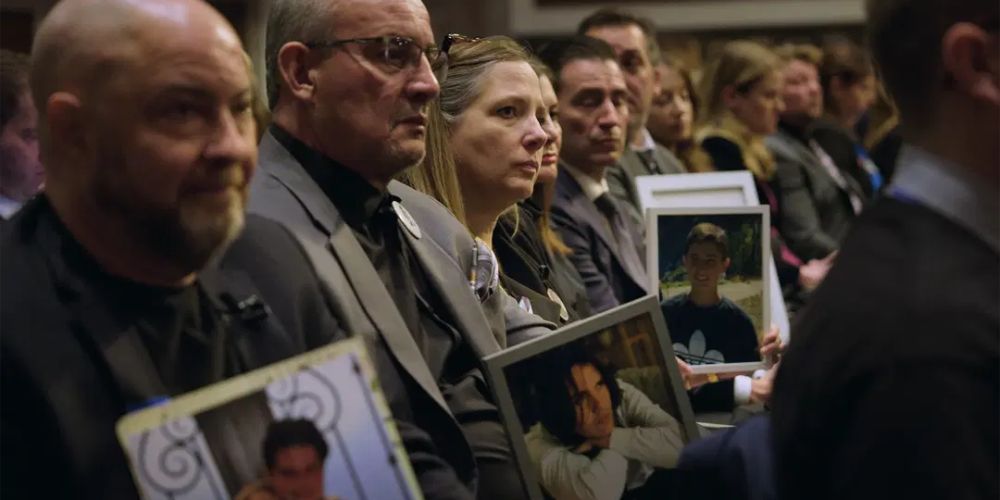
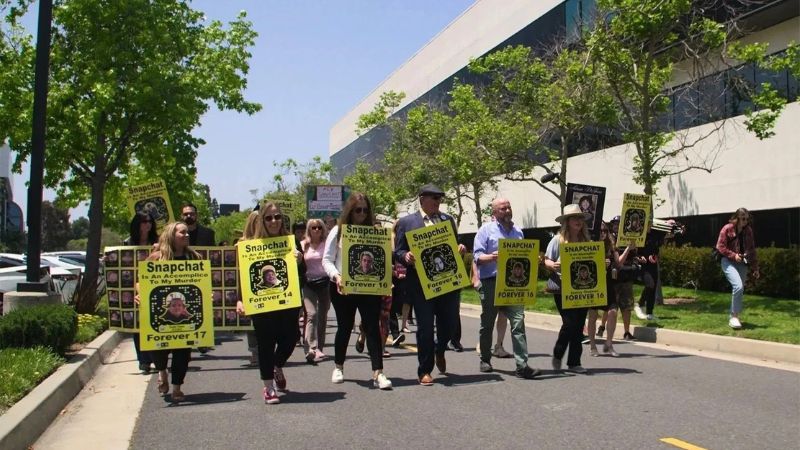
The film opens with parents who lost their children to social media-enabled harm – overdoses, suicides, exploitation. In the Senate Judiciary Committee hearing of 2024, grieving parents hold up photos of their deceased children. One tragic example is a 16-year-old boy who, after a breakup, searched for positive affirmations but was instead served suicide-promoting videos until he took his own life. He is just one of many, actually, of thousands of other young people. Meta CEO #Mark Zuckerberg# turns toward them to say: «I’m sorry for everything you have all been through.» But apologies, as the film shows, are not enough. The hearing raised awareness, but unfortunately, did not result in any (much-needed) new laws.
social media is not simply a neutral tool misused by a few; it is a product engineered to exploit its youngest users.
Social Media Victims Law Centre
At the centre of the film is the Social Media Victims Law Centre (SMVLC), a Seattle-based firm led by Matthew Bergman, Laura Marquez-Garrett, and Glenn Draper. Laura Marquez-Garrett explains, «social media platforms have created, developed, and programmed a very different type of #algorithm that is operated not based on users’ choice; they are choosing what the children see, and they are choosing things that will engage them most, which happens to be extremes. The children are being addicted to these ads, and once addicted, they are being force-fed harmful, violent, and terrible stuff to keep them hooked.»
Their legal strategy borrows from the Big Tobacco lawsuits: if a product is designed in a way that predictably causes harm, it can—and should—be held responsible. The film frames this as a David-and-Goliath battle: a small, conviction-driven legal team facing corporations with limitless legal budgets. «The social media companies know what their product is doing to young people,» Bergman argues in court. «They know the levels of addiction. They know the suicide rates. But they have no legal brakes on their behaviour. Our strength is in the voices of children, coming back from their graves, holding these companies accountable.”
Until now, tech companies have been shielded by outdated laws such as Section 230 of the U.S. Communications Decency Act, which protects platforms from responsibility for user-generated content. In one courtroom exchange, Snapchat’s lawyers compare the platform to a telephone company—simply connecting people. Bergman counters that #Snapchat is more like a video parlour that lures in kids while also letting in the worst kind of predators. Its disappearing messages, anonymous interactions, and Snap Map features make it easy for drug dealers to reach teens. In 2022, an average of 22 U.S. adolescents ( the same as a whole class) died each week from fentanyl-laced pills, many sold via Snapchat. Dealers post temporary, funny emoji-coded ads that vanish before law enforcement can act. SMVLC has pushed Snapchat to preserve communication histories—changes that would be invisible to users—but the company refuses to change its design.
Internal research conducted within social media companies has shown for years that platform design intentionally exploits young users. Arturo Béjar, former Director of Engineering for Facebook’s «Protect and Care» division, testified before the U.S. Senate in November 2023 that one-third of children on Meta’s platforms received unwanted sexual advances within a week. His warnings were ignored; he was later dismissed. Ten years ago, safety would have been prioritised by the executive boards; now it is all about making a profit. Following the 2020 U.S. election, #Facebook reportedly scaled back its efforts to limit the spread of misinformation on its platforms.
These companies know exactly what they’re doing: engineering addiction to maximise ad revenue. In 2022 alone, social media generated an estimated $11 billion in advertising revenue targeting minors. «It’s not a fair fight,» one whistleblower says. «On one side, you have powerful algorithms; on the other, a young brain not yet fully developed, drowning in emotionally charged content.» What Can’t Look Away makes painfully clear is that addiction is not a glitch in the system—it is the system. The film refuses to reduce this to «good parenting» or «healthy screen time.» Instead, it exposes the structural incentives that make harmful content inevitable.
The new arms race
Last week, The Guardian reported that each of the central platforms plans to invest $50–100 billion in developing #AI over the next two years. In this technological arms race, safety isn’t even an afterthought. The digital revolution was supposed to bring us together. Now we have to protect ourselves—and our children—from the very tools we created. If we can’t regulate today’s platforms, what chance do we have against AI-generated exploitation that may be impossible to detect?
Can’t Look Away does not merely suggest social media is dangerous; it argues persuasively that it is designed to be harmful, and the only way to force the social platforms to change their design is through the judicial system. As of July 2025, approximately 2,500 lawsuits are pending against social media platforms worldwide. What we need is an international law that can protect our children from exploitation and harm online.