Set in the Democratic Republic of #Congo, Of Mud and Blood revolves around the lives of diggers and miners in mineral-rich #Numbi, a rural valley with mixed settlements and dirt roads beside an expanse of mountains.
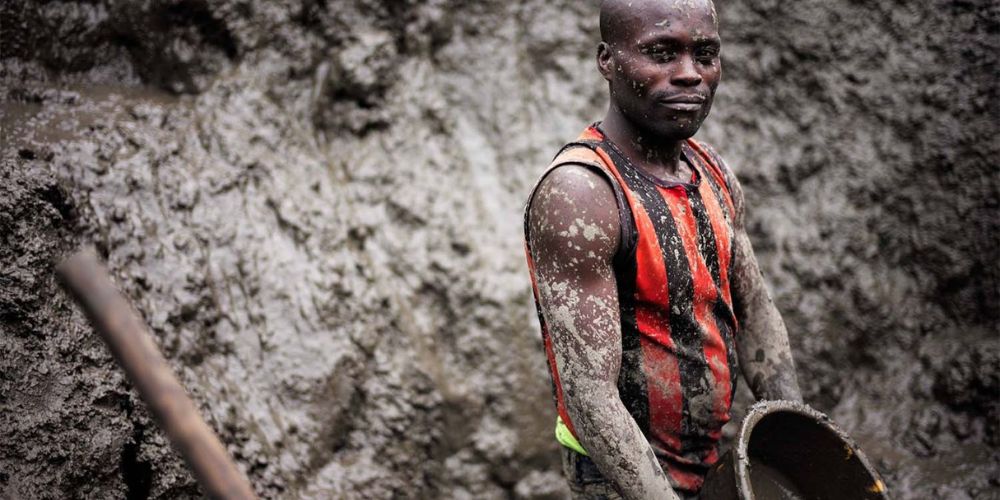
Its main character is Ujumbe Sabahutu Claude, a digger who faces significant financial struggles that are only partially alleviated by his work in the mines. Many of the diggers, like Ujumbe, grew up impoverished as child fighters or survivors of the #genocide in #Rwanda. Their lives are militarised by the conflict and violence of their region. Their lives are also marked by tragedy and suffering, where becoming a digger is their only hope.
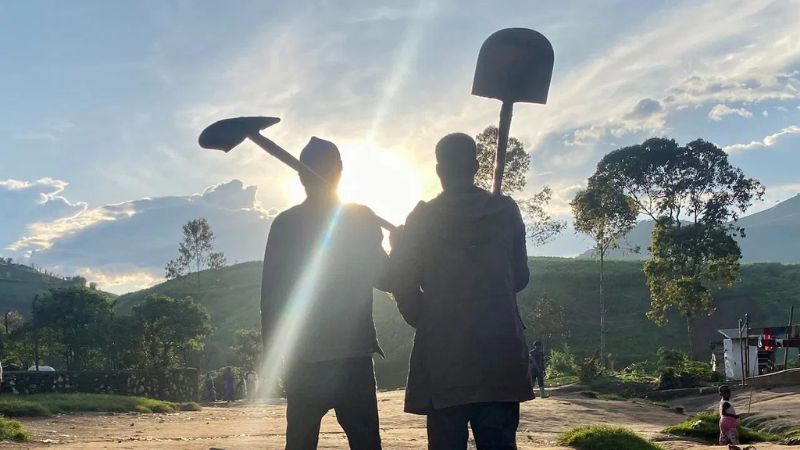
People die, minerals survive
Life remains usual in Numbi as villagers play on a sand field with wooden posts during the day. Much of the community gathers to watch. Soccer is a pastime. But death is also usual as the hillsides are littered with gravesites from ethnic conflict, banditry and accidents in the mines. A collapsing block in a mine killed Ujumbe’s father. There is no protective gear at all, and anyone can be injured easily. There are no security measures. No healthcare. No accountability. Just a miner and their pick.
The people die, but the ore remains alive. Looming over Numbi is the threat of an incursion of the #M23 militia, who are similarly attracted by the region’s vast minerals.
The village is also patriarchal. A woman character refers to #sex work# as one of the only viable trades for herself. Men decide matters of marriage and dowry on behalf of women. Men are expected to labour in the mines, seeking new veins of wealth. Men work in the government. Men are the teachers in schools. Only boys attend.
There is a strong focus on education in the film. Mining is talked about in schools, including the role of foreign nations in Congo’s mineral economy. Many of the diggers are young and include women as well, standing under armed police guard.
Children are taught about DRC’s rich reserves of minerals such as zinc, copper, uranium and of course, #coltan. At the same time, the teacher explains that becoming a miner is not desirable due to its dangers, such as bandits, and the value of being educated instead. Most of the children admit to going to the mines after school, however. The film shows children with spades digging in landfills. This is despite it being outlawed and the police confiscating ore from child diggers. Yet, there are child-headed households where digging is their only sustenance.
To find coltan, you must become the mud.
The haunting spectre
Coltan is a spectre haunting the film, as it is spoken about much more than it is shown. As explained in the documentary’s opening screen, coltan is a black ore essential for manufacturing the electronic components of smartphones, computers, electric cars, planes, and satellites. The mountains of Congo, bordering Rwanda and #Uganda, have been in #conflict as a result.
A village elder claims that multinationals fuel war to get access to coltan. There have been repeated wars in Numbi to the point where most houses were destroyed and people were buried in mass graves on the hills overlooking the village. Minerals are a curse which have bloodied the fauna, flora, soil and underground.
These costs of extraction are captured in real time. «We ate the mountains with our shovels», Ujumbe claims, while not knowing what becomes of coltan once it is processed. The ore is merely a means to feed his family, which he risks losing if he cannot afford the dowry.
There is no ethical side to coltan mining. The local government has set up processes to be regularised as a digger, but Ujumbe cannot afford the fees. Neither can any of the other diggers. Child diggers are outlawed, but they remain widespread. Overall, the state has lost much of its ability to control or regulate the mines.
Local brokers who collect and process the coltan struggle to find a profitable selling point to international markets, which are shown to hold control over its price. The diggers also get only a small fraction of the minerals’ worth.
There is a local who buys and treats the ore, separating the coltan and cassiterite using magnets, and then sells the coltan to the state mining office. Bags are then registered in a process called «tagging». There are evident flaws in this process of ‘ethical mining’, but such limitations are also products of the region’s instability. To prove the traceability of this process, the film crew follow the coltan and #cassiterite all the way from the state depot over bridges, valleys, hillsides and the city. State officials and police are also bribed to not disrupt this process in what is effectively an informal tax.
In our pockets
On show is how laborious digging is because not all ore has coltan, and one needs to keep digging deeper and deeper, separating the soil into its parts. There are long scenes of digging to illustrate just how time-consuming and labour-intensive the process is. Notably, there is a very long shot of people digging into the ground and singing. The film effectively displays the great difficulty of being a digger. To find coltan, you must become the mud.
Ujumbe summarises the film succinctly by saying, «Here in Numbi, some have blood on their hands, many have mud on their hands, but the whole world has coltan in its pocket».
This review emanates from the Talent Press programme, an initiative of Talents Durban in collaboration with the Durban FilmMart Institute and FIPRESCI. The opinions expressed in this article are those of the author and cannot be considered as constituting an official position of the organisers.