Synthetic Sincerity, from the renowned British director Marc Isaacs (Lift, Men of the City, The Filmmaker’s House), merges a documentary account of scientific AI research with fictional elements to illustrate the current reality at the dawn of complex social interactions between humans and AI. In a light-hearted form, the film indirectly tackles serious concerns by focusing on the notion of an image and its «truth» and by humanising aloof AI through personal stories of people engaged in the project. The increasingly frightening prospect of our forthcoming cohabitation with AI-run machines is soothed here by a call for AI’s democratisation, reliance on academic quality assurances, and human control, and by social experiences of researchers from various immigrant backgrounds. Jean Baudrillard’s hyperreality in the fourth phase of simulacra, in which a sign is entirely independent of physical reality, becomes here an object of reflection that raises numerous questions not only about the feasibility of all-encompassing AI, but perhaps most of all about the responsibility for its actions and the social consequences that come with it.
The Synthetic Sincerity Lab
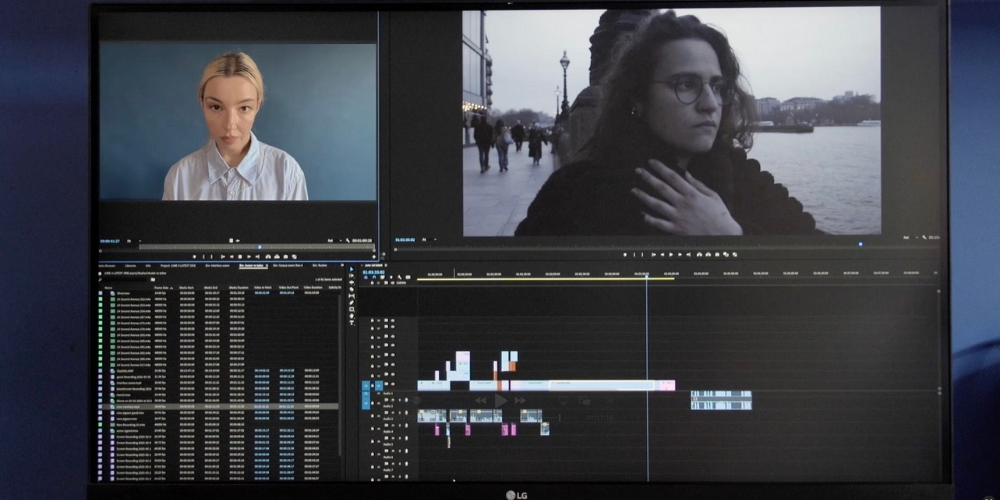
The scientific project aiming at sensitising AI agents is run by The Synthetic Sincerity Lab, which is affiliated with the University of Southern England. The scientists invite the director to collaborate with them by allowing the AI to analyse the interviews he conducted with numerous people while making his previous documentary films. The director, in turn, observes the scientific work as it unfolds by following the initial phase of the project, which collects and incorporates data on various, visible, and minuscule ways the human body reacts to impulses. Professor Song, who runs the Lab, introduces Lynn, the project manager, and other scientists who came from different countries. In the sophisticated AI capture facility, they feed the AI with tons of data to create a wide array of human behaviours that are supposedly designed to help the AI communicate better with humans. The Inscribed Humanity Synthetic Sincerity Project aims to uncover the less obvious traits of human conduct and presence, and to collect the human picture and voice to freely generate future-perfect AI agents.
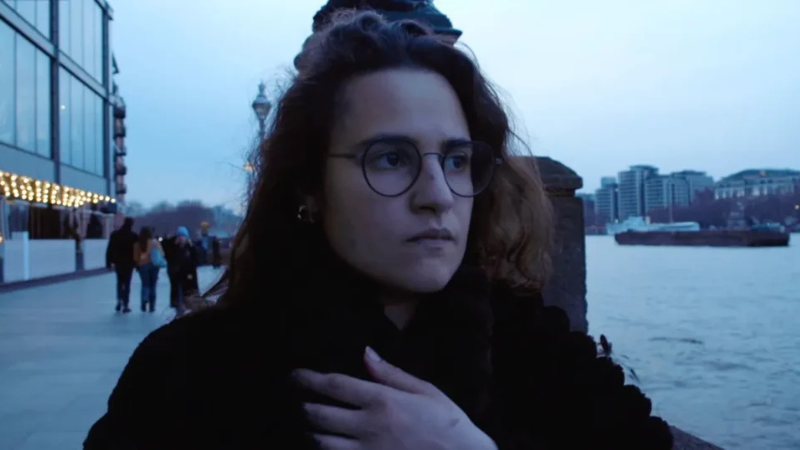
At a certain point, the Lab asks the director to suggest someone who would agree to provide visual and auditory samples for the avatar, and the director points to his neighbour, a Uyghur chef who had to escape from China decades ago. Chef’s personal struggle leads the film to the political field of enforced silencing and racial profiling, and through it to a tragic situation in other places of the world, as Lynn comes from Beirut, and is also restricted in what she may say about the fact of Israel bombing her hometown. In turn, Professor Song left China to study in the UK at 19, and, as a renowned AI scientist, he emphasises what connects distant cultures and countries. Other scientists keep their distance when commenting on and revealing details of their work and personal stories, but all admit that their primary motivation for working in AI is financial. Among the personal stories of the characters in Isaacs’ earlier documentary films, now being incorporated into AI and by researchers, the film focuses on the human face bearing the marks of past experiences, internal life, and a character shaped by life’s struggles. Following Ingmar Bergaman’s remark: «the essence of cinema is the human face», the director wonders about «What is happening to documentary film and the world it depicts as AI cinema becomes a reality»; «What do we consider an authentic image in the age of AI»; «What will happen to documentary when film loses the power to document? And what will happen to a society that cannot be documented?»
«What is happening to documentary film and the world it depicts as AI cinema becomes a reality»
Personal stories
These theoretical questions about the nature of image and imagery, however, are hidden behind the personal stories of people working on the project we examine through traditional documentary filmmaking. The film relies on observing the world and on intimate conversations with people, gradually revealing their inner depths and experiences, often refuting earlier presuppositions one might have formed on first viewing their pictures. Their stories evoke broader social themes, discussions, and events, and offer a portrayal of individual sensitivity and coping mechanisms that the audience can view and interpret. As the researchers discovered, in Isaac’s earlier films, they’re putting into AI to analyse, the moments of silence, in which the camera depicts just a person’s face, are more «valuable» in terms of information load than the ones in which the same characters express their experiences. Yet in silence the picture signifies not only the inner world of a given character, but becomes also canvas upon which a viewer might project one’s inner world, concerns, knowledge, convictions, or aims, as the act of communication in its basic dimension is at least a two-way process, involving a sender – a sign – a channel – and a receiver.
The problem of interpretation
This brings us to the problem of interpretation, the action formed on its basis, and the social and political responsibility for this action. Inflicting certain human sensitivities on machines that are presumably supposed to help people communicate with AI agents could endanger the project politically. In Synthetic Sincerity the AI generated version of the Uyghur chef explicitly expressing his postulates (although he himself for years stays silent to protect his family still living in China) stirs controversy and disciplinary hearing for Lynn, who as a woman and immigrant, is, in a way characteristic for our times, made responsible for a possible anger of Chinese institutions collaborating with the project internationally. She bears the whole weight of responsibility, while her graceful superiors and collaborators are surprised – the responsibility for the social and political consequences is shuffled down the social ladder to the weakest point, to the ones who can hardly protect themselves.
The reality and fiction intermingling in the hybrid form of the Synthetic Sincerity playfully juggle various elements, posing questions hidden beneath the surface of the film’s topic – it is up to us to formulate them, consider them, and seek solutions.