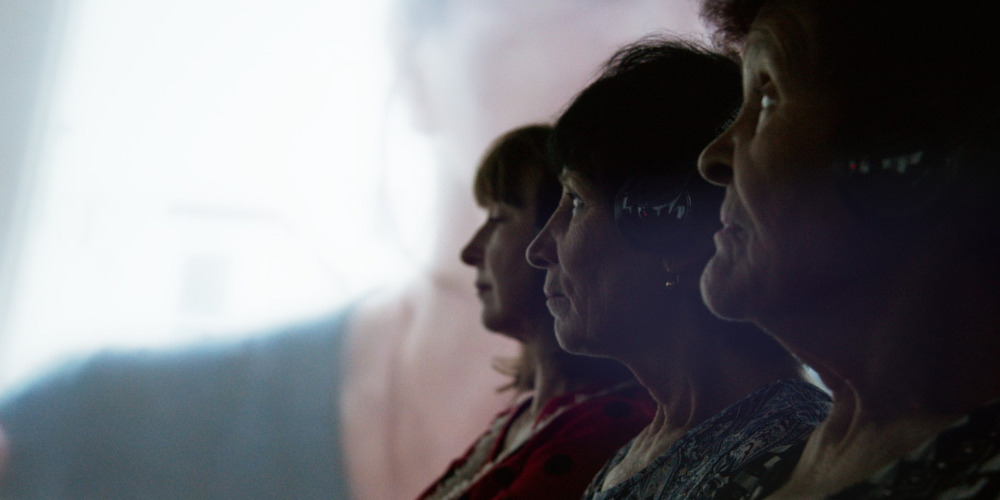
Alisa Kovalenko – the director of Traces – is no passive observer of CRSV (Conflict-related Sexual Violence), she herself was raped during the war and is an active member of sexual violence organisation SEMA Ukraine and the Global Network of Victims and Survivors to End Wartime Sexual Violence.
Together with co-director Marysia Nikitiuk, she charts the work of SEMA Ukraine founder, Iryna Dovhan, who was raped and abused by Russian separatists in Donetsk in 2014. Photos of her, beaten and bruised, standing in a public square with a sign around her neck labelling her a “child killer”, garnered international attention after they were published by the New York Times. Reminiscent of Nazi photos of people labelled partisans, the images probably saved her life, she says.
Brought before a senior commander, he ordered her to undergo «re-education». Later, she fled with her husband to re-establish their life in Kyiv.
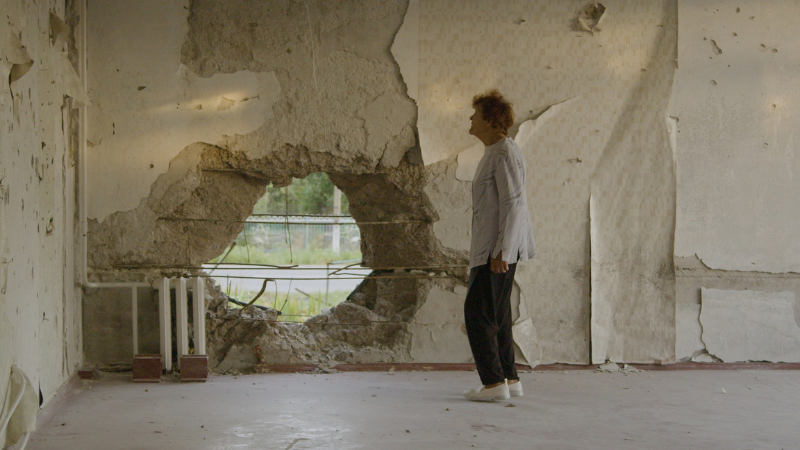
Iryna’s story
Traces opens with Iryna’s story – and how working with nature, planting trees and tending to her garden is a true therapy in itself. Founding SEMA Ukraine in 2019 has also been a huge step forward for Iryna. The very act of speaking out, finding other survivors of sexual violence and torture, supporting them to move from shamed to shamer, has been immensely empowering, she says.
As a French woman, Gisèle Pelicot – serially raped while drugged by her husband and other men – says in her new book A Hymn to Life, «Shame has to change sides».
That could be Iryna’s credo as she tenderly persuades women still traumatised by rape to tell their stories on camera.
Tetiana – whose flowing dark hair belies her age (60) – is initially hesitant to recount the events of the night when soldiers from Russia’s Asian Buryat minority knocked at her door, forcing their way in at gunpoint and separating her from her husband. She thought about escaping, but eventually – after being choked close to the point of unconsciousness – understood there was nothing she could do.
The stories unfold like a gradually increasing weight on one’s chest
The recurring theme
This is a recurring theme in the testimony of survivors, forming a body of evidence to present to the Hague. Late-night visits from often very young soldiers who violently assault women before raping them. None of the women are young, and their stories expose the truth that rape is not a crime of sexual force, but sheer brutal, oppressive force, designed to terrify and destroy the victim.
Mefodiivna is a great-grandmother who awoke to find a Russian soldier young enough to be her grandson, standing next to her bed. Threatened with execution, she was raped on the spot and left with his warning ringing in her ears, «if you tell anyone, I shall come back and kill you with this bullet», as he casually tossed an AK47 round at her. She still has the bullet, opening her soiled, peasant’s hands, to show the small copper projectile.
Halyna had her teeth knocked out with the butt of a rifle as soon as she opened the door, and was beaten and dragged around the kitchen of her apartment before being cut on her stomach and then brutally raped. She was also told to stay silent.
Olha, who had a nephew serving in the Ukrainian army as she attempted to survive with her husband and 19-year-old son in the occupied zone, had been passing on information about Russian forces. Betrayed by a neighbour, she was forced to listen to her son being tortured in an adjacent room before she too was subjected to electric shocks, with electrodes attached to her fingers. «When they do this on men, they attached the electrodes to one of their genitals and the other to an ear», she remarks.
Mutated violence
The stories unfold like a gradually increasing weight on one’s chest, with some relief only when the directors turn to SEMA’s current public activism and the growing confidence of its witnesses.
When Iryna is forced to move to Ireland – where her sister lives – to undergo treatment for cancer likely brought on by the stress she has endured – others take up the reins, demonstrating how much stronger they have become through unity and mutual support.
Ultimately, an empowering film, Traces throws a light on some of the darkest episodes of the war in Ukraine, reflecting both the brutalising effects of war and the ways victims can turn the tables on their oppressors.
And, as recent revelations of the pervasive violence, torture and culture of executions within the Russian army units fighting in Ukraine demonstrate the insidious ways that violence, once unleashed, can mutate.