«No one knows how this will end,» was excited Swedish journalist Erling Söderström while tying his hiking boots. It was the autumn of 1996, and he was about to set off deep into the Amazonian forests to take part in the first-ever peaceful contact with the Korubo, a tribe living in isolation in the Javari Valley, one of the largest indigenous territories of Brazil. Söderström eagerly shared his childhood memories and dreams of exploring distant horizons and unknown cultures. What he didn’t mention were hundreds of years of European expeditions into the territories of the global South, of discoveries that turned into conquests, of drawing maps that transformed the regions into the property of those who «discovered» them. There were many more unknowns than he had anticipated. Indeed. 30 years later, the filmmaker Nathan Grossman filmed Söderström’s return to the Javari valley.
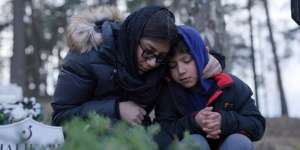
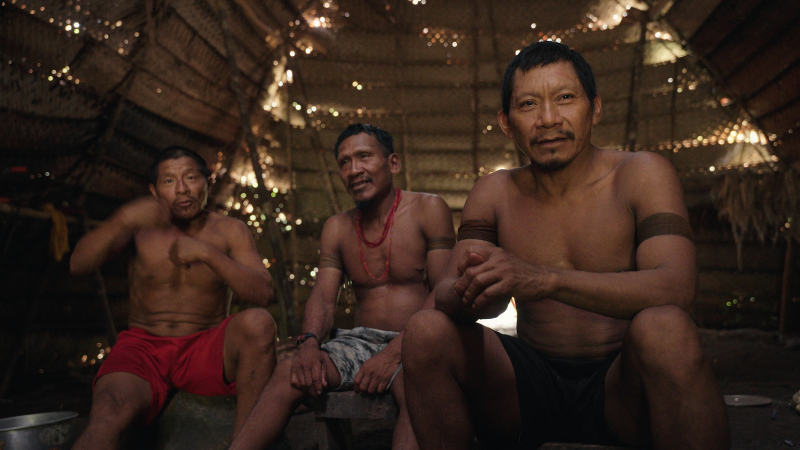
Contrary to expectations, and notwithstanding the considerate attitude and enthusiasm shown by Söderström and other members of the expedition after the first contact, the memories revealed by the Korubo were not pleasant. The expeditionists were not even aware of what was truly going on during the first contact. And Söderström, proud of the collection of photos he took on the 15 expeditions in the Amazon («I don’t think anybody has so extensive coverage of the isolated Indians as I have»), faced the claim that these photos don’t belong to him.
Beware of the brutes
Grossman presents the argument in an utmost detached way, outlining in reverse the interpretations of the contact. Amazomania comprises three independent parts: first, the material filmed by Söderström during the 1996 expedition. Second, the award-winning film The Hidden Tribes of the Amazon by Söderström from 2003, his interviews, and his testimony before the visit with Grossman. Third, the material filmed during Söderström’s 2023 visit. The 1996 expedition, led by Brazilian activist and civil servant Sidney Possuelo, differed from the image of expeditions from the 19th Century, but its dedication to peace was similarly controversial. The expeditioners were marking the areas where the Korubo lived as forbidden zones to prevent conflicts with local settlers, mostly fishermen who were killing the Korubo, but they were also aiming to prevent these conflicts by «appeasing» the Korubo, showing them, by their example, that the white people were coming in peace. Even more surprising, for the late 20th Century, was their complete immersion in the colonial imagery of brutes. Both the journalist and the activist were reproducing the same narrative of danger and suspense by repeatedly warning against the Korubo as «clubbers,» who are crashing enemies’ heads in cold blood, and «can smash your skull with one blow» of the club.
…the memories revealed by the Korubo were not pleasant
Who are you?
The contact Grossman filmed in 2023 proved that these fears were justified, just not for the reason the intruders projected. The first peaceful contact with the unknown Korubo was such because the Korubo decided that this was the right approach for that particular group of intruders. And this is not all, but you’d better see for yourself. Amazomania, filmed as a routine anthropological study, reveals so many surprising details that make this film a true enlightenment for anyone interested in cultural communication, and a hard challenge to those immersed in colonial ideology.
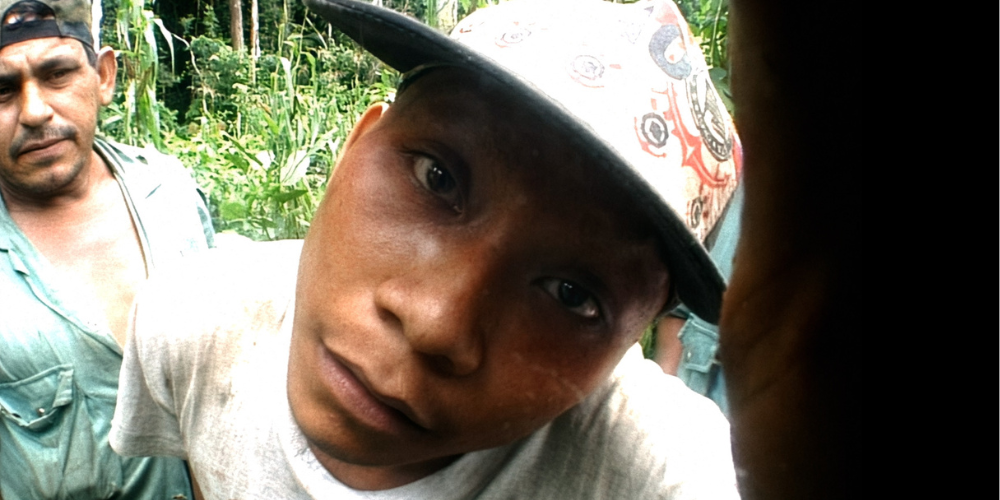
Yet, one scene deserves special attention. It is the moment when, in the first contact, the young Tsamavo approaches the lens of the big camera in the hands of a white journalist, asking, several times as he is approaching to see better, «Who Are You»? The fact that they have not (yet) been the subject of others’ gaze has fuelled the curiosity of anthropologists, journalists, and adventurers about «unknown» and «isolated» tribes in the Amazonian forest. This «first» look is at the heart of the Amazomania. Seeing this look turned around, towards those who believe they are pointing it towards the «unknown», like they do with their rifles, immediately at the contact, is an outstandingly powerful experience. It shows power relations shattered at their core. And it is a result of an unprecedented action by the presumably passive object.
Who do you think you are?
This first look fuelled Söderström’s fantasies of life in the Amazonian forest as «the untouched garden of Eden», and he brought home parts of it in the photographs he took there. The parallel between the photographic camera and the rifle lies at the heart of the invention of cinema, similarly signifying the domination of the person pointing the camera over the filmed object.
As this look is turned around, the question also translates into «who do you think you are?» because it exposes, in a tragic and also humorous way – depending on who you are – the naive self-love of (white male) humans, who are used to dominating the world by their look alone. Human communication is based on misunderstanding: to establish contact with the other, we need to assume we know how the other sees us, even if «you can never see yourself from where I am watching you». This asymmetry is the basis of power relations among individuals and between groups, such as between men and women, and it also played a significant role in colonialism. The dominating look Edward Said exposed in his studies on Orientalism is even today serving as an ideological alibi for the genocide in Gaza. Franz Fanon analysed how black people, trying to please the look of the white people, adapt to it by developing what he called «white mask». In Amazomania, we have a unique opportunity to see this dominating look appropriated by the presumed object of the look and turned around, towards the dominator. This already happened during the 1996 expedition. In 2023, Grossman filmed the confirmation – the isolated people of the Amazon got to speak up. Don’t miss.