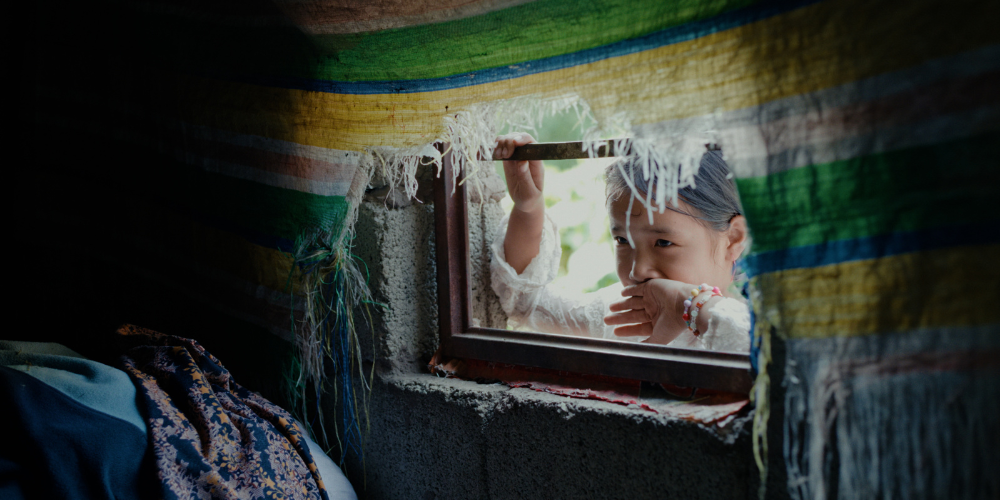
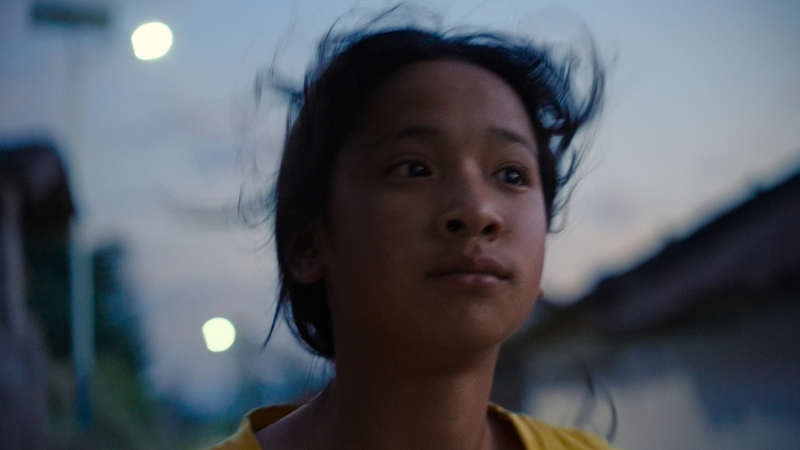
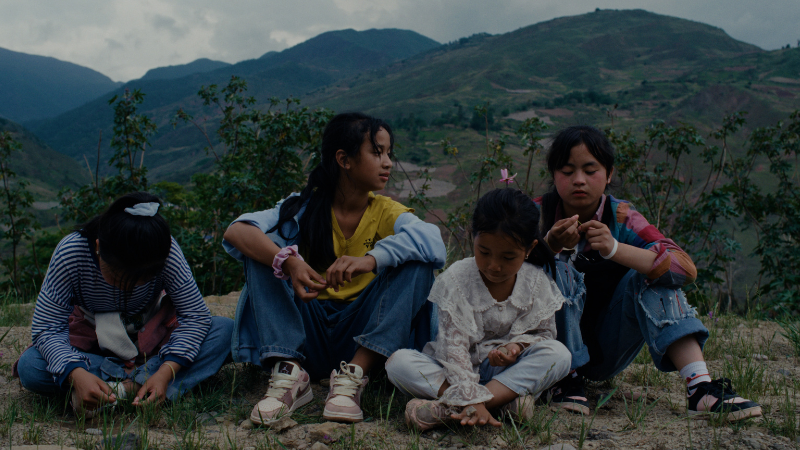
Girls run through a verdant field, chasing one another playfully as their voices spill across the landscape. This tenderly lensed scene opens Dongnan Chen’s Whispers in May, which celebrated its world premiere in this year’s DOX:Award competition at CPH:DOX. Set in the remote Liangshan Mountains, home to the Nuosu (Yi) people in southwest China, the documentary gently draws us into the world of a 14-year-old lanky girl, Qihuo, and her two best friends.
Life is about to change
Qihuo carries a secret: She had her first menstruation a few months ago. Life is about to change for her, as menarche signals not only her physical maturing but also transition into adulthood, which means she can be married off for a dowry, assume a marital role, and work. This rite of passage is marked by the Changing of the Skirt ceremony, a traditional coming-of-age ritual, where she is to don a longer adult skirt. With her parents away as migrant labourers and her grandfather recently passed, the task of finding a skirt falls on Qihuo, who has been no stranger to solemn responsibilities, like caring for siblings and housework. Flanked by her two best friends, she begins her search at a local market, where palm readers tell their fates and fortunes. This quest also takes them to Butuo, where a wholesale centre offers cheaper garments.
The film’s narrative unfolds in the ensuing journey, trailing the trio (along with one of the girl’s younger sisters who tags along) as they travel mostly on foot, with some yuan and snacks tucked into their rucksacks. Keeping a tight focus on the girls, the camera captures their world that feels at once intimate and vast, where seemingly small moments, like sending an ant on a leaf downstream or chatting about «monsters» with a stranger, suddenly become grand. Time stretches on in this world, as days fade into nights and landscapes shift from rugged mountains to lush valleys. Wilderness sets the scenes, nurturing and protecting the girls as they venture outside their immediate environment. But the various terrains and winding paths also mirror their inner landscapes, at times acting as emotional signposts that allude to the looming changes.
Time stretches on in this world, as days fade into nights and landscapes shift from rugged mountains to lush valleys.
Lingering childhood
Unlike the conventional road‑movie arc, where protagonists go on a journey, often emerging with altered perspectives, Whispers in May seems to pursue no such aim. Instead, the film conjures up a delicate space for the girls where childhood is allowed to linger, free from society’s prescribed roles. Grown-ups are a rare sight in this space, and phone calls, which are revealing of the girls’ reality, often serve as their sole link to adult life. In one scene, Qihuo speaks with her mother on the phone, who is «outside» as a migrant labourer (the details of these circumstances are left vague to keep the narrative anchored in her experience). As the conversation spirals, her mother announces she is «done» with her maternal «duties», as Qihuo is «already 14,» and «boys can marry and have kids at 13.» Adult reality also intrudes on the girls’ adventure in other forms: be it through a glimpse of a wind turbine, or a funeral of a woman, reduced to ashes along with «all of her skirts». On the road trip, the girls also contemplate their future and the need to shoulder their parents’ burdens.
Hybrid form
The film loosens the constraints of a documentary narrative through its hybrid form, weaving in observational immediacy, improvised scenes (which grew from close collaboration and improvisation with the girls), and dreamlike vignettes that run parallel to reality. The latter centres on the myth of Coqotamat (an oral story passed down through generations in communities in the area) and is framed by markers such as folkloric motifs and distinct illustrations, adding intriguing philosophical undercurrents that resonate with the girls’ journey. While it’s not immediately clear how some scenes were co-authored and improvised with the young protagonists, for instance, one where they spend the night in a house they stumble upon, the distinction between fact and fiction may not be significant, as it creates moments of sincerity that remain faithful to the girls’ experience and preserve the spirit of girlhood and friendship in all its joys and sorrows.
Set in the backdrop of society’s gendered norms and customary practices that produce and reproduce girls’ social roles, Whispers in May captures the resistance of childhood and a longing to hold on to innocence, which is slowly weathered by hardship and duty. The final scene is poignant, leaving us with a lingering sense of nostalgia that only arrives after something is lost: The adult world at last catches up with the girls.