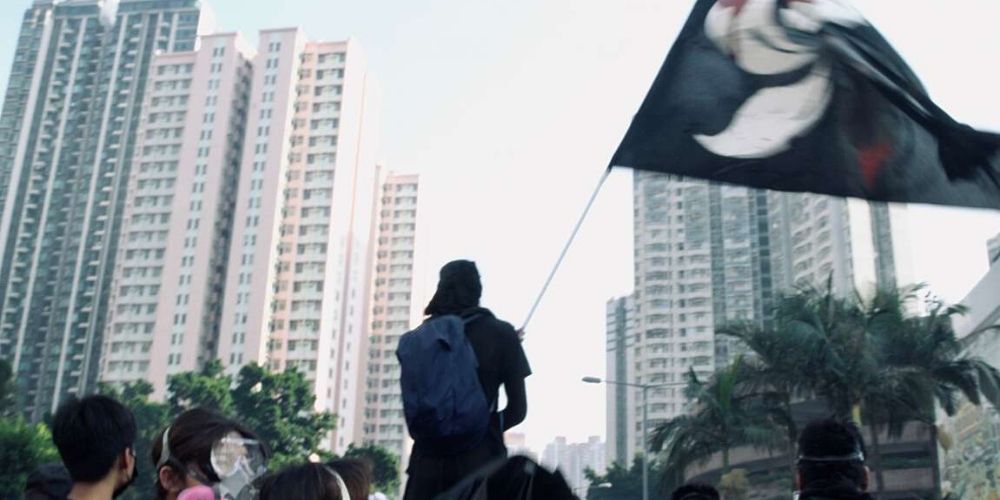
The notion of living «a borrowed time in a borrowed place» comes up in Chinese director Zhou Bing’s documentary Hong Kong Moments. It’s an interesting turn of phrase, given the cultural discontinuity, the push and pull of belief systems, that underpins the social unrest in contemporary Hong Kong the film explores. In terms of identity, what does it mean to be a Hong Konger, born under the #colonial rule# of Britain and its instilled individualism, and now in the sphere of rising #Chinese influence after 1997’s mandated handover?
The film does well in capturing the complexity of allegiances and tensions in a polarised #Hong Kong#, as it charts flashpoints of conflict during the 2019 pro-democracy protests. Thousands took to the streets to oppose the perceived threat of their huge, authoritarian neighbour to rights (including freedom of assembly and freedom of speech) guaranteed in law only until 2047. The initial catalyst was #Beijing moving to allow extradition to mainland #China — plans critics feared could undermine judicial independence and be used to target activists and journalists. Hostility had already been growing against China, as mainlanders poured into Hong Kong following the handover. «Five demands, not one less!» was the protesters’ motto, and after the demand to withdraw the extradition bill was met the demonstrations continued around issues such as police brutality and the demand for an inquiry.
Politics and imperialism
The film strives to be even-handed. It carefully balances its protagonists between pro-democracy and pro-Beijing viewpoints and affords dignity to both, as protests are followed in September and on October 1, the 70th anniversary of the People’s Republic of China. #Violence is not dismissed out of hand as a method of control or resistance. Of course, there is an argument to be made that not all positions are in fact equal, but this is filmmaking of the common humanity school, which implies good faith endeavours to understand the other are the most fruitful path out of hostile polarity.
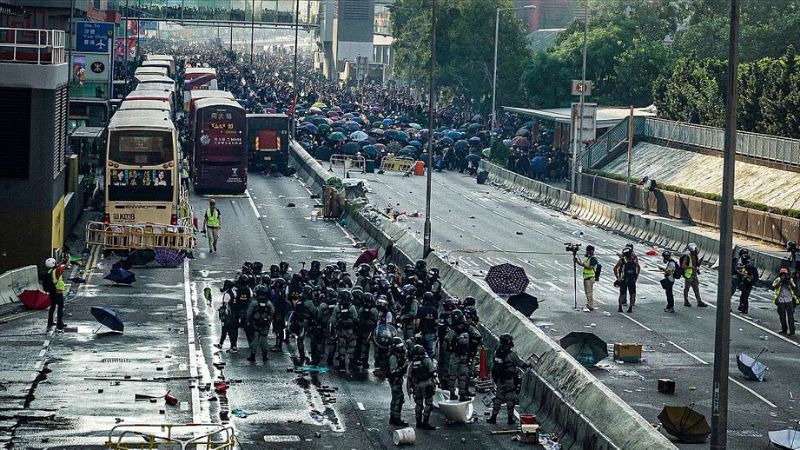
A volunteer first-aider points out how young many of the protesters are, as well as the unrest’s generational nature. Unlike his schooldays, teens now spend their holidays fighting for #social justice#, and he feels a duty to assist them, he says. It’s a gap we feel keenly in comments from a cab driver, who expresses support for peaceful protest as inherent to democracy, but says his 15-year-old son’s vocal opposition to the police has led to arguments between them. We see clashes between police and activists escalate violently through the course of the demonstrations, as police start to fire live rounds. Unusual deaths in custody among the arrested, deemed suicides, have also been questioned by the protest movement. A member of a police unit, for his part, comments on the uncomfortable nature of his role; that not all officers called in to do their job are against the protesters in their personal views, but that he does not believe putting himself in their shoes would be met with any reciprocal show of empathy. By keeping the focus of the population’s attention on hostilities between protesters and police, some believe the government can distract from demands at the political level.
In terms of identity, what does it mean to be a Hong Konger…?
An activist, kitted out in a face mask, explains that while he is of Chinese ethnicity, he cannot be made to artificially identify with the Chinese nationality, against who he is, and all that is intrinsic to the Hong Kong way of life. A tea shop owner discusses the threats and harassment she has received for vocally backing the police. The stakes are high, in other words, for any committed stance of allegiance in such an emotionally volatile environment, in which the very essence of a person’s mode of being faces an uncertain future on the table of politics and #imperialism.
Be water
We also meet two political candidates. Benny Yeung Tsz-hei is the incumbent, pro-Beijing district councilor, who has been in office for 12 years. Jocelyn Chau Hui-yan is the 23-year-old pro-democracy candidate running against him. They both take to the streets, appealing to constituents as poll day approaches. Amid a record voter turnout and mistrust at counting stations over potential state election rigging, the pro-democracy movement emerges victorious, able to win 17 of the 18 councils and strengthen their position within a system they had been fighting to pressure from outside.
«Be water,» the mantra of philosophy made famous by Hong Kong cinema martial arts star #Bruce Lee#, was adopted as a guiding principle of method by the pro-democracy protesters. Everyone was to fight in their own way in a leaderless movement; to disperse and regroup, to be anonymous, flexible, and spontaneous. This ability to take form, shift, adapt, and reform again like the water’s flow might just be the only way to survive and avoid the yoke of others’ oppressive definitions in territory claimed and passed between hulking world powers, yet with its own people resilient, inventive, and ever hopeful.