In March 2022, Russian state television’s First Channel witnessed two high-profile staff departures. Producer Marina Ovsyannikova’s was sudden and very public – on 14 March, she strode onto a live news broadcast and unfurled a homemade banner declaring «No War.» Startled technicians left the show on air for several long seconds, ensuring that millions across Russia saw her anti-Putin protest.
The story went global, Ovsyannikova was arrested, placed under house arrest and eventually sentenced in absentia to more than eight years in prison for «discrediting the Russian army». By that time, she had fled to Paris with the help of Reporters Without Borders.
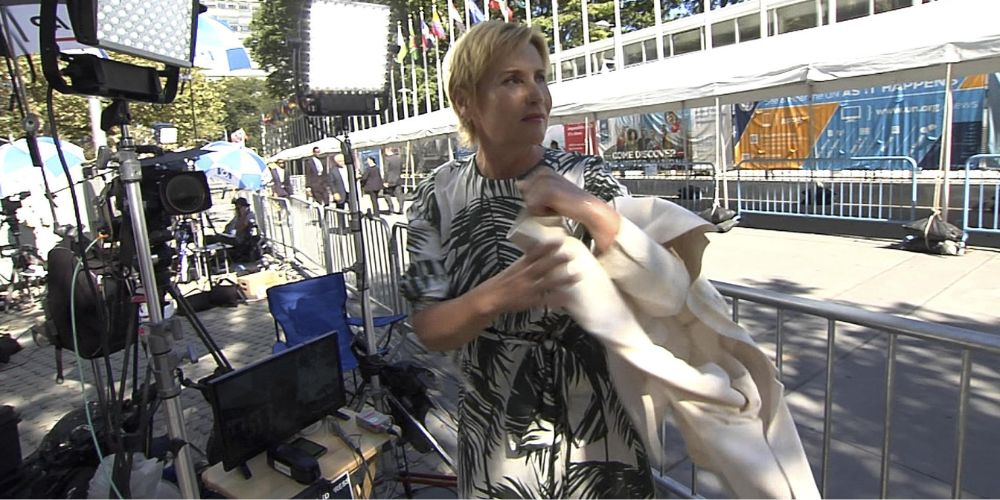
On 17 March, Zhanna Agalakova quit the First Channel – two weeks after submitting her resignation (coincidentally, the same day Ovsyannikov formally resigned). Although it was a quieter departure, she too ensured, with the help of Reporters Without Borders in Paris – that reason for her decision – Putin’s decision to launch an invasion of #Ukraine – was made public.
Zhanna was already in Paris – she’d been based there as a foreign correspondent since 2019, after a few years as a special correspondent in New York, and again in Paris before that. She was beyond the reach of Putin’s police, but not the online vitriol of fellow Russians who dubbed her a traitor, and worse.
Ovsyannikova’s decision to make a very public protest came quickly. I know her and have some insight into her thinking. Zhanna’s decision came less in the heat of the moment, but more through a gradual journey of self-examination.
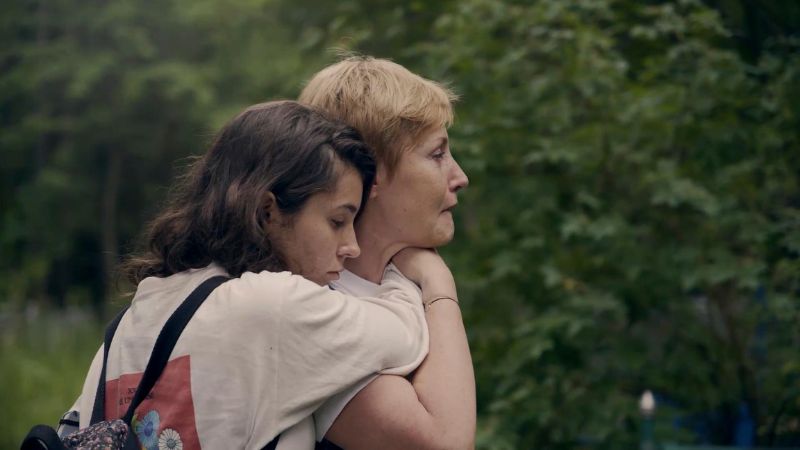
Her film, A Little Gray Wolf Will Come, is based upon years of footage she had already shot, as she explored her identity as an ex-patriot working in the US, and bringing up a teenaged daughter with dual Russian-Italian nationality. Zhanna’s husband, Giorgio Savona, is working with her and their daughter, Alice, to record their annual family trips to Russia. Worried that Alice was growing up more ‘Italian’ or ‘international’ and knew little of her Russian roots, Zhanna constantly pushed her daughter to speak Russian, participate in Russian cultural events, and ‘feel’ Russian.
For this writer, who is also the parent of a dual Russian-British national, there was a resonance to her anxiety. Balancing the two cultural traditions is not easy, but in my case, it is clear that my child has navigated the difficult issues of a dual cultural identity, and particularly those of the past four years, well. Frequent and early exposure to life in Russia also plays a part.
Zhanna’s daughter barely knows Russia, feels no sense of pride or joy when she is issued her first Russian passport, and although fluent in Russian, speaks it grudgingly at her mother’s behest.
Zhanna’s decision came less in the heat of the moment, but more through a gradual journey of self-examination.
Toska naroda
There are deep family and cultural issues at stake for Zhanna, who lost her mother as a teenager and has spent much of her adult life outside of Russia. A visit to family in Kirov, nearly 1,000km east of #Moscow by road, does little to endear Alice to Russia, or bring some sense of closure to Zhanna’s тоска народа – toska naroda, a deep, melancholic yearning for one’s people, or roots that is actually all-but impossible to accurately translate. (See Vladimir Nabokov’s attempts to explain it.)
Zhanna searches for the grave of her mother – who died in tragic circumstances the family prefer to keep a secret – and fails. She is utterly distraught.
As we approach Putin’s invasion of Ukraine in February 2022, the internal pressure between Zhanna’s disciplined obedience to First Channel ethics – reporting on American and, later, French issues increasingly had to be critical, she struggles with accusations from her daughter that she is a ‘propagandist.’ She acknowledges that she enjoys the freedom the West offers, and understands that she is making compromises, but worries about losing her job.
The breaking point comes – as for so many Russians (and Moscow-based foreigners) on 24 February 2022, when Putin announces his so-called ‘Special Military Operation.’ I had been based in Moscow for years, but left a few days later. Most of my colleagues were gone within a week. A few stayed longer. One spent 18 months in a Russian prison, convicted of espionage. Others eventually left after heavy hints from the FSB, the successor body to the #KGB. Russian friends in professional or creative professions left in droves. Zhanna is careful to point out that her last broadcast came several days before the war started. She tendered her resignation in early March.
Vrag naroda
Earlier this year, she was declared «a foreign agent» by the #Kremlin, a designation not a world away from the Stalin-era phrase враг народа – vrag naroda, enemy of the people.
Her film may not be well received by some critics of Russia; I doubt it will find a welcome in Ukraine. But that does nothing to devalue what it means to be human in a time of an illegitimate war waged by your government.
Nearly four years later, Zhanna has only one regret about her decision.
«I really regret the circumstances in which everything changed,» she told Modern Times Review.
«Basically, I remain the same – to open up and live my true life, to not have this gap between what’s inside and what’s outside. I never wanted that it would take a war to change my life.»
Since she quit Channel One – and returned a top state honour Putin had awarded her some years earlier – she has been working on the film and recently returned to journalism as a presenter on the independent Russian YouTube channel, The Breakfast Show. And she is now preparing a new documentary – an Italian story of a woman of 80 who rebels against societal constraints.