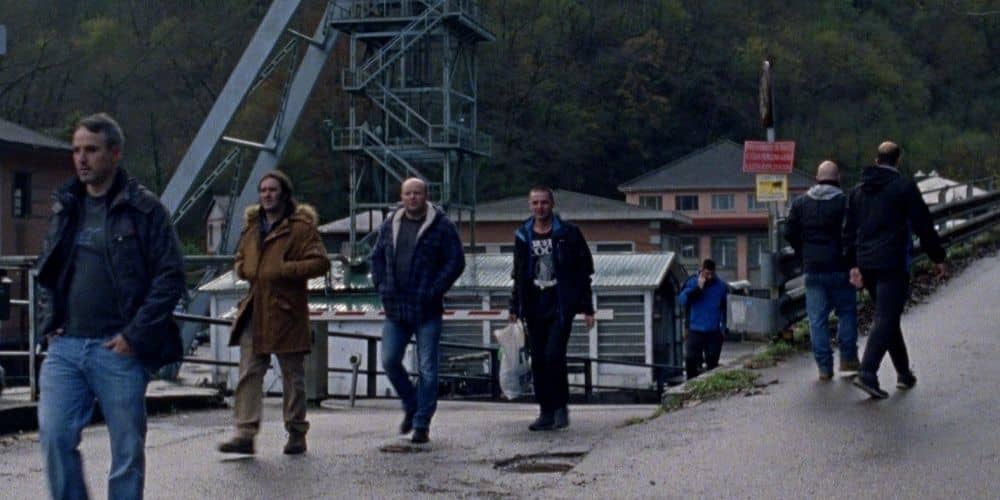
«Down with dictatorships, long live the strike,» is a slogan of resistance that once resounded through the #anti-fascist underground in Asturias in the north-west of Spain, a rugged territory with large coal deposits. The people there have been heavily shaped by the mining industry and the exploitation of their labour in a harsh subterranean environment by the machinery of #capitalism, a dynamic set out in Work, or to Whom Does the World Belong, which screened at Porto/Post/Doc and #Doclisboa and was made by a local of the region, Elisa Cepedal.
Vanguard of revolt
Workers in Asturias have in the last century been at the vanguard of revolt for better working conditions (in 1919, pressure by strikers led to it having, at seven hours underground, the shortest working day in Europe — gains countered by a 1934 government anti-strike law, and the confiscation of socialist newspapers). A male, British narrator takes us through a chronology of its mining industry and the surrounding political tensions, and offers ideological musings on the power clashes from a leftist perspective — an approach that feels somewhat distant and academic, but manages to capture the global significance of on-the-ground action of solidarity in this remarkably politicised labour force.
Workers in Asturias have in the last century been at the vanguard of revolt for better working conditions
Also spliced into the film is a substantial excerpt from the 1932 German film Kuhle Wampe or Who Owns the World?, directed by Slatan Dudow and written by famed #Marxist thinker and playwright #Bertolt Brecht#, set in a ‘30s Weimar-era Berlin of spiraling unemployment, in which a debate on a crowded train turns on scarcity economics, the price of coffee in #Brazil and the global financial crisis. Only those who don’t like the world, rather than the wealthy who are fine with the status quo, can change it, observes a worker. A scene, then, that interspliced into the history of Asturias reveals it as part of a much wider ongoing struggle of workers to take over or at least have a stake in, the means of production. It’s a fight that could only grow bloody in an era in which militant #fascism was ascendant in Europe. In 1934 in Asturias miners carried out an armed insurrection and proclaimed a revolutionary state — a move that was brutally repressed by means of rapes, tortures, castrations, and executions. The 1937 occupation of Asturias by fascist forces as dictator Franco came to power saw amid thousands of killings and incarcerations advances to worker conditions quashed, and the working day extended by two hours without extra pay. Calls of solidarity with the Spanish resistance came in the decades after and from across the world, from Mexico to Paris, Buenos Aires, Germany and beyond. As for Brecht, his film was banned, and the #Nazi period forced him into exile under fear of persecution — another signal that awareness of the machinery of capitalism and a belief in equality was a dangerous and contagious intellectual currency.

The more they stay the same
Observational footage from current times of daily life in Asturias, in the town of Barredos, shows an aging population grocery-shopping, playing bingo, and dancing in the evenings — a sleepier vision of a de-industrialised locale half-forgotten by those shouting for progress, in which collective resolve and agitation has given way to more individualised, private rhythms and concerns. Coal mining, now condemned as a major pollutant, is ending and protests in the mining valleys now call for re-industrialisation to bring back jobs. «Trade unions sold out,» reads graffiti on a wall. Worker takeovers, road blockages, and fights with law enforcement are tactics of the day, with a toughness to action that has its legacy in radical tradition but today finds a far less clear-cut opponent in the environmental crisis and a stark change to the energy sector that has seen workers shrink from 52,000 in the ‘50s to just less than 1,000 in number. A worker assembly to debate the issues gathers, and we are privy to the frustrations, the economic hardships, and the dogged determination to fight back, even if it just amounts to avoiding passive complicity in the chipping-away of rights and livelihood. «We understand that they’re getting rid of jobs that pollute, but first they should create ones that don’t pollute,» points out one attendee. The more things change, then, the more they stay the same: coal may need to go, for the good of the planet, but the wealthy will ensure they’re impacted the least. The workers are left, decades on, to fight for their own survival and dignity — for a fragment of ownership over their own fates.