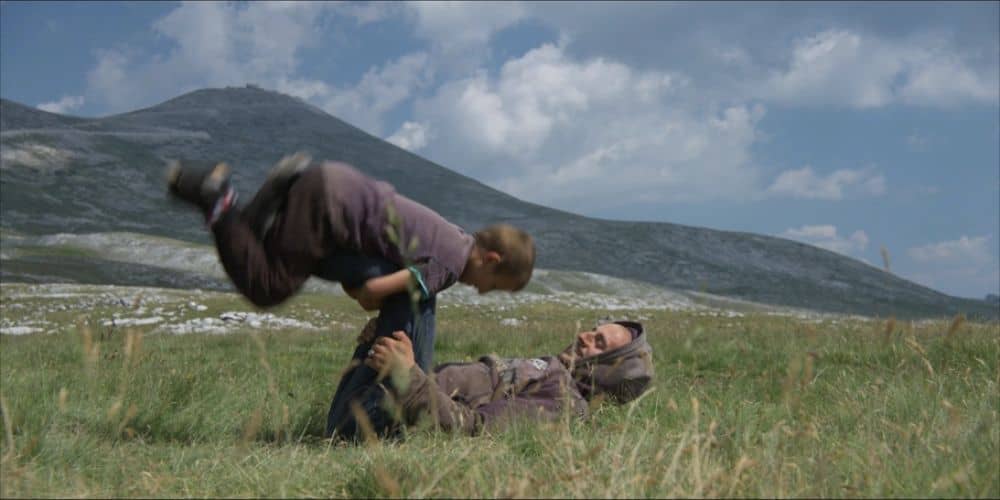
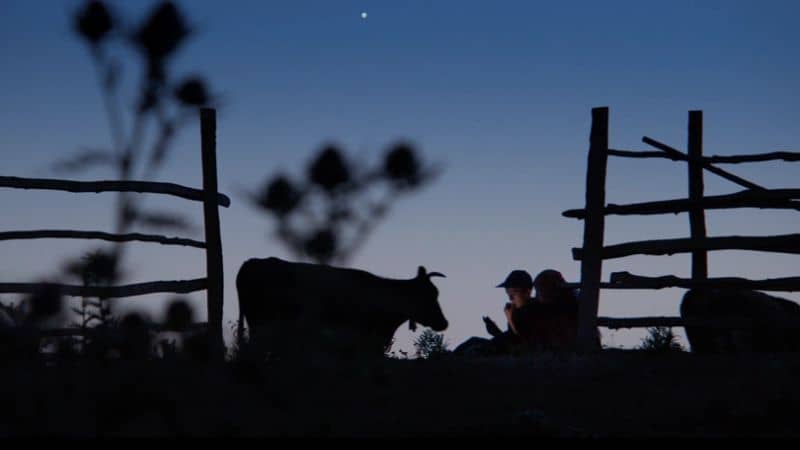
The observational documentary The Mountain Won’t Move (2025), directed by Petra Seliškar, takes us on a meditative journey to rural North Macedonia, a country eighty percent covered by hills and mountains. There, three teenage brothers, Zekir, Zarif, and Zani, along with their twenty shepherd dogs—devoted, uncompensated laborers—look after hundreds of sheep and cows. Their younger siblings are present from time to time, but otherwise, the young men are surrounded by animals and nature. The slow rhythm of the film and the dreamlike light conditions invite the viewer to immerse themselves in picturesque, idyllic landscapes and thereby escape the hectic lifestyle so many of us are trapped in.
Traditional versus modern animal-keeping
Zekir, Zarif, and Zani still practice traditional animal care; however, this does not come without struggles. Despite the fact that the viewers see the city only from afar, the presence of modern life is felt in many details. The constant use of smartphones is the most direct reminder of our century. Also, the brothers’ playful conversations remind us of life out there—their longing for intimate relationships is played out in jokes. A young man talks about his wish to find a girlfriend; however, girls typically want a man with a car, while he has only a donkey to offer, which doesn’t use much petrol. An attitude resonating perfectly with today’s environmental activists’ ideals!
A conflict arises when one of the brothers, Zarif, starts to crave another life. And he is not the only one. Finding shepherds is becoming increasingly problematic in North Macedonia. Working for months together with animals has some romance; however, many young people long for something else. Therefore, local sheep owners often hire more workers from the neighboring country of Albania.
An older brother, Zekir, is worried about whether he can keep going without his brother. He informs the viewers about other animal keepers in the area who have already sold their sheep. The question is: sold to whom? Even though it is not mentioned in the film, one thinks of other farming practices known from animal activist films and videos about the miserable, prison-like conditions in which many domesticated animals are kept and exploited, as revealed in activist documentaries that often practice guerrilla-style filmmaking—shooting without permission and using hidden cameras—like Hogwood: A Modern Horror Story (dir. Tony Wardle, 2020), which reveals the shockingly terrifying conditions in British pig farms, and Dominion (dir. Chris Delforce, 2018), which exposes animal abuse in Australian slaughterhouses and farms.
Despite the fact that the viewers see the city only from afar, the presence of modern life is felt in many details.
The Question of generations
The conflict between traditional and modern farming is reminiscent of another North Macedonian movie, the Oscar-winning Honeyland (2019), directed by Tamara Kotevska and Ljubomir Stefanov. The film portrays Hatidže Muratova, one of the last wild beekeepers in Europe, who is challenged by her new neighbours. In the beginning, Hatidže has a good relationship with the neighbours and even helps them start keeping wild bees. As the film progresses, the neighbours, hoping for more profit, begin to break Hatidže’s rules, taking more honey from the bees than is recommended. This decision has devastating consequences that endanger Hatidže’s bees and her very existence.
The distinguishing factor between the two films is that, in contrast to Honeyland‘s protagonist, an older woman, the protagonists in Seliškar’s documentary belong to the new generation and, therefore, symbolize hope for the future. Zekir, a young man, shows the passion to persist in his profession, remaining steadfast just like a mountain.
In Macedonia and other #Balkan countries, many young people are not only leaving rural areas but also searching for better opportunities abroad due to limited career options and low wages. The farming community is ageing, and younger people are less keen to work in the agricultural sector.
Time and interconnection
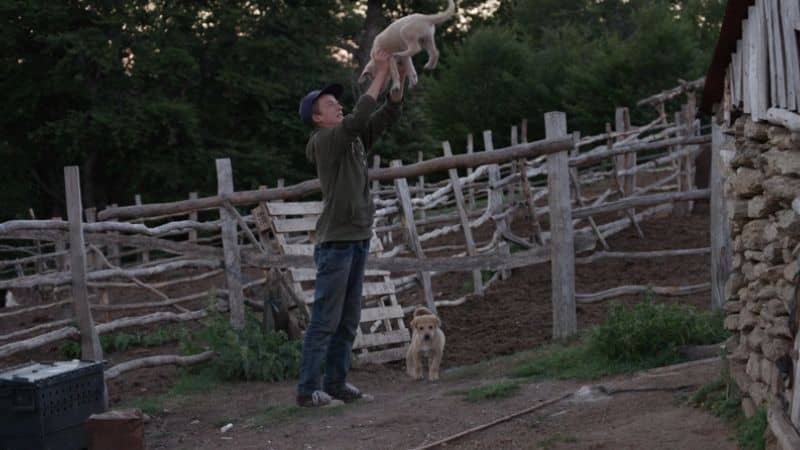
Despite the fact that the documentary is made from an anthropocentric point of view—humans are leading the way in the Macedonian mountains—their intervention is peaceful. One can feel the interconnection of everything—humans, dogs, cows, sheep, and plants—existing in harmony with one another. It’s possible also to argue that Macedonian farmers lack the latest technologies and are, therefore, less productive and competitive in the global market. However, they also have something we have lost in the West: harmony and time.
The film’s slow rhythm and minimalistic narrative are justified by the immersive experience. The spectator is not following an exciting classical narrative; instead, they are invited to experience life in the mountains similarly to the protagonists—sensing the gradual passing of time, the serenity of nature and its sounds, and the atmosphere of calm—a glimpse of a vanishing world.