Growing up fragmented
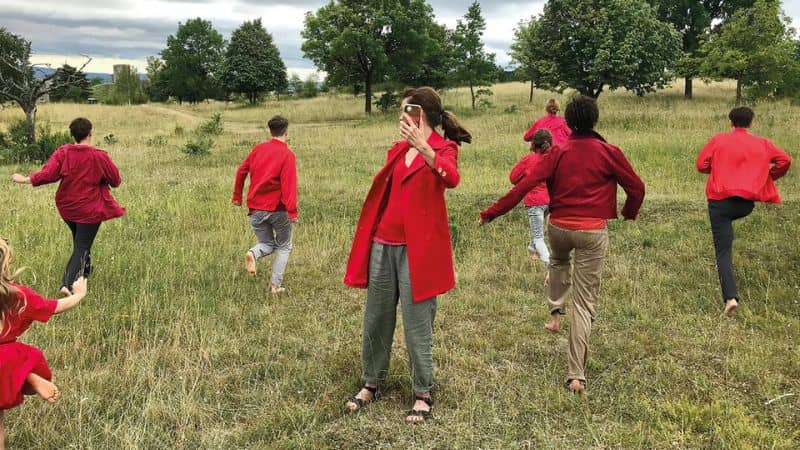
Eighteen red scarves waving in the open space, eighteen quick moves, eighteen flats. Miriam Bajtala’s autofictional project Becoming Outline maps the difficulty of growing up in conditions that force constant migration. Spanning drone footage of a sunny open landscape and an empty city apartment, the documentary reconstructs the fragmented childhood of a Slovak-born artist, now living in #Vienna, accompanied by #poverty, physical violence, and the need to deal with authorities and fixed #gender roles#. What does it mean to come from an economically weak family? How do patriarchal structures translate into living conditions? Is it possible to break out of the cycle of poverty, and can performative processing help?
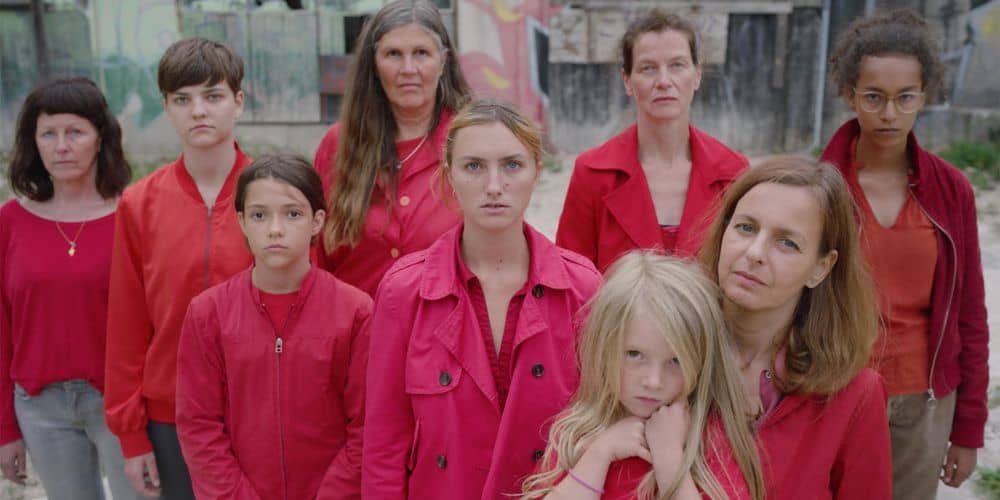
Classical anthropology says that the home and the field we research are two different spaces. As soon as we start to explore ourselves, the boundaries between them disappear—says Miriam Bajtala in the film’s introduction. Here start the memories. A six-year-old girl sits in a small sunny apartment; her parents lie nearby, all dressed in similar colours. First move. «Each room belongs to me and someone else,» says a voice in the background as the family crosses the shawls with backpacks, bags, and toys on their way to the Austrian border with no money or knowledge of the language. They pull alcohol out of giant bags to bribe the officer with. A little later, the line between outside and inside ceases to be visible. People become furniture: «You’ll be the table, and I’ll put you next to it as a lamp.» They stick to each other; their bodies come closer and closer until they finally become one huge mass. The red, blue, and yellow colours of their shirts, dresses, and trousers unite them; their bodies are illuminated by the sun. Some are asleep or making sounds we cannot recognise. Others are cheerful. Home, field, and body are involuntarily shared.
How to become different
Thanks to the fusion of author, narrator, and protagonist, we can speak of the documentary as autofictional. Although there is no consensus on whether autofiction, so popular in recent years, is a genre or not, we can observe common tendencies in works in which roles are merged. Books by #Edouard Louis# (The End of Eddy, Change) and Nobel Prize winner #Annie Ernaux# (The Years, A Girl’s Story), for example, have lately become the subject of critical and popular debate. From the field of documentary, Christine Angot’s A Family resonated. ‘I am in a position where I don’t want to be; my identity depends on things I can’t control. What my body looks like, what colour my skin is, what social background I come from, what happened to me as a child’—these are typical autofictional motifs. These realisations are often accompanied by an attempt to break out of one’s involuntary identity.
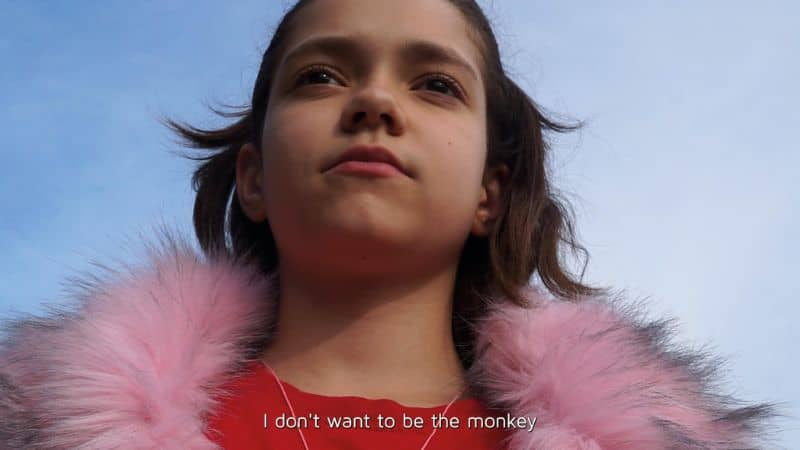
Bajtala’s documentary is autofictional, specifically using specific visual and sound elements. The characters are often placed in the position of puppets; their ‘moving’ occurs through commands by which differently aged versions of Bajtala refer to each other: ‘Lie down on the floor. Now, I will stand in the light.’ The child-Bajtala’s ‘spells’ and imagery trigger the transition from one flat to another. Bajtala is also presented in the documentary in several similar versions; they are often on the stage together, speaking with each other. The choice of which part of life will be shown is also performative. We observe a chronological sequence of events from her childhood, moving to different countries, to studying art history at the University of Vienna. At this point, however, the film ends. Bajtala finally finds a stable home and describes her further life journey ‘only’ through art. She has remained living in the same apartment for 22 years.
Home, field, and body are involuntarily shared.
A few words on social shame
Bajtala’s childhood is hugely marked by life in a low-income family. In her case, low income is also associated with shame. A performative element in this regard is a shot of Bajtala’s mother reading from a book in which social shame is also addressed professionally: «When people write about the working-class world, which they rarely do, it is most often that they leave it behind. They thereby continue the social illegitimacy of the people they are speaking of.»
Shame is the most persistent attribute of contemporary poverty. Its sphere is dominated by the social narrative, which has a long tradition, especially in the #Anglo-Saxon# world, that a person with low income is responsible for his or her own situation and that poverty is conditioned by laziness or inherited biological and psychological characteristics. To be poor means to be at the bottom of society in terms of income, wealth, and social prestige, as well as in terms of space for personal development and participation in social life. Bajtala’s parents are situated in the secondary labour market. The mother sells newspapers on the street or works in an optic, while the father is often unemployed. The girl Bajtala has no friends at school; even at college, she feels like a stranger: «Do they know anything more than me?» Her parents are constantly telling her she has to be obedient or submissive. There is always someone more powerful, whose actions may not make sense but is an authority figure who cannot be overturned in the eyes of the girl’s parents. The girl Bajtala rightly asks, «Why is it such a shame to be a victim?»
In the film, Bajtala’s mother experiences #domestic violence# from the father. Bajtala observes this anxiously. Her father has an alcohol problem, which, combined with a low or absent income, increases the likelihood of such a phenomenon. Unlike many women who remain in the family despite the persistence of physical violence due to poor economic conditions and the impossibility of monetary independence, Bajtala’s mother manages to break free from an abusive relationship. At that time, however, Bajtala and her mother are already strangers.
I am on a search
Breaking out of the family’s low-income roots is a big theme of the film. Bajtala struggles to get into university; much like the aforementioned Edouard Louis in Change, she finds refuge from the continuing cycle of poverty in #academia. Breaking out is presented in the film mainly through sound. The performative repetition: «I am the one who gives myself strength. I have control over my own actions. I have control over what happens in my life.» But even this is questioned. The question then may be whether this is enough. And whether Bajtala’s story is just another case of the rejection of poverty paradoxically encouraging its continuation.
In the last shot, two versions of Bajtala look at a painting in which all previous versions of her and other characters sleep ‘glued’ together. «I am not describing someone who says, ‘this is how I am.’ I am on a search for tools for future actions,» sounds in the background as string music fades into the void. What that search will be, however, Bajtala has yet to discover.
This text was published thanks to the support of EEA and Norway grants