There are films that derive their impact and necessity not from providing new facts and information but rather from condensing them into a meta-message—an evocation of the current state of affairs. Raoul Peck’s Orwell: 2+2=5, presented in the «Cannes Premieres» section, is one such film, allowing a century to pass by to condense the facts, separated from the daily news, into clear patterns and reveal underlying strategies. #George Orwell# is honoured here as one of the most lucid visionary commentators.

Travels
George Orwell, born Eric Arthur Blair in 1903 in Motihari, Bihar, British India, was himself an uncritical member of an imperialist ruling class in his early years. However, he soon recognised the injustice of the mechanisms of oppression concealed behind rhetoric and false values. While working for the Burmese police, he began to despise colonial rule. After he left the service, he commuted between London and Paris, experiencing #poverty and the effects of unemployment firsthand. He eked out a living as a dishwasher, journalist, social reporter, and bookstore clerk, suffering from pneumonia and later also contracting tuberculosis, from which he succumbed in 1950.
Engaged in the Spanish Civil War, he observed the takeover of existing socialist communes and the destruction of their political ideals by #Stalinism. Repeatedly active as a correspondent during World War II, he retreated to the Hebridean island of Jura off the west coast of Scotland at the end of the war. In Barnhill, an abandoned, poorly heated farmhouse without electricity or a telephone, surrounded by heath, peat, and moors, he worked, already severely weakened, on completing his work 1984, a roman à clef analysing totalitarian tendencies that have only gained in relevance since then. #Surveillance technology, pressure to conform, the questioning that analyses, even the very claim to physical torture, and a radically accelerated destruction of all individualism and every claim to private happiness are his guiding themes.
There are films that derive their impact and necessity not from providing new facts and information but rather from condensing them into a meta-message—an evocation of the current state of affairs.
«Ministry of Truth»
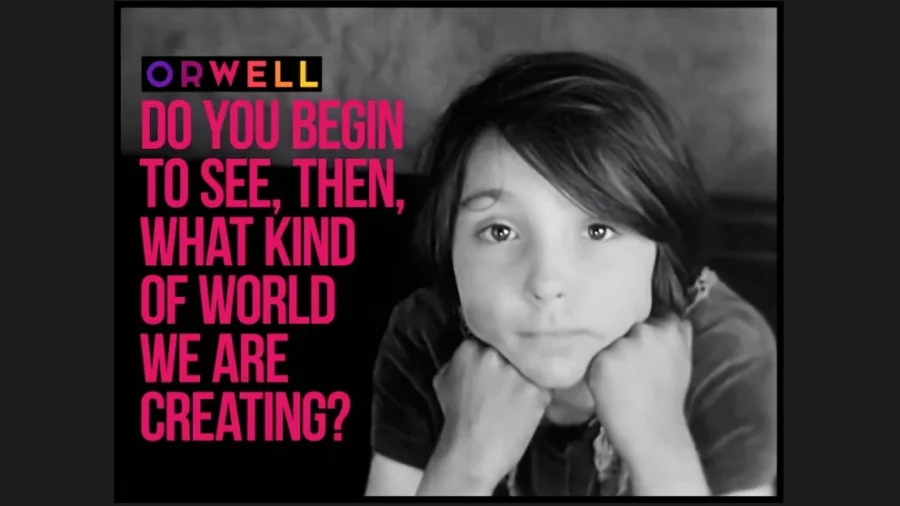
Raoul Peck brilliantly connects phases of Orwell’s life, especially his late letters, with the completion of his book. As a third layer, excerpts from the film adaptation of his work are inserted into this breathless potpourri of a world which is consolidating and destructive, ultimately aiming for total accumulation of power. Film clips, especially from Michael Anderson’s 1984 (1956) and Michael Radford’s 1984 (produced in 1984), are expanded by segments from David Lean’s Oliver Twist (1948) and Sydney Pollack’s Out of Africa (1985), to name just a few.
Peck also utilises archival footage and TV news reports as additional image sources, showing political leaders from recent decades declaring slogans from Orwell’s work as their own truths – certainly without any sense of historical context or reference. Here, too, #Trump can claim a dominant position.
The «Ministry of Truth» in Orwell’s novel represents the perfected cooperation between #media and #government: history is rewritten, and at the same time, current events are transformed in real-time through euphemisms and prefabricated rhetoric, allowing facts to be manipulated as desired. Peck cites rhetorical patterns such as «collateral damage,» «illegals,» «campaign finance,» «recession,» «peacekeeping operations,» and — particularly actual — «antisemitism.»
Peck offers no analyses of historical contexts, although interpretive statements such as those of sociologist #Pierre Bourdieu#, #Edward Snowden#, or writer #Milan Kundera# briefly flicker in. One may struggle with some of the suggested parallels due to the close juxtaposition in Peck’s film, but the global patterns of #fascism and the increasingly perfected totalitarian structures are brought to light in the rapid rhythm of the segments.
Act of resistance
The political filmmaking of former Haitian Minister of Culture Raoul Peck (*1953, Port-au-Prince, Haiti) has already garnered international attention in his 1992 documentary, Lumumba: Death of a Prophet. Works on the #genocide in #Rwanda followed the assassination of the Congolese freedom fighter (When the Killing Began, 1994) and #racism in the USA (I Am Not a Negro, 2017), to name just a few.
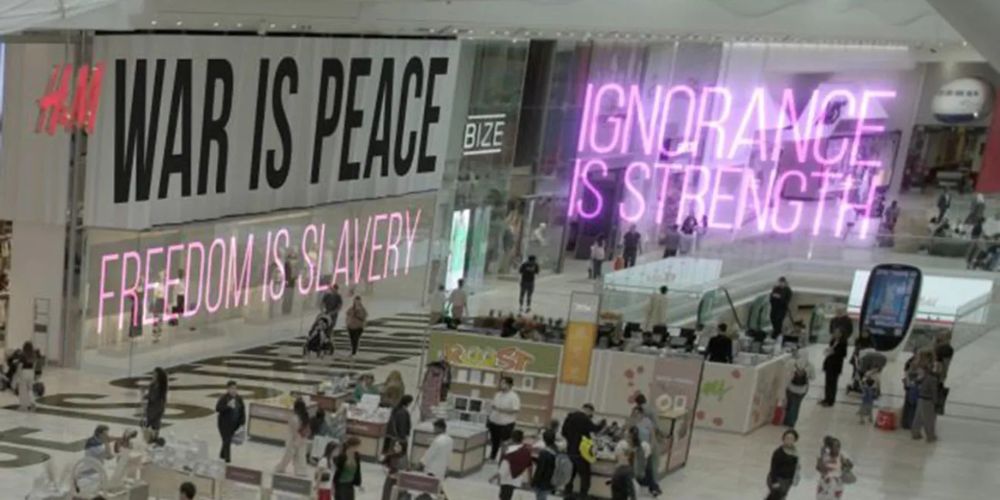
Orwell: 2+2=5 is a political reference work that belongs in every political science class. Orwell’s term «thought crime» is interpreted as the key to stabilising totalitarian regimes. Peck’s work itself is an act of resistance here. Orwell’s analysis of totalitarianism condenses into the motto: «War is peace. Freedom is slavery. Ignorance is strength.» It is applied to contemporary realities.
Peck seeks to end his film with a glimmer of hope, the belief that the common people, the silent majority, will not abandon their moral orientation and can thus become an effective resistance to totalitarianism. However, this appears to be in direct contradiction to what Peck himself has demonstrated as a perfected, supervised monoculture.