In December 2014 a grand jury decided not to indict Daniel Pantaleo, the New York police officer who earlier that same year had been involved in the violent death of #Eric Garner# on a #Staten Island# street. At that time Roee Messinger was in his second year of film school in New York. He lived in #Harlem and realized that everyone who would have testified in the trial, that never came about, was probably living close to him, and considering the case a blatant example of injustice, he decided to make it his first major film project.
This turned into a cinematic «what if» experiment of a very special kind. American Trial: The Eric Garner Story was screened in November last year, and at that time nobody could tell that his semi-experimental documentary would gain such prominence today. The film explores the killing of a black man, and the story has a chilling similarity to the recent killing of George Floyd in Minneapolis.
Minor and trivial offence
Eric Garner was a small-time crook. He had been arrested at least 30 times, and on July 17, 2014, a police cruiser was sent to take him in once more. Officer Daniel Pantaleo and a colleague got out of the car and approached him. Garner had been spotted selling loose cigarettes on the street, and when another four officers arrived at the scene they attempted to arrest the man. A bystander filmed most of it on his cellphone. It shows us when the scene gets out of hand, and Pantaleo grabs Garner around his neck leading to his death by choking.
«There never should have been an encounter in the first place. The alleged offence was so trivial and minor that at most a ticket should have been handed out,» says Harvard law professor #Alan Dershowitz# in the film.
In the end, the encounter did take place, and that is where the story continues. Dershowitz mentions the blue wall of silence that every juror in New York has met. Police officers protect each other and do not testify against one another. This is why the Garner-case was, in earnest, closed before it even began.

I can’t breathe
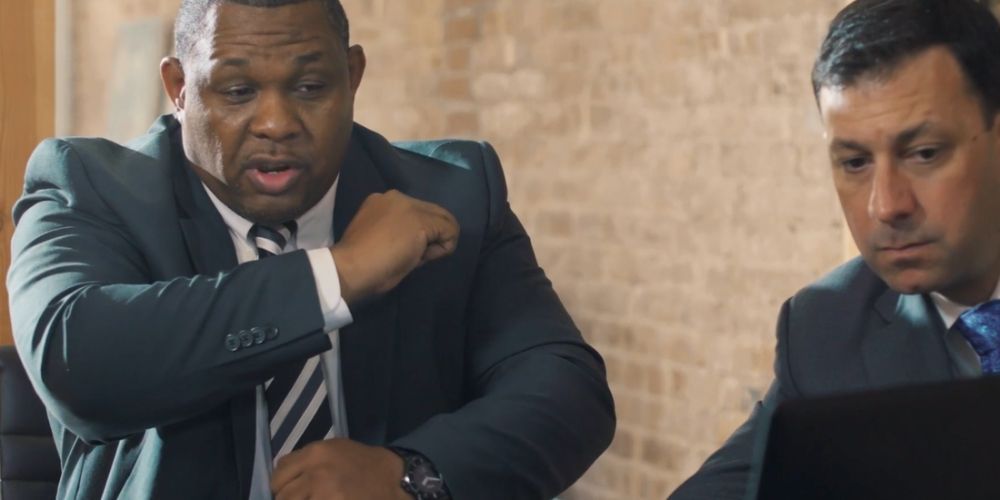
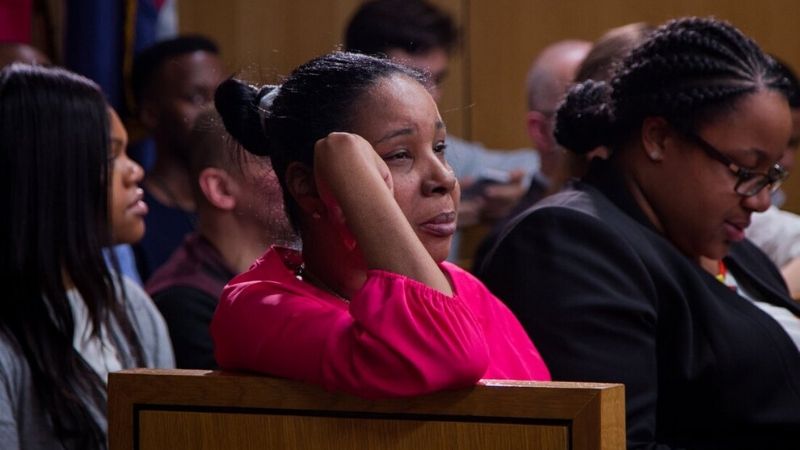
This is where Messinger takes over by describing a trial that never happened. But the legal arguments and the circumstances are very real, as is the live coverage from the scene of the crime. The judge, the prosecutors, and defense attorneys are all played by real-life lawyers that are well versed in a courtroom, and only Daniel Pantaleo is represented by an actor – Anthony Altieri giving a brilliant performance. As a strong statement, the victim’s wife, the real Esaw Garner, gives her surprisingly balanced testimony, as she would have done in a real courtroom.
The arguments hover around the question of chokehold accusations and the limits of physical methods utilized by police officers in action. In some ways, it seems absurd and academic, but that is probably the nature of the legal system. Does a man on the verge of death have enough air to say «I can’t breathe» is a question that comes up time after time. In the same breath, Messinger leaves no doubt that it is all about the institutionalized #racism in American society.
The film explores the killing of a black man, and the story has a chilling similarity to the recent killing of George Floyd in Minneapolis.
«You would never see a video like that from a white community,» says one of the commentators that Messinger has put in between the courtroom scenes.
This trial never happened, and therefore we do not see the jury reach a verdict. The film gives us all the arguments of the case, and in that way, we – the audience – is given the role of the jury. In some online screenings in recent weeks, that is exactly what happened. When the screening ended, the American viewers were asked to decide whether Pantaleo is guilty of the two charges against him – strangulation of the first degree and manslaughter of the third degree. Messinger refers to one screening where 70% found Pantaleo guilty on both counts, and 30% considered him innocent.
One would have expected the rate of conviction to be higher, given the severe circumstances of the case. The thing is, as is also pointed out in the film, that a lot of jurors are sympathetic to the police, and think to understand the pressure, each police officer has on his or her shoulders. And when the victim is a petty criminal and black, a lot of wrong conclusions are taken.
The #Black Lives Matter# movement gained additional prominence in the wake of Eric Garner’s death and has been active ever since George Zimmermann’s acquittal Trayvon Martin shooting. Today it is on everybody’s lips, after the tragic killing of #George Floyd#. That is one of the reasons why Roee Messinger’s brilliant film is so important in these days. It has an important message that underscores the necessity of action – not only against police violence but also against institutionalized racism.
Messinger leaves no doubt that it is all about the institutionalized racism in American society.
Daniel Pantaleo continued to serve in the New York Police Department. Only in 2019, it was decided to let him go, following a departmental hearing that found him guilty of applying a chokehold on Eric Garner. Pantaleo was never prosecuted.