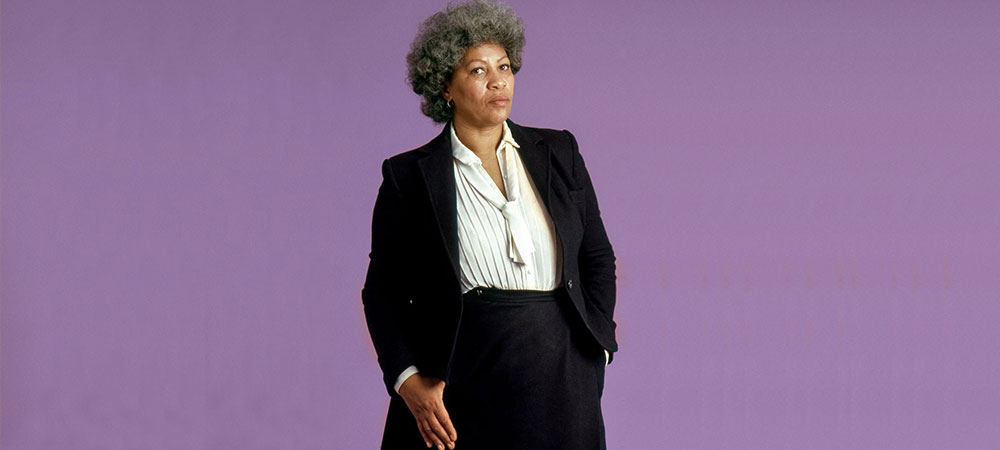
Toni Morrison: The Pieces I Am is an intimate look at the life of the titular American icon by famed photographer/documentarian – and Morrison’s friend of over three-and-a-half decades – Timothy Greenfield-Sanders. This collaborative closeness between the filmmaker and his Nobel and Pulitzer Prize-winning subject proves critical, beyond merely allowing for unguarded access. In a swift-moving two hours Greenfield-Sanders (The Black List, Lou Reed: Rock and Roll Heart) manages to painstakingly and lovingly pack every «piece» of his dear friend that the Morrison fan and uninitiated alike would ever need in order to grasp her transformative effect on literature – redefining who gets to tell whose story – around the globe.
Grandmotherly warm and intimidatingly sharp
Morrison, equal parts grandmotherly warm and intimidatingly sharp onscreen wasn’t just a writer (and editor and teacher) but a force of nature. The author of such classics as The Bluest Eye, Sula and Song of Solomon, all of which are delved into deeply, Morrison was forever questioning why the world was the way it was. When it didn’t live up to her noble standards, she took action to change it (after all, this was a woman who defiantly took up the pen as a child, once she became aware that little black girls weren’t being taken seriously).
On hand to sing this radical artist’s praises are a venerable whos-who lineup of celebrity intellectuals. In addition to Morrison – the only talking head to speak directly to Greenfield-Sanders’s camera (mimicking the style of his still portraits) – the dozen other subjects include everyone from Angela Davis to Walter Mosley to Oprah Winfrey (who, of course, turned the bestselling Beloved into a feature film).
Smartly, the film is also heavily infused with the African-American experience via the inclusion of work by black visual artists – notably Jacob Lawrence, Kara Walker, and even Mickalene Thomas (whose Morrison collage images are animated for the opening). The end result is a doc that feels like a dense journey encompassing both Morrison’s life and her place in history, unapologetically demanding her seat at the table while making room for more.
Beloved
Born in the steel town of Lorain, Ohio, Morrison went on to attend Howard University (one of America’s most celebrated Historically Black Colleges) and the prestigious Cornell before going on to publish nearly a dozen novels that gave heroic voice to the marginalized (thus, marginalizing the default straight white male gaze). What we tend to forget, however, is that Morrison began her career behind the scenes as a diligent editor at Random House (shepherding some of the greatest African-American literature of our time), and eventually an educator at Princeton. In other words, Morrison’s roles as a mentor championing other silenced voices, and a hardworking mother (teaching and editing supported her two sons) defined this grand lady of letters just as much as her Presidential Medal of Freedom-anointed identity ever did.
Morrison, equal parts grandmotherly warm and intimidatingly sharp onscreen wasn’t just a writer (and editor and teacher) but a force of nature.
Perhaps most interesting is the fact that this iconic African-American allowed herself to be profiled by Timothy Greenfield-Sanders at all. Greenfield-Sanders, of course, is a wealthy white male, his gaze the very essence of what Morrison had spent her entire life pushing back against. Fortunately, Greenfield-Sanders is also a humble filmmaker, fully aware that he himself must similarly challenge his own point of view. To that end, he makes deft visual choices – nearly all the faces seen onscreen are black and brown, the black images sprung from black artists. And just as important, he employs a film crew comprised mostly of people of color to be a part of the cinematic decision-making.
The subtitle of the doc actually refers to a line from Beloved, «She is a friend of my mind. She gather me, man. The pieces I am, she gather them and give them back to me in all the right order». Greenfield-Sanders has said that he saw this as a metaphor for Morrison’s work. Yet now with Morrison’s passing earlier this year the words suddenly take on an unintended dimension. Morrison is gone, the film seems to say, but here are the pieces of her spirit. Given to you the viewer in all the right order.