In their documentary portrait of a young Mongolian woman and her resolute struggle for a better world, Kristoffer Juel Poulsen and Christian Als uncover a fascinating and, at the same time, sinister reality of the globalised world on the verge of the #apocalypse in which turning to «blood and soil» might seem like the solution.
Who owns the Swastika?
A #nationalist movement that contests the Nazis’ ownership of the #Swastika sounds like a dark humour joke. Unfortunately, it’s not. We learn about this in the documentary shot on location in Mongolia from 2015 to 2022, following #Gerel Byamba#, a nationalist activist and single mother, and her son Temuulen in their daily struggle for survival. Byamba is an ex-member of the Mongolian underground nationalist White Swastika movement and the founder of Bright Swastika – Women’s National Movement. It is she who, at a certain point in her seven years long personal evolvement portrayed in the film, asserts that the Swastika is Mongolia’s ancestral symbol of power and does not belong to #Nazis. This, however, is just the most crystallised expression of the paradoxes of globalisation and controversies of the contemporary world that Daughter of Genghis addresses in a surprisingly lucid way.
It is she who… asserts that the Swastika is Mongolia’s ancestral symbol of power and does not belong to Nazis.
The voice of an angry woman
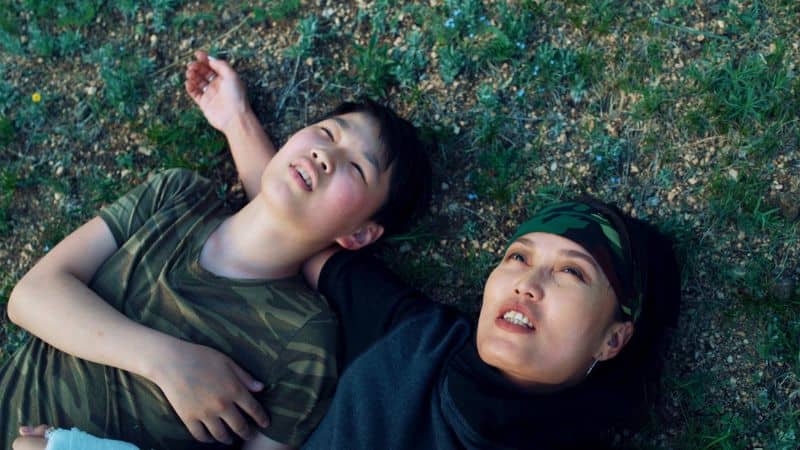
The film synopsis describes 33-year-old Byamba as «a fiery nationalist, shaman, violent gang leader, and indignant, hooded avenger» and also as «a complex woman.» During the film, it is she who voices her own narration. We get to know her more intimate portrait and learn about her story, which is not very different from that of millions of women worldwide. Her father was a guard on the Chinese border. When she was six years old, her mother died, and he practically stopped caring about her. She was left on her own. Meeting her husband gave her a temporary relief, but shortly after their son was born, the husband died in a mining accident. «I was devastated and filled with range,» she explains her motives for joining the underground ultra-nationalist movement. It gave her strength; she believed the movement was «the future.»
The heirs of the Genghis Khan
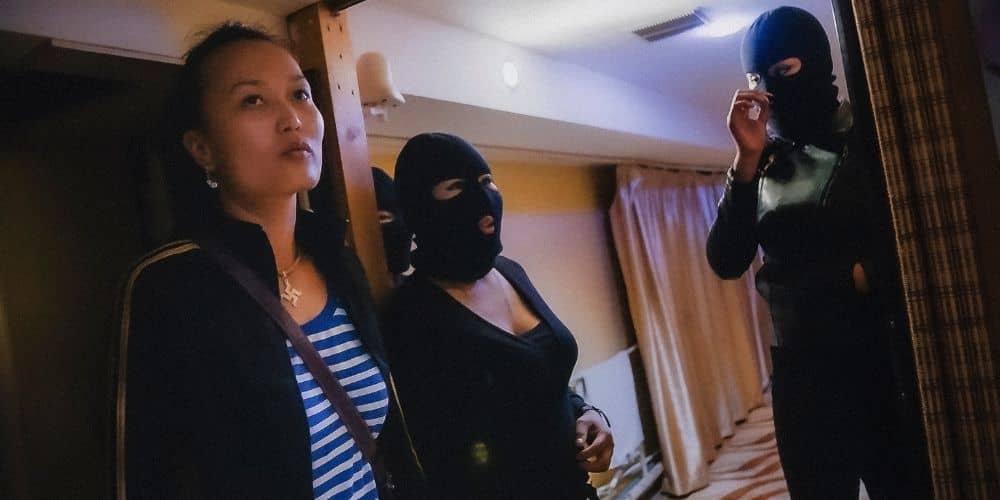
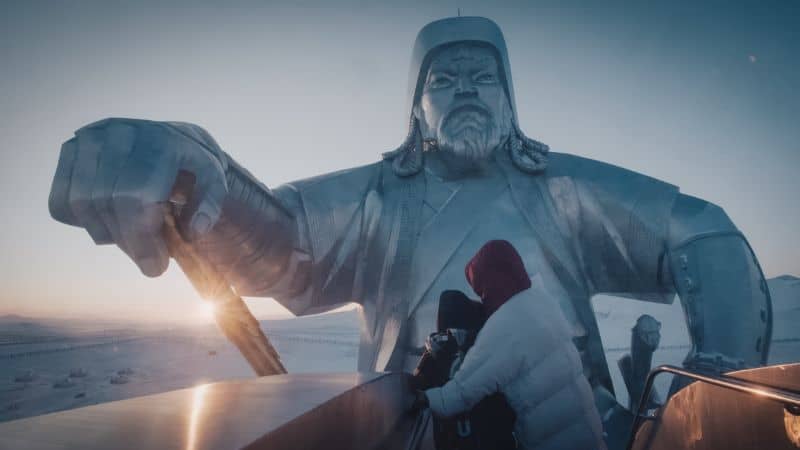
Actually, the movement was turned towards the past, the glorious memory of #Genghis Khan# and the #Mongol Empire#, which once was the largest contiguous empire in history. Today, we learn that Mongolia, «a democracy surrounded by China and Russia,» is the prey of its neighbours who exploit its natural and human resources through activities such as mining and #prostitution. Gerel Byamba is fiercely fighting prostitution through clandestine violent actions against the massage and sauna clubs. These venues serve as a mask for prostitution because it is officially prohibited in Mongolia. But she also, together with her followers, visits women in the Mongolian countryside to help them with information about state subsidies and other strategies, apart from prostitution and arranged marriages with foreigners, to escape poverty.
At a certain point, she decides to stop these activities and dedicate herself to her underaged son, who, during her actions, is often left alone. She retains her self-reflective stance. Just like she defined her personal despair as the reason for joining and later founding her own ultra-nationalist feminist gang, it is her inefficiency and disappointment with the idea of «save Mongolia» and «die for the national security and blood purity» that motivates her to look for the job and eventually start taking care of her own son.
There can be, of course, no excuse for the violence nor the «blut und boden» nationalist ideas.
Citizen Activism
The sublime narrative structure of this film does not permit seeing this as a relief. Rather, it posits it as a challenge to the whole of #humanity. Traditional criticism would see Gerel Byamba’s return to the role of mother as a sign of her alienation. But she is, in a way, also alienated in the role of activist because she is trying to give other women exactly the help she needs herself. The extremist activism of Gerel Byamba, in a twisted way, portrays both the problem and the solution: the predicament of millions of abandoned children, of single-parent women with kids, of men who are victims of work accidents. And the desperate attempts of all these wretched of the earth to do something to better their lives in a situation when the «help yourself» logic of liberal #capitalism prevails.
The documentary portrait of Gerel Byamba, the nationalist gang leader, hardcore feminist, and single mum points to the hidden side of citizen activism, which, on the one hand, originates in the student protests of 1968 and, on the other in «Do it yourself» logic that with digital technologies penetrated practically every part of human activity, from user-generated #social media# content to self-service fuel pumps at petrol stations and other similar self-service mechanisms. At first, they seem to give more power to the people, but their prime function is to reduce production costs, making consumers pay and, at the same time, provide service by themselves. Similarly, the activism of Gerel Byamba can be seen as a self-service mechanism by which women in trouble attempt to help themselves in the absence of systemic democratic mechanisms to assist those who need help. There can be, of course, no excuse for the violence nor the «blut und boden» nationalist ideas. But Daughter of Genghis will surely show that something is very wrong when people perceive blood purity as the way to a better future.