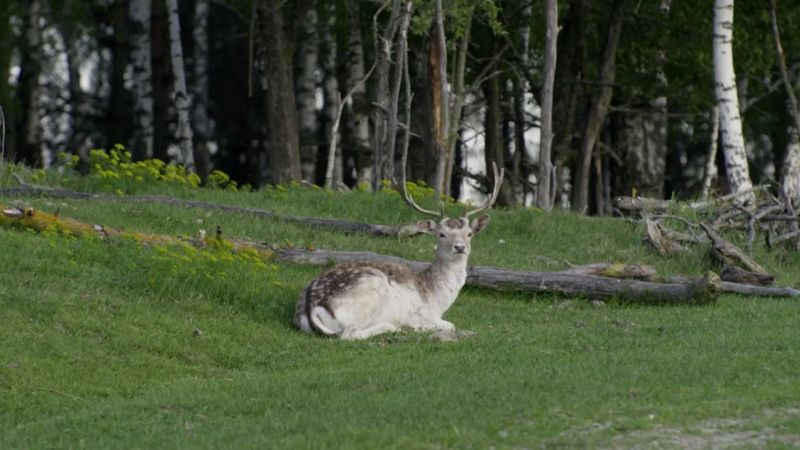
In the first few minutes, the viewer seems to be confronted with a #nature film depicting the beauty of a still intact natural world and undisturbed flora and fauna, observed from drones and land perspectives. Butterflies, swallows, deer, bears, and stags among themselves — this could be part of our reality. It has been. But reality is different. The first bomb impacts become audible, and the first arson attacks become visible.
Cinematic aesthetic
In his documentary Divia, presented in the Karlovy Vary Horizons section, Dmytro Hreshko delves ever deeper into a reality in which living beings of all kinds not only fight for their survival but have also partially lost it. With an impressive cinematic aesthetic that even serves as a contrast to the catastrophic destruction depicted, Volodymyr Usyk and Dmytro Hreshko’s camerawork presents bombed-out cities, some of which now consist only of ruins; torched tanks; remnants of war equipment; and charred and torn-open human and animal bodies. Left at the scene of their death, ass-eaters have already gathered near the carcasses. The camera glides past all of this, from a great height or in close-up, hovering and sovereign.
The vast, devastated landscapes, burnt-out forests, and amputated cities and towns create their own indigenous scenario of destruction and death. They require no interpretive rhetoric. They are self-evident. Divia has dispensed with any dialogue or commentary; intertitles or location information are missing; only sporadically, military instructions are heard from off-screen.
One of the few people who come into the picture is a scientist taking soil samples, or mine detectors and bomb disposal experts gathering their hundreds of finds to explode under controlled conditions.
Of particular importance in this silent work are the sound compositions by Sam Slater, in collaboration with sound designers Vasyl Yatsushenko and Mykhailo Zakutskyi. During the first few minutes of harmonious sounds, subtly electroacoustic sounds blend with natural sounds. But entering the death zones, which the camera now captures at ground level, a rasping metallic sound emerges, evoking associations of rust and splintered sheet metal, accompanied by sounds reminiscent of trombones and alpenhorns modelling low tones. These soundscapes, constantly maintaining a threatening tension, avoid any dominance, oscillating with silence and those captured on the location of a constantly flickering nature, strive to awaken again. Among them are insects, but equally natural, roaming cats, which—in one of the milder cinematic sequences—are being fed by a helper who has rushed to the scene. Slaters’ instrumental soundscape captures them and gives them space.
Flooded land areas and overflowing rivers sweep away everything fragmented and detached. A washed-out life continues beyond the temporary scenarios of war.
The vast, devastated landscapes, burnt-out forests, and amputated cities and towns create their own indigenous scenario of destruction and death.
No named culprits
In Divia, there are no named culprits, only victims. He erodes not the causes but the consequences of war. He gives a voice to those who have none: the plant and animal world. Divia is an anti-war film per se. It is a cautionary tale of widespread environmental destruction that will have an impact for decades. Here, a war against nature, one that will not end with a #ceasefire, is made into a haunting experience.
Celebrating life
Once again, the Ukrainian film director creates a work that celebrates life itself. In Snow Leopard of the Carpathians (2019), it was the rescue workers in the #Carpathian mountains# fighting for every life; in Mountains and Heaven in Between (2021), it was the paramedics who trekked long distances up mountains to rush to the sick during the #Covid-19 crisis; and in King Lear: How We Looked for Love During the War (2023), it is the art of theater that brings people together to resist and help one another in times of a war on Ukrainian soil that is destroying their entire past.