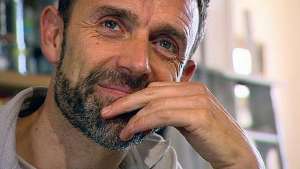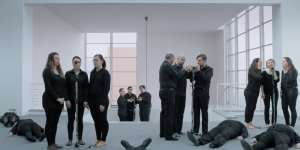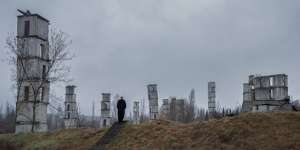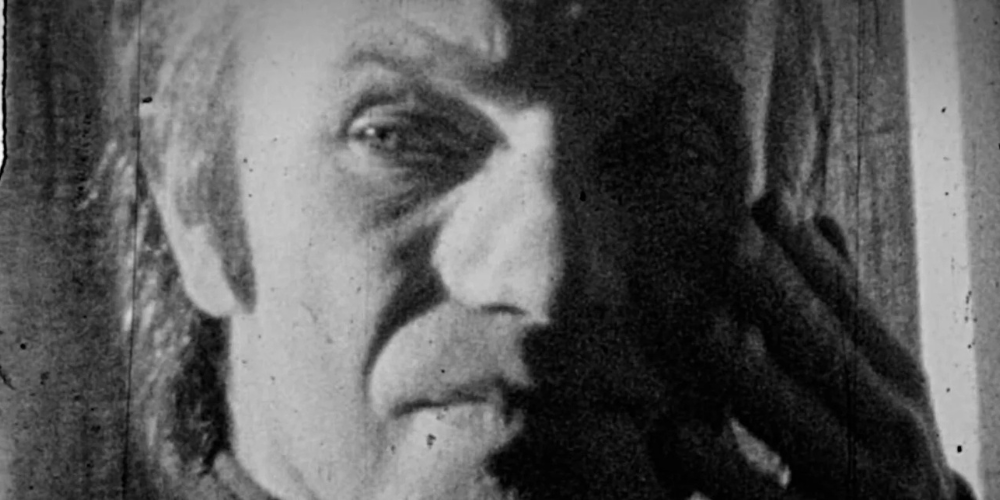
Do Painters Die Elsewhere is a work of art. It doesn’t merely portray an artist—it is artistic expression and transcends traditional biographical storytelling. What unfolds on screen is not a documentary in the usual sense but a cinematic improvisation—a free jazz of image, sound, and memory—that mirrors the life and art of Boloko (Bolesław) Gasiński.
Confession and farewell
Bolesław Gasiński, born in 1935, is not widely recognised as an essential figure in the national (Polish) or international art scene. Unlike prominent Polish artists of the postwar period—such as #Tadeusz Kantor#, #Magdalena Abakanowicz#, or #Roman Opałka—Gasiński# does not appear frequently in major art historical texts, museum collections, or significant international exhibitions.
The film does not try to correct this marginal status. Rather, it embraces it. Gasiński’s art is not presented as part of a grand art-historical canon but as a personal, emotional, and deeply human journey. The filmmakers seem less interested in elevating his artworks than in immersing us in his way of being an artist. That, ultimately, is the true subject.
The structure of the film resists chronology. It moves with feeling rather than facts, weaving fragments of Gasiński’s extraordinary personal archive—tape recordings, 8mm films, video diaries, photographs, letters—into an ever-shifting emotional collage. We hear his voice in intimate phone conversations with Eva, his great love, as she is dying in the hospital. These moments of raw vulnerability, at times tormented, at times tender, form the red thread through the film. «I will keep recording until they let you out,» he says with trembling hope. Later, the voice breaks down: «Despite your forgiveness, I can’t bear all the sins I’ve committed against you.»
This recorded letter is both a confession and a farewell. It frames the story not with biographical facts but with emotional truth. The void left by Eva’s death becomes the void that art tries—and fails—to fill.
Gasiński’s art is not presented as part of a grand art-historical canon but as a personal, emotional, and deeply human journey.
Inner fragmentation
The visual language of Do Painters Die Elsewhere mirrors this inner fragmentation. Nothing is static. The camera constantly shifts focus, panning and fading between frames as if possessed by a life of its own. Colours merge with black and white. Abstract fragments—of dogs, hands, decaying walls—appear and disappear. Images of nature, faces, and materials fade in and out like memories. The editing resembles dream logic or the rhythm of a diary, a mosaic of impressions rather than narrative coherence. The result is impressionistic, surreal, and poetic.
Music, likely composed in response to the visuals, adds another dimension. It is as improvisational and expressive as the camera—perhaps inspired by free jazz—and reinforces the film’s restless, searching quality. Like the rest of the film, it doesn’t illustrate; it resonates.
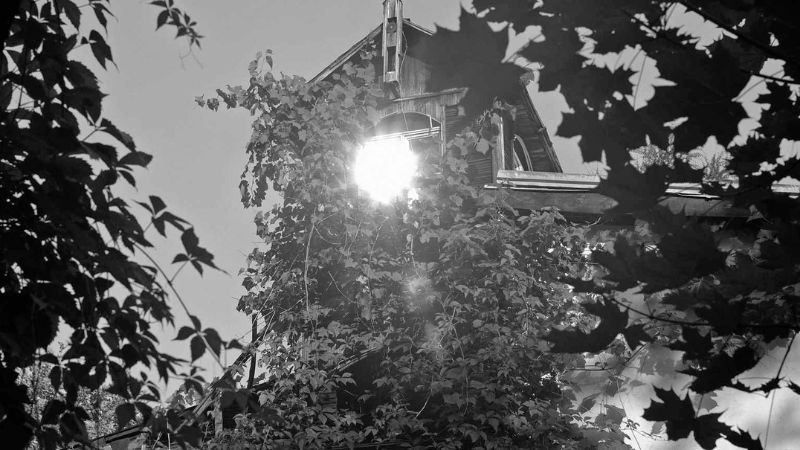
Gasiński’s art was rooted in experimentation. Most probably influenced by the #Arte Povera# movement, he worked with debris, rusted metal, rags, and construction scraps. He often lacked canvas, so he painted whatever he found, like window blinds or pieces of clothes. His home was an extension of his work—chandeliers made from leaves, sculptures embedded in walls. Nothing was too insignificant to become part of his aesthetic world. The house itself resembled an art piece, a living sculpture, chaotic and beautiful in its decay.
A former construction worker, Gasiński created art from nothing—not only out of necessity but from a deep belief in transformation. Every object held potential. Every moment offered a chance for improvisation. His chaotic home became a haven for a close-knit circle of artists—actors, musicians, dancers—who gathered there daily. Amid the grey monotony of repressive communism, Gasiński cultivated a space where creative souls could come together with a rare sense of freedom. His countryside studio evolved into an epicentre of artistic and intellectual exchange. This role, however, must have shifted dramatically after the fall of the #Berlin Wall#. As public attention gravitated back to the urban centres, Gasiński may have been left behind—isolated in the rural periphery, facing a quiet sense of abandonment.
The film returns halfway through to his childhood: the black shawl of his mother, the hunger, the loneliness. «Each painting is a new form of suffering,» he once said, «a suffering from the need to express oneself.» Despite being beloved by women and surrounded by admirers, he never married or had children. The void of his early losses shaped him and made intimacy both essential and impossible.
Meditation on the soul
One of the film’s most powerful qualities is its use of Gasiński’s archive. He meticulously documented his life—recording conversations, cataloguing events, and summarising each year. In the film, what might seem obsessive becomes a window into the soul. These fragments—especially the audio recordings with Eva—are astonishing in their intimacy. They reveal not only the artist but also the man behind the art: insecure, passionate, obsessive, funny, and essentially lonely.
No «talking heads» appear in the film, no academic analysis, no curators explaining what his art means. Instead, the film allows the archive to speak for itself. The multilayered visuals, sounds, and textures create a portrait more truthful than any biography. It’s as if we’re listening in on a private world, piecing together a puzzle of someone’s inner life.
By the end, we are left with an impression—a sense of what it means to live creatively, suffer and love, make meaning from chaos, and age into obscurity. The film ends where it began: with Gasiński’s voice, now younger, recording with excitement the opening of one of his first exhibitions. Full of anticipation, that hopeful voice echoes in our minds and stands in great contrast to the despairing voice of old age.
Do Painters Die Elsewhere may become more significant than its subject. But it is not trying to make a hero out of Gasiński. It is, instead, a meditation on the soul of an artist and on creativity itself—fierce, fragile, and fleeting.