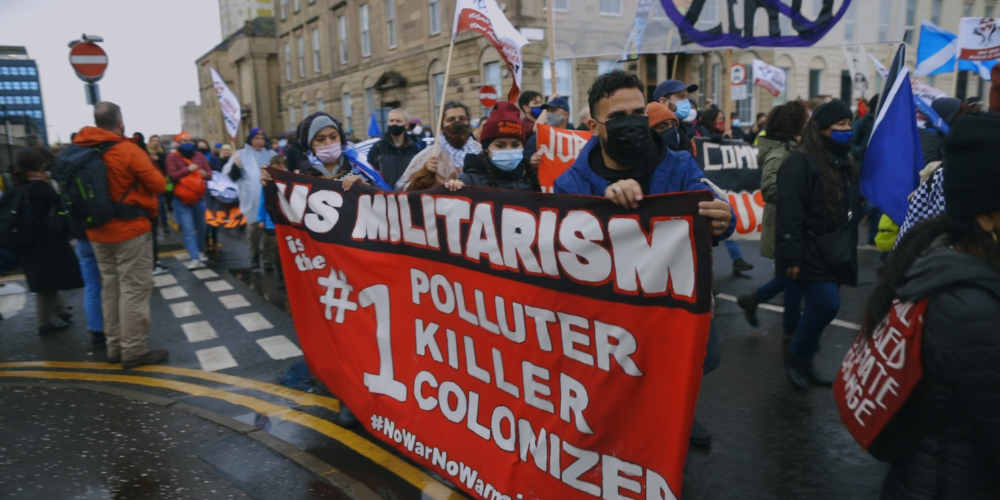
Since 2010, a group of economists and anthropologists at Brown University’s Watson Institute has kept a receipt the U.S. government declines to keep for itself. The Costs of War project puts the price of the post-9/11 wars at roughly $8 trillion through fiscal 2022, $5.8 trillion of it appropriated and $2.2 trillion owed to veterans over the coming half century. All of it was borrowed. Servicing it has already cost more than a trillion, and by 2030 the interest will match what the fighting cost.
Abby Martin has plainly read those figures, and Earth’s Greatest Enemy (Vimeo VOD) turns them into images. It also opens a second account, one nobody keeps at all, denominated in carbon.
Source: Costs of War, Brown University
News graveyards
Martin came to the subject by way of Gaza Fights For Freedom (2019), her first feature, assembled largely from footage shot by Palestinian journalists during the Great March of Return. That collaboration has since acquired a grim postscript, and Brown supplies it. In a Costs of War paper published last April, Nick Turse, whose Kill Anything That Moves: The Real American War in Vietnam remains the definitive account of how that war was fought, found that Gaza has killed more journalists since October 7, 2023 than the American Civil War, both World Wars, Korea, Vietnam together with Cambodia and Laos, the Yugoslav wars, and the post-9/11 war in Afghanistan, combined. Most of the dead are local reporters, and Turse calls the places this produces news graveyards. Martin’s first film exists because such people went on filming.
Before Gaza, she had built Empire Files into a rare American outlet treating the Pentagon as a subject rather than a source, and before that hosted Breaking the Set on RT. The method has stayed constant while the frame has widened. Gaza was one enclave under one siege. The new film points the same camera at the entire apparatus, which reads either as the logical next move or as overreach. Martin describes Gaza as connective tissue rather than as a discrete cause, so the escalation of scale is deliberate.
Earth’s Greatest Enemy, a film by Abby Martin
A world affected
Co-directed with Mike Prysner over five years, the film travels. Martin walks a defence contractor expo where the ordnance sits under gallery lighting. At Okinawa’s Oura Bay, she meets residents who have spent three decades trying to stop a runway being poured over a living reef. Then Camp Lejeune. Then Alaskan ice.
The numbers do the arguing. The U.S. military burns some 270,000 barrels of oil a day, more than any other institution on Earth, which puts its direct emissions above the national totals of roughly 150 countries. It runs close to a thousand installations abroad. Russia runs nine. China runs one. The Air Force by itself outweighs the next five air forces combined. Fold in the manufacturers, the supply chains, and the mines that feed them, and the total roughly triples. None of it appears in national climate inventories, because Kyoto exempted military emissions at Washington’s insistence and Paris made the reporting optional.
That exemption is the sharpest thing in the film. Mainstream environmentalism has organised itself around consumer virtue and corporate villainy while omitting the institution that guarantees the extraction in the first place. The oil companies do have a military.
Camp Lejeune is where the film stops counting and starts grieving. The Marine Corps pumped solvent into the base wells, tested the water, learned it was poisoned, and went on pumping for years while Marines drank it, bathed in it, cooked with it. Roughly a million people were exposed. More than a thousand pregnancies ended in stillbirth or infant death. A judge has estimated a century to process every claim. Martin walks the cemetery with a woman who points out headstones marked born and died, one every couple of years, women who spent four decades believing the failure was in their own bodies. Nothing in the emissions data does what this sequence does.
Boarding an aircraft carrier alongside the defence trade press, Martin finds reporters whose function is to admire ordnance closing ranks before the briefing starts. A documentary that catches the press corps inside its own frame is doing something more interesting than reporting.
It is spending upwards of $100 million to put the word War back on the door.
The reservation is structural. Prysner and Martin gathered several hours of material and released two, and the compression tells. Every base, as Martin has put it, carries both legacy contamination and ongoing contamination, which is a problem of scale no edit resolves. A narrower film, one base pursued all the way to the bottom, might have done more damage.
Talking to Chris Hedges after the release (The Chris Hedges Report), Martin located her hope in the incompetence of the adversary: a ruling class stupid as well as banal in its evil, too sealed inside its own self-preservation to notice it is poisoning its grandchildren. Hedges let it stand, then answered that capitalists under pressure reach for fascism, that fascists are frequently buffoons, and that buffoons kill efficiently all the same. The phrasing has a recent provenance. Two weeks earlier he had interviewed Ece Temelkuran, the Turkish novelist exiled under Erdoğan, whose How to Lose a Country anatomises that buffoonery and whose newer work scorns what she calls our mania for hope. He was turning her argument on Martin without saying so.
«Department of War»
The arithmetic since suggests he had the better of it. In April the White House asked Congress for $1.5 trillion in national security spending for fiscal 2027, the largest single-year request in American history. On July 22 the House passed its version by 216 votes to 212, authorising $1.15 trillion and formally renaming the Department of Defence the Department of War. This is an institution that has failed every audit since Congress required one in 2018, eight straight, alone among twenty-four major agencies in never having passed. It cannot say where its money goes. It is spending upwards of $100 million to put the word War back on the door.
Earth’s Greatest Enemy is a record of what that has cost so far, in dollars, in carbon, and in the small headstones at Camp Lejeune. Nothing in Washington’s behaviour this year suggests anyone intends to stop.