As KFF Industry 2026 prepares to gather filmmakers, producers and decision-makers in Kraków from 1 to 6 June, the event arrives with two decades behind it and a changing documentary ecosystem ahead. Held during the 66th Krakow Film Festival, this year’s industry programme positions itself as a meeting point for projects, funding, and festival circulation, but also a space where Polish, Ukrainian and international documentary communities negotiate what visibility, access, and long-term support mean in practice.
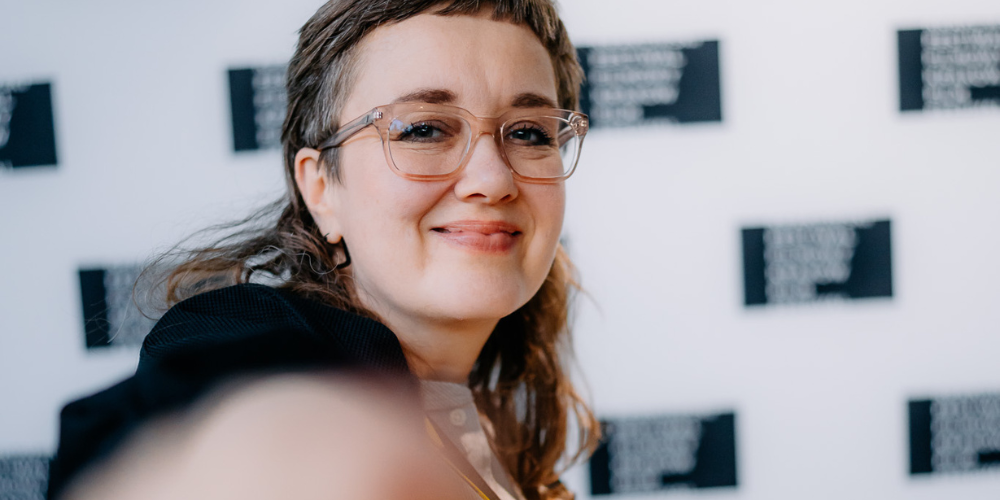
Few people sit more directly at that intersection than Katarzyna Wilk, whose work spans KFF Sales, Polish Docs, Polish Docs PRO and KFF Industry. In our conversation, she describes a year-round movement between taking Polish films outward into the international festival circuit and bringing the world’s documentary industry back to Kraków.

You work across KFF Sales, Polish Docs, Polish Docs PRO and KFF Industry. For the 2026 edition of Krakow Film Festival, how do those roles connect in practice?
That’s a very interesting question! It does seem like quite a lot of different roles, but in reality, all these activities come together and complement each other perfectly. At Polish Docs Pro, I’m responsible for promoting the Polish documentary industry internationally and ensuring its presence at key events for film professionals, whilst at KFF Sales, I oversee the festival circuit for Polish documentary films. That’s what I do throughout the year. And in May, the roles are reversed, and the documentary industry from all over the world comes to KFF Industry to watch Polish projects at the Docs to Start and Docs to Go pitching sessions and to meet Polish filmmakers. Travelling with projects and films gives me the opportunity to meet key decision-makers and invite them to our event in Kraków.
After KFF Industry marked its twentieth edition in 2025, what does Krakow need to be in 2026 that it did not need to be ten or twenty years ago?
First and foremost, we’ve grown significantly. We started modestly with a video library for a handful of international guests who came to us looking for new Polish films. After a few years, the programme naturally grew to include further pitching sessions, workshops, consultations and presentations. But we don’t just focus on the Polish industry. For over ten years, together with our partner DOC LAB POLAND, we have been organising the major international co-production market CEDOC. Every year, over thirty selected projects from around the world have the chance to find partners to collaborate with. Our open programme has also expanded significantly, and a new element is added every year. We strive to keep a close eye on developments in the global market and to make our programme more attractive each year, meeting the needs of both the Polish and international industries.
Internationalisation is often presented as an unquestioned good, but it can also push filmmakers to translate local realities into forms more legible to Western European decision-makers. How do you help filmmakers enter the international market without losing the specificity of their work?
It is true that there is a noticeable trend among creators to fit into certain moulds, particularly if they are keen to secure foreign funding. But we must remember that the viewer is always at the top of this pyramid, and it is they who decide whether they like something or not. That is why some stories that are too local or too deeply rooted in the regional culture or history of a given country may be incomprehensible to a wider audience. I’m always pleased that Polish filmmakers want to tell local stories, but every such story must have a universal dimension – that’s unavoidable. Besides, Polish films stand out for their production quality – they feature superb cinematography and distinctive editing.
Fortunately, with documentaries now winning top awards at major festivals – honours previously reserved mainly for feature films – there is hope that, step by step, the audience’s attitude will also change.
Polish documentaries have strong festival visibility, but that visibility does not automatically translate into distribution, financing, or audience access. Where do you see the biggest gap in 2026 between recognition and real circulation?
It’s true that when it comes to film festivals, we can’t complain. But the cinema and television distribution system is still lacking. There aren’t many Polish films on streaming platforms either. This is slowly changing, of course, but a festival-goer is a different kind of viewer from a regular cinema or television viewer. We also look for a different kind of documentary on streaming platforms. The real challenge is reconciling the needs of these different audiences, and very few films of this kind are made. I don’t think it’s a question of funding. And certainly not to that extent, because the money for wider distribution would certainly be found, but rather the persistent belief that a documentary film is a different kind of cinema, that it is more serious and demanding. Fortunately, with documentaries now winning top awards at major festivals – honours previously reserved mainly for feature films – there is hope that, step by step, the audience’s attitude will also change.
KFF Sales is directly involved in the festival distribution and international promotion of Polish documentary films. How has that work changed in the current climate, as festivals, broadcasters, platforms and sales agents rethink what they can support?
To be honest, I haven’t noticed much of a difference, particularly when it comes to the festival circuit. If you have a good film, its presence at festivals is almost guaranteed and frequent. But things have certainly changed over the years – I know that films that were once very popular wouldn’t attract nearly as much attention today. Another issue is the trends linked to the ever-changing geopolitical landscape. But also the approach to so-called political correctness, which is on the rise and has recently often become a caricature of itself. We have had instances where a film was rejected by a festival because it told a story from a different region or social group from a European perspective. In my opinion, this is deeply unfair, particularly to those filmmakers who approach making their films with great integrity and full empathy for their characters and subjects.
We have had instances where a film was rejected by a festival because it told a story from a different region or social group from a European perspective.
What kinds of Polish or Central/Eastern European documentary projects are hardest to finance or place internationally right now, even when they are artistically strong?
In my experience, the most difficult ones are those about Polish artists – musicians, painters, writers and actors. They often portray outstanding figures, and the films are made in a very universal style, yet they fail to attract international interest. I think that – unless the subject is an internationally recognised figure – this is a problem not unique to Polish films.
It goes without saying that it is our moral duty to support our filmmaker friends from a country where professional and artistic development has been halted by the war.
The 2026 DOC LAB POLAND and Ukraine selection gives Krakow a very particular regional and political context. How has the presence of Ukrainian projects changed the meaning of KFF Industry, both practically and emotionally?
We are absolutely delighted to have Ukrainian projects taking part from 2022 onwards, both in the Docs to Start and Docs to Go pitching sessions and at the CEDOC Market. It goes without saying that it is our moral duty to support our filmmaker friends from a country where professional and artistic development has been halted by the war. In practice, this means we have a more diverse programme. The quality of these projects is very high, and they often go on to win awards following the pitch sessions.
For you, what would make KFF Industry 2026 a success? Is it deals, festival invitations, co-production relationships, stronger projects, or something less measurable but perhaps more important?
To be honest, it’s a bit of everything, because there’s no denying that such events – unlike the festival itself – have a practical side to them. But I like to think that KFF Industry isn’t just a place where business deals are struck. In line with this year’s slogan – MEET / SHARE / CREATE – we want to be an event where people don’t just seek funding for projects – though that is, of course, extremely important – but a place where valuable, long-lasting creative professional friendships are forged, resulting in extraordinary films.
Featured Image: © Maciej Zygmunt / KFF