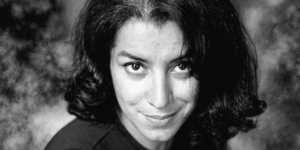
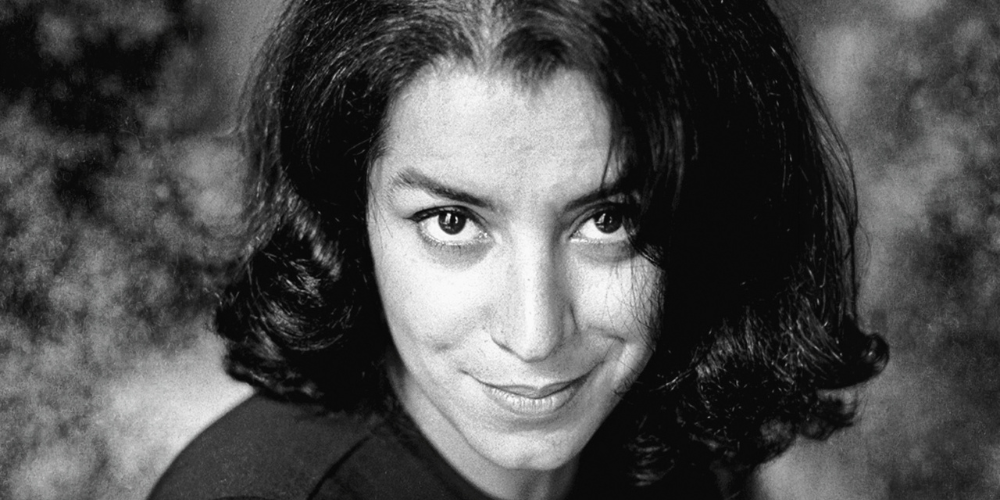
In Iran, her books are banned. And yet in 2025, she did not accept France’s highest decoration, the Legion of Honour, criticising the falsehood of France, her adoptive country, toward Iran – because France speaks of freedom and democracy, but then, she said, denies visas to dissidents as oligarchs close to the Ayatollahs chill out in Saint-Tropez. Here is all Marjane Satrapi. That is, nowhere.
Always out of line. Always outside the box.
Always herself. And nothing else.
 Persepolis, a film by Marjane Satrapi, Vincent Paronnaud
Her first, and main, graphic novel, Persepolis, translated into over 25 languages, is largely viewed as one of the best accounts of Iran. And indeed, Marjane Satrapi changed the image of Iran. But because she described not Iran, but Iranians. For many, Iran still is not a country; it is a problem. An international issue. A matter of strategy and security. We talk of Iran, and we talk of the 1979 revolution, the mullahs, the chador. Evin prison. The fatwa against Salman Rushdie and the conflict with the United States. The nuclear weapons. Marjane Satrapi, instead, focused on everything else. Simply describing what surrounded her: with its contradictions. Parents with liberal ideas, but also tied to tradition. The opportunists, yesterday monarchists and today Islamists. And perhaps, privately, secularists. The cynical clergy.
Society and the individual. The past and modernity. Opposition and conformism.
Somehow, it is all already in the opening of Persepolis, which is her own story, actually. Born in 1969 into a Marxist family, where she grows up reading books on dialectical materialism, like Quino’s Mafalda, on Vietnam, on Cuba, on Palestine, she lives through the Shah’s last years in power, the rise of Khomeini, and the Iran-Iraq War, before being sent to study in Vienna at 14, after a missile hit her neighbors’ house – and among the rubble, she glimpses a bracelet still clutched to the remains of a hand: her dearest friend. As a child, she dreams of becoming a Prophet. Because her dad had a Cadillac, and the maid ate in the kitchen, which was not very communist, she said, but above all, to heal her grandma’s arthritis.
And how will you heal it? Her grandma asks. «I will forbid pain,» she replies.
And in just one scene, there is all her mockery of those who delude themselves into thinking they can change the world in this way.
By forbidding this and that.
Be it mixed school classes or private property.
And yet, Marjane Satrapi did not just write about Iran. She wrote about the West as well. And with equal clarity. Equal disenchantment. She lived most of her life in France. Moving from the mandatory hijab to the hijab prohibition. From the imposition of religion to the imposition of secularism. Which in France is the law, enshrined in Article 1 of the Constitution: just as in Iran, Article 1 of the Constitution makes Islam law. She went from one fundamentalism to another. And her early years in a Catholic boarding school in Vienna are a scathing portrait of our society. Ready to judge everything and everyone: but hollow. Lost in trivial matters. She is left to herself, relegated to the role of a «third-worlder,» the one who knows what war is, who has been under airstrikes, who has seen blood, the colourful one: and she ends up in drugs, to the point of sleeping rough, in the heat of winter, rummaging through garbage for food and spitting blood from untreated bronchitis. She will be found lying on the ground. Unconscious. And she will be saved. But she will return to Tehran, for university. And she will never speak to anyone about her last months in Vienna.
Which has little of the European dream for which so many drown in the Mediterranean.
And the fact that this side of her work is overlooked confirms how right she was.
The West watches, judges: but remains invisible to itself.
The cartoons on George W. Bush and his crusades for democracy could be about Trump. He speaks like Khamenei. One quotes the Bible, the other the Koran, but both feel like messengers of God, both base their plans on weapons, rather than diplomacy: and yet, one is the Good and the other is the Evil. Why?
Even though, deep down, she said, if you are George W. Bush, how can you not think God chose you? A man whose only passion has always been soccer, soccer and alcohol, who does not speak any language, only his own, and poorly, who has not studied, nor traveled, who only knows Texas, and whose only social activity has been supporting the death penalty, and who runs for office, and with elections of controversial regularity, finds himself president of the United States, she says: how can you not believe in miracles?
«I will forbid pain»
She drew in ink. With this essential, minimal, two-dimensional black line, with no colours, with no greys, with no shadows: because Marjane Satrapi took sides, instinctively telling right from wrong. And so she passed away, on June 4th, a year after the passing of her partner after a long illness, with the same sharpness, with her family saying simply: «She passed away of sadness\” – without compromise.
In a world she no longer wanted to be in.
She also often confronted the Iran outside Iran. That segment of the Iranian diaspora that called, and still calls, for armed intervention against the Ayatollahs. But more than yet another revolution, more than yet another promise of a perfect system, she wanted evolution, she said. Because that black, neat line with which she noted, and above all, she said, what many prefer not to notice and not to say, was not a form of ill temper or intransigence, but its opposite: it was the awareness that nothing and no one is perfect.
And that opposition to the fundamentalism of others always begins with one’s own.
She will be missed.