The murder of Kitty Genovese late one night in the 1960s outside her apartment building in New York became one of the most notorious and much-discussed cases in American history — because of the large number of witnesses who saw what was happening and did not intervene, with psychology textbooks using the example as one of «bystander effect.»
Fast-forward to today, and femicide is still a crime that flourishes in atmospheres of tacit social acceptance of gender-based harassment and violence, or those in which there is simply not enough recognition of the level of danger, or enough attention given to preventive measures. German-Brazilian filmmaker Daniela Magnani Hüller knows this all too well because when she was seventeen years old, a classmate who had been stalking and threatening her stabbed and very nearly killed her, despite many around her being aware of the situation leading up to the attack. Fourteen years after the traumatic event, she invites those people, and some she interacted with in the immediate aftermath, to meet with her so that she can find out what was going through their minds, and share her point of view on the experience. What results in Sometimes, I Imagine Them All at a Party, which premiered in the Forum section of the Berlinale and now screens at DOK.fest München, is a documentary that is an act of processing and reckoning, or therapy of sorts, as well as a powerful reclamation of agency by the filmmaker over her own body, and the terms under which others see it.

The attack
Sometimes, I Imagine Them All at a Party begins with Hüller recounting in voice-over her memory of the attack, in moment-by-moment, impressionistic manner — the confrontation with her assailant near a bus-stop, and the spreading sensation of warmth in her chest before she even could realise it had come from a knife; then the small cluster of onlookers at the stop who turned away and failed to assist her, despite the severe injuries, before she ran toward home. A memory of waking in a hospital also factors in as central, because it is of a criminal investigator asking her, with visible emotion, not to lose her faith in humanity. Later, she credits this gesture of human kindness as instrumental in her regaining trust after this catastrophic event. In this framework of recollections, what happens to us is not the full story. How others react to what is occurring, and the level of support we receive before, during and after, can determine to what degree the trauma changes us and our worldview. An attempt at femicide can destroy our peace of mind — but add a crowd of indifferent bystanders, and the impact is even heavier, because the lack of security in a patriarchal world for women is underscored as an ongoing norm. Accompanying Hüller’s impressions is some quite textured, abstracted imagery, shot on film stock, that emphasises the fragmentary, bodily nature of trauma, which cannot easily be reasoned through but impacts the way we perceive our surroundings.
How others react to what is occurring, and the level of support we receive before, during and after, can determine to what degree the trauma changes us and our worldview.
Objective clarity
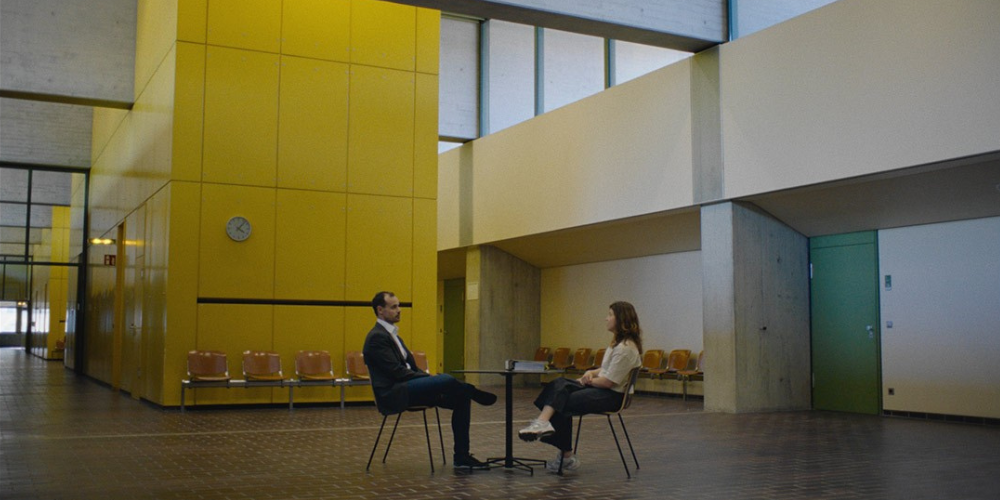
The interview segments have a more objective clarity. They are filmed at a distance, with Hüller’s face not discernible (until right at the end) — a choice that allows her some control over her privacy and our access to her in close proximity. This visual approach stands in counterpoint to the story she tells. When she was at school, her eventual attacker was in classes with her, and would turn around to stare at her for nearly the whole lesson — an act of intimidation that made her and her classmates extremely uncomfortable, but which the teacher at the time did nothing to stop. The teacher in question describes her later shame, and an outspoken classmate discusses the ineffectiveness of her efforts to call out the behaviour. An interviewee from law enforcement sets out the lack of legal options available for stalking, often classed as a «minor offence» despite it being a well-documented, frequent precursor to major attacks. The lack of vocal acknowledgement of the attack by teachers or the school principal, even after Hüller returned to school three weeks later, also comes under critical scrutiny.
Daily reminders
Hüller returns to Brazil for a trip to reunite with family. It’s a different land, with a different set of impressions — but the issue of femicide is an almost daily reminder in news reports in Brazil. She recognises the common threads in all the stories and a wider, systemic system of distrust and victim-blaming that can make seeking justice a retraumatising ordeal. Sometimes, I Imagine Them All at a Party stands not only as an act of personal reckoning with a life-changing event, but also as an act of solidarity with all women who have been targeted or lost their lives to femicide, and a wake-up call to all citizens to act early and act together to protect the vulnerable or the structurally disadvantaged within their communities.