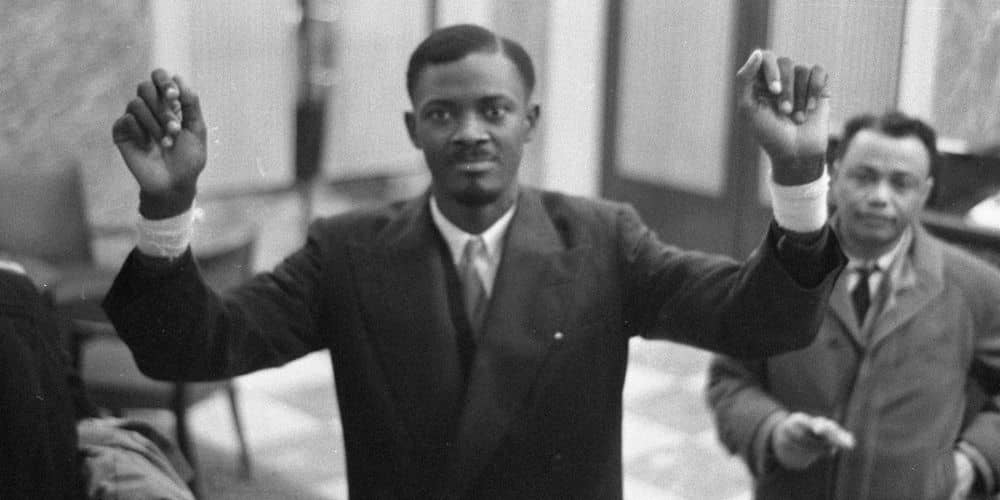
One man’s terrorist is another man’s freedom fighter, as the old slogan goes, and the murdered Congolese leader/assassinated civil rights martyr #Patrice Lumumba# is certainly the latter in Johan Grimonprez’s #Sundance debuting Soundtrack to a Coup d’Etat. Nearly a decade in the making, the veteran director’s (dial H-I-S-T-O-R-Y, Shadow World, Double Take) cinematic reframing of history is every bit as grand and showy as its title might imply. (Not to mention as overwhelming as a doctoral thesis, albeit a groovy one.)

Accidental spark
Indeed, in a surprisingly swift 2.5 hours, Grimonprez revisits/revises the sprawling, real-life, early 60s saga that pitted the 16 newly independent African countries recently admitted to the #UN against the long-established, Western democratic powers newly committed to #decolonisation or, perhaps more accurately, a decolonisation version of illiberal democracy. One which would guarantee the West’s access to precious resources like, say, #uranium – a necessary ingredient for the world-ordering atomic bombs. And a metal that just so happens to be abundant in the #Katanga region of – you guessed it – Belgium’s former colony, the Congo.
Which is where a former beer-hawking, rabble-rouser named Lumumba mistook his role as the Republic of the Congo’s first prime minister as a mandate for kicking out the West – and paid with his life. But unlike Raoul Peck’s 2000 biographical thriller Lumumba, a methodically detailed account of the political machinations behind the nationalist hero’s rise and eventual fall, the CIA-involved elimination of Lumumba is where Soundtrack to a Coup d’Etat begins, not ends. For the killing was also the accidental spark that ignited and then united oppressed peoples from the #Global South# to the racist #Global North#, which is where the crashing of the UN Security Council by American musicians #Abbey Lincoln# and #Max Roach# in protest occurred. Cue the titular soundtrack and let the credits (rock and) roll.
the killing was also the accidental spark that ignited and then united oppressed peoples from the Global South to the racist Global North
Not surprising
Actually, cut. This would be a good time to explain that Soundtrack to a Coup d’Etat is also about as far from Peck’s aesthetic as #Haiti is from Belgium. Firstly, Grimonprez’s latest is a tour de force of editing, its chaotic nonlinear structure shaped by an editor, Rik Chaubet, who also happens to be an experimental musician, which is important since Lincoln and Roach are far from the only jazz legends to play a role in the historical proceedings. In fact, jazz was sort of the Eisenhower administration’s Trojan horse, a way to win hearts and minds while distracting from those nasty CIA-backed coups. Black «jazz ambassadors» – including #Louis Armstrong#, #Nina Simone#, #Melba Liston#, #Duke Ellington# and #Dizzie Gillespie# – were sent overseas on what most assumed were goodwill missions but were often much more nefarious. Horrifically, it was Armstrong himself who served as the unwitting smokescreen for the coup that led to Lumumba’s removal and eventual death.
Though to a cynical American like myself, who lived through the CIA black site debacle of the Bush-Cheney years, the Satchmo deployment is shocking but not all that surprising. More unexpected is the Belgian filmmaker’s lifting up of Soviet premier #Nikita Khrushchev# as a crucial ally to the anti-colonialist cause, a virtuous comrade who «bangs his shoe in indignation at the UN’s complicity in the overthrow of Lumumba» (per the Sundance synopsis). Really? While Soundtrack to a Coup d’Etat displays a compelling cinematic rigour (and is painstakingly researched right down to title cards that include author names, print sources and page numbers for every quote), the quick-cut, jazz-infused atmosphere is also upbeat and fun. Perhaps too fun. Not unlike the #Adam Curtis# oeuvre, a viewer can’t help but get swept up into becoming a true believer. Only later to be left wondering if all that onscreen action was really true.

History rhymes
For history, as with great cinema, doesn’t depend on the story but the storyteller. And Grimonprez’s take seems troublingly simplistic at times, the film often playing dangerously fast and loose with the facts (and history is not an improv session). Case in point: the aforementioned Khrushchev as a catalyst, infuriated on behalf of the African countries, demanding an immediate end to #colonisation. Are we meant to now see this infamous shoe-banging incident (itself disputed) as some sort of benevolent act on the part of the Russian leader – and unsee the fact that the theatrical outrage came from the uranium-coveting, colonialist and imperialist #USSR he was there to proudly represent? (Does Grimonprez think Khrushchev was likewise in favour of returning the Tatars to Crimea too?)
As for the US side, the Belgian director rightly celebrates American icon Armstrong’s refusal to play for a segregated audience in #South Africa# and also Satchmo’s subsequent cancelling of his jazz ambassador tour in reaction to the Arkansas National Guard being sent to Little Rock to prevent Black students from entering the state capital’s high school. But Grimonprez then gives short shrift to the seismic event that happened as a consequence: the ordering of the federal National Guard into Little Rock to enforce integration (overriding the racist Governor Faubus’s refusal to comply with Brown v. Board of Education). And who handed down that righteous mandate? None other than the coup-approving President Eisenhower.
But ultimately, as the Twain saying goes, «History doesn’t repeat itself, but it often rhymes,» and Soundtrack to a Coup d’Etat also moves and shakes in glorious cacophony. Just best to keep in mind that that quote attributed to Mark Twain might not actually be his.