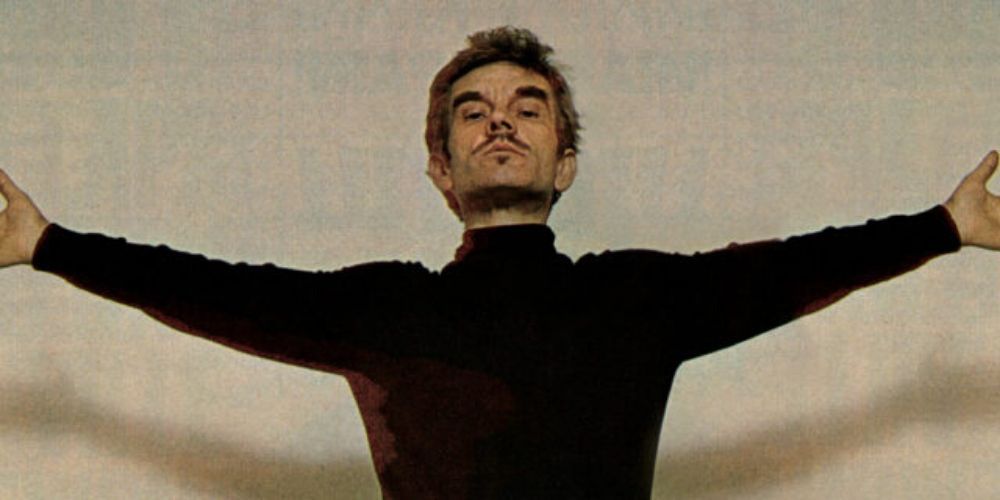
«The most skillful politicians have always mastered hypnotic methods,» it’s said in Finnish documentary The Hypnotist, screening in the online edition of #DocsBarcelona. Fascist dictator Adolf Hitler’s powers of oratory in mesmerising the masses and his links to celebrity hypnotist and stagecraft master Eric Jan Hanussen have long been a subject of attention — and controversy, for could it not be a side-stepping of responsibility to claim a kind of spell over-rode a nation’s free will? Director Arthur Franck explores the terrain of politics, showmanship, and mind control through the strange, lesser-known story of #Olavi Hakasalo# (or Olliver Hawk, as he preferred to call himself). This Finnish hypnotist, who carried his knack for dark pomp and dramatic timing to the end as he died on stage in the middle of a show, had shady links to Urho Kekkinen, who ruled Finland for a quarter of a century from 1956 with what many would call an autocratic hand. The film makes the claim that Kekkonen secretly hired Hakasalo to conduct research and advise the government on mass hypnosis and suggestion for political purposes, and in particular to offer methods by which popular rival Veikko Vennamo and his Finnish Rural Party could be sabotaged and silenced.
Power
Hakasalo’s biography is set out, painting a picture of an eccentric, somewhat narcissistic figure whose interest in #occult subjects infused all aspects of his life off-stage as well as on. His mother was a clairvoyant, and by the age of nine, in 1939, he had already begun studying hypnosis, along with his associated interests of telepathy, witchcraft, and the supernatural. The notion that all the power that exists in the world is bound by words impressed him deeply — an idea that points to language’s association not only with indoctrination through reason, but also with the more mystical domains of religion and magic (the film names Jesus, in his mixing of persuasive speeches and miracles, as the first great hypnotist). To what degree do people choose to follow a leader? Can they really be manipulated to do anything, regardless of their own free will, simply by the inflection of a voice, a snap of the fingers, or the magnetism of a gaze? The unsettling prospect that one’s sense of self is intrinsically weak and malleable, and can be altered with ease under the right conditions, is not systematically examined by the documentary, but its impact hovers, like a sleight-of-hand trick, after the credits roll, casting doubt on our confidence in ideological conviction. It was suggested in Hakasalo’s era that television and hypnosis combined might be more effective than biological warfare in controlling a populace. Today, we might rather say the power of #social media# and algorithms — but can we doubt their brainwashing capabilities?
The notion that all the power that exists in the world is bound by words impressed him deeply
Hakasalo, on reaching adulthood, spent time in #Australia learning hypnosis from #Aboriginal people, having heard of their reputation for skills in #telepathy and other widely lost mental capabilities. On his return to Finland, he started holding hypnotist shows. These were controversial, but he was undeterred since there was once vigorous opposition to literacy too. Footage from these modest-sized spectacles, held in towns throughout the country, shows volunteers under the full sway of suggestion, feeling as if they are covered in hives, or picking money from imagined trees, to the amusement of the rest of the audience. In the ‘60s, Hakasalo bought an old mansion in western Finland and converted it into a sanatorium. His aim was «to map the human soul.»
On trial
Hakasalo’s penchant for manipulation and self-aggrandising spectacle in the realm of romantic relationships is touched upon, but largely in passing as if the domestic sphere is inevitably a side-note to the machinations of #big government#. His first wife, Laila, eventually left for #Sweden, with custody of their children. Another partner, Susan, was swept off her feet by him at a show and, believing his promise she would be treated like a queen in Finland, went to live with him there, finding she soon had had enough of his sexual kinks, involving moose and ritual-punctuated orgies.
The fiasco the film hones in on is Hakasalo’s trial in 1980, at which he was convicted of fraud for using the title of «Professor of Behavioural Sciences,» which is not even an official title in Finland, and practicing medicine without a license. It’s claimed that the case was a form of extortion by the state, a mode of pressure to retrieve the evidence from him that its «inner circle» had employed him to help silence Vennamo. His advice on how they could do that had been less than esoteric, and hardly murderous: place an executive order on newspapers not to publish any stories on him, and carry out a character analysis on all his party’s parliamentary members to determine which might be subject to being bribed. In terms of historic scandals, then, this may have been small-fry — but it is a timely reminder of the murky lines between leadership and coercion; information and propaganda; image and illusion.