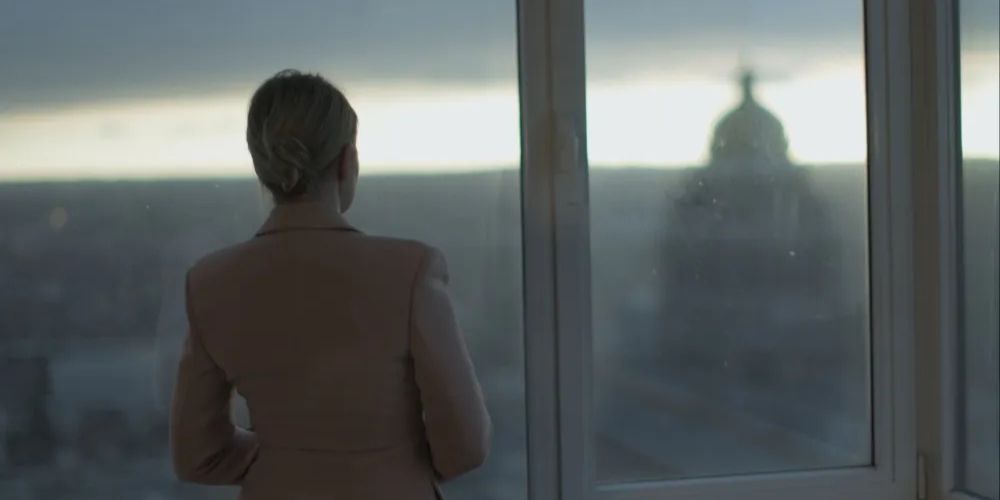
In The Eukrainian, Swedish director Viktor Nordenskiöld follows #Olha Stefanishyna#, tasked with one of the most unthinkable missions in contemporary Ukrainian politics: bringing the country into the #European Union# as swiftly as possible. Yet the film reaches far beyond a narrative of #war and resilience — it invites a far less comforting reflection on the current values and functions of the European Union itself and on what might be learned from countries that are, quite literally, bleeding in their struggle for democracy.
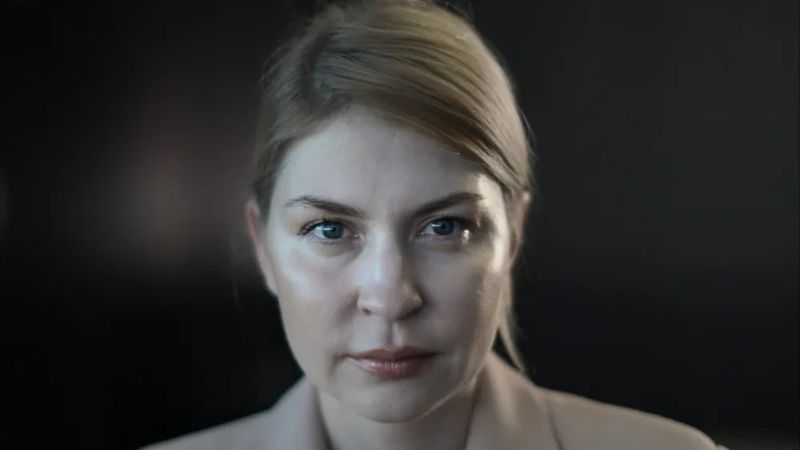
Deputy Prime Minister
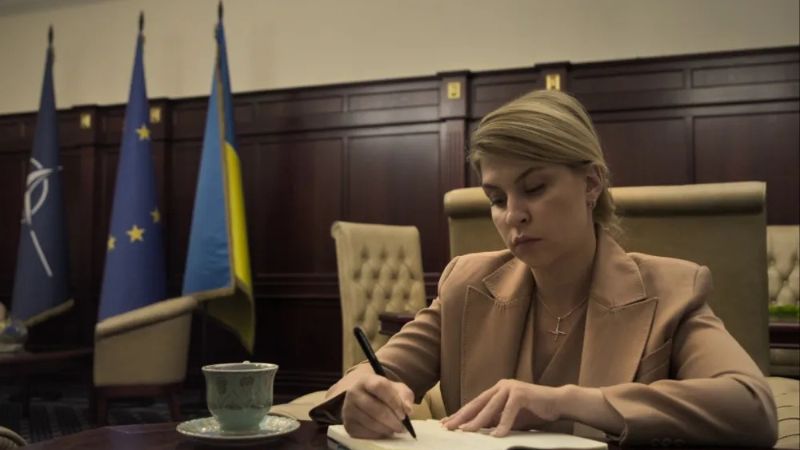
Olha Stefanishyna was appointed Deputy Prime Minister for European and Euro-Atlantic Integration of Ukraine in her early 30s. With the onset of the invasion, her job became both more tangible and more impossibly complex, as she had to lead her country into the EU at a time when the country itself might cease to exist at any moment. Nevertheless, on the fourth day of the war, Ukraine submitted its application for EU membership, launching a monumental campaign. Leaving her children at home and spending long nights on trains to the #Schengen border, Olha is on a constant journey through the big offices of European lobbies, gradually observing the waning interest and support for Ukraine. Politicians, TV studios, and nine binders of ‘Annexes to Candidacy Application’ stacked nearly human-height surround Olha everywhere. Her charisma and fierce determination are undeniable, but they cannot shield the country from real obstacles.
Eventually, the time comes to face the greatest internal and external challenges. On the one hand, there is #Viktor Orbán#, who repeatedly imposes vetoes and is presented in the film through parallel montage alongside #Putin. On the other hand, there is deep-rooted corruption in Ukraine, which is both the main red flag for EU ministers and a real, acute problem within Ukraine itself. The obstacles multiply, the Russian shelling continues, and EU membership begins to feel like something galactically distant.
Still, as Ukrainian Foreign Minister Dmytro Kuleba says in his brief appearance on screen, «To win a war, you have to be an optimist»—a truth difficult to deny. But does this mean that the film should also adopt an optimistic tone, glossing over shortcomings and idealising its protagonist? The process of Ukraine’s accession to the EU seems as complex as the challenge facing a Western filmmaker: to create a portrait of a Ukrainian politician that does not rely solely on admiration.
Olha is on a constant journey through the big offices of European lobbies, gradually observing the waning interest and support for Ukraine.
Dramatic Intersections
Nordenskiöld continues to follow his curiosity-driven focus: the pressing political precedents within the European Union. He first made a name for himself with The Feminister (2019), in which he spent four years observing Sweden’s then-Foreign Minister Margot Wallström, capturing her sharp personality and fearless feminist politics in a male-dominated environment. His next film, Behind the Swedish Model (2022), focused on the country’s unique response to the COVID-19 pandemic, exploring a controversial strategy of rejecting lockdowns.
For his third film, Nordenskiöld leaves Sweden, his zone of directorial comfort, and heads to Ukraine, significantly raising the stakes for himself. From The Feminister, he borrows the wordplay embedded in the title itself, forcibly juxtaposing elements into a unified concept. Once again, he follows a female politician in a white suit, navigating masculine spaces and persevering against all odds.
But while The Feminister offers a generous spectrum of facets and emotions, The Eukrainian suffers from a constructed image of unconditional heroism surrounding its central figure, which obscures a more nuanced gaze. The director relies on the seductive intersection of Olha’s multiple social roles to create a dramatic and, at the same time, highly convenient portrait: a mother of small children, a Ukrainian citizen at war, and a politician tasked with an impossible mission in the here and now.
In this sense, the film somewhat echoes Klitschko (2024) by Kevin Macdonald, who constructed an emotionally resonant yet misleading portrait of Kyiv’s mayor by juxtaposing the two «rings» of his life: the boxing ring and the political arena. In creating a tender, even amusing image of the politician, Macdonald ignored the torrent of criticism over massive corruption and unregulated urban development. Olha, of course, is nowhere near as compromised a figure as Klitschko. However, the film also chooses not to focus on the fact that Stefanishyna — despite her vocal anti-corruption stance — has been accused of corruption-related controversies herself.
The Ununited EU
Although the director falls short of creating an ambivalent portrait of Olha, he succeeds in articulating a direct critique of something he knows intimately from his experience as both filmmaker and journalist: the contested ideals of the European Union. More than that, he prompts us to reflect on the function of the EU itself and question the meaning of the word «union» at a time when the continent is becoming increasingly fragmented under the weight of growing dissent.
Nordenskiöld’s cinematic language is often expressive, at times excessively so — yet his goal is to highlight the surreal dichotomy between peace and war on a single continent. He contrasts archival footage of Ukraine’s fierce struggle — from the bloodshed of the #Maidan protests to the present-day bureaucratic avalanche of tens of thousands of documents prepared under missile fire — with the aloofness of European politicians, many of whom, judging by their level of engagement, seem unfamiliar with the true scale of Ukraine’s literal fight for membership.
The film also questions the European Union’s positioning as a prestigious and near-mythic democratic ideal, pointing out the stark inequalities in access. For some, membership is simply a given, and the director’s voiceover repeatedly says «we,» speaking from the vantage point of Swedish citizens in one of Europe’s most privileged countries. Meanwhile, in places like Ukraine — or, more recently, #Georgia — the dream of #democracy remains a matter of life and death. But still… Do we still believe that democracy and our values are worth fighting for? The director asks. The film leaves us without an easy answer — and with an aftertaste that makes a positive one difficult to believe.