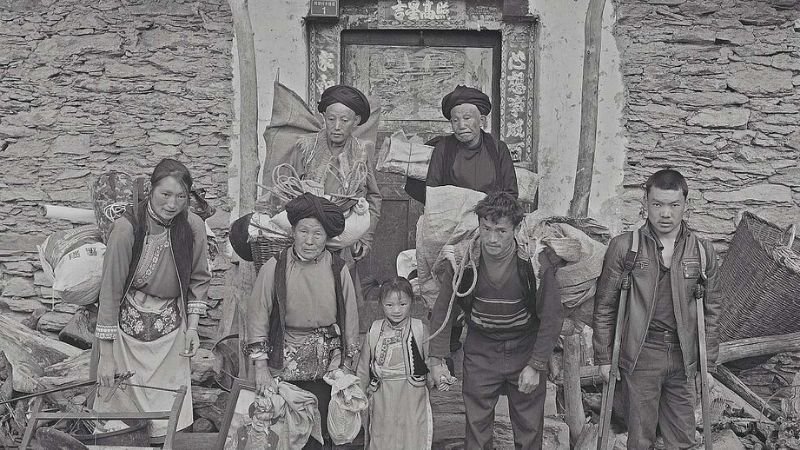
On 12 May 2008, an 8 grade Richter scale earthquake struck China’s Sichuan Province. Almost 70,000 people lost their lives, of which almost half were Qiang, a Tibetan ethnic group that lives off the land. In its aftermath, the Chinese government decided some of the Qiang communities needed to relocate in order to prevent further disaster. Qiang’s Journey tells the touching story the group’s traditions and beliefs in the light of the displacement process that follows. By capturing the heartbreak of their village departure, Tunzi Gao’s film gives a nuanced and subtle insight into the core of this unique culture, and the deep connection these people feel with their ancestors, their gods, and the place they inhabit.
Of gods and ancestors
From the beginning, for someone unaccustomed to Chinese names, keeping track of characters and their relation to each other might prove challenging. Gao maps the villagers’ links to each other, but soon enough it becomes clear that this mapping is, and at the same time isn’t, important. Each individual story blends into a collective narrative, of a community that lives in harmony with the past, the earth, the gods, and each other.
The only necessary distinction has nothing to do with family lines. The true divide is a generational one, between the young, looking forward to moving to a more developed place, and the old, deeply attached to the spirits they share their land with. What for the young generation means excitement and perspective, for the elderly, is a tragedy. Their parents and grandparents are buried in the village, their gods live in the mountains around it, and their existence has meaning in the context of tradition and magic that has its roots and coordinates only there.
Each individual story blends into a collective narrative, of a community that lives in harmony with the past, the earth, the gods, and each other.
One doesn’t have to share Qiang’s beliefs in Gods and ancestors to feel for them. Bearing witness to them saying goodbye to their land, with the despair and sorrow that brings, is enough to see that their heartbreak goes beyond basic attachment to a place they call home. This departure touches on the existential. What they leave behind is not only what they know, but their entire sense of identity, and the raw bond with nature, the supernatural, and the people that were there before them. Once moved away, to a place close to a highway – an element they try to convince themselves is a good thing – that whole world will cease to exist.
A place of no return
What is lost in the transition between tradition and developing China is a theme addressed in many documentaries. But the depth of it goes beyond a sense of nostalgia. That sense of living close to nature and of magic is something most developed countries have sacrificed for comfort. That is the point where this small, remote community of people living in the mountains in China becomes relatable to everyone who longs for lost bonds. As the villagers say goodbye to what they value – their herds, the graves of their parents, a beautiful and loved red horse – it is clear that this is a crossroad and a place of no return.
It is capturing this sense of disappearance, of the illusions of capitalism swallowing up yet another piece of the old ways of life, that makes Gao’s film so profound and powerful. He avoids the pitfalls of romanticizing rurality to only show how that existence is simple and, at the same time, multidimensional. It transcends the past and what is visible to the eye. «Only Believe in the things your eyes can see? How far can your eyes see?» says one of the elderly.
That sense of living close to nature and of magic is something most developed countries have sacrificed for comfort.
To the young who need to live with the present and the new, and are absorbed by it, the elderly sticking to their magical world seems backward, outdated. But in looking at them in this way they miss the essence of what the elderly believe – the strength found in surrender, the sense of belonging, the compass that always brings you home. That is exactly what the modern cities and the new China has lost. And that is what a human heart essentially longs for.
Mabi
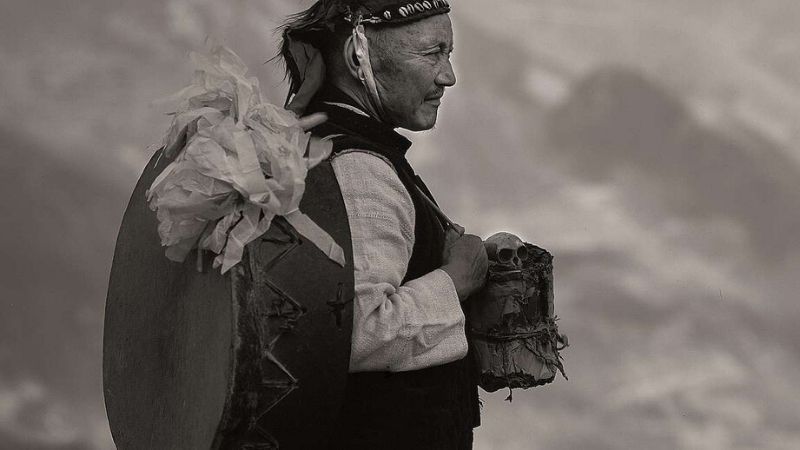
The film goes full circle in the end, when years after they move, the elderly go back to the village to bring with them Mabi, a god that stayed behind but will now be invited to come along to their new location. In preparation for the trip, no one except them seems to care about this god anymore. As they receive some polite dismissal based on supposed priorities from the authorities of the place they now live, and even the young in their community don’t seem to care, that brings the bittersweet realization that Mabi is, in fact, forgotten, and these old men are the only ones wanting to invite the divine into this modern world they now live in. «Uncle, where will we place our gods?» asks one of the few younger men that joins the trip to bring Mabi home. «Anywhere is good» comes the answer – «The most important thing is to place them in our hearts».