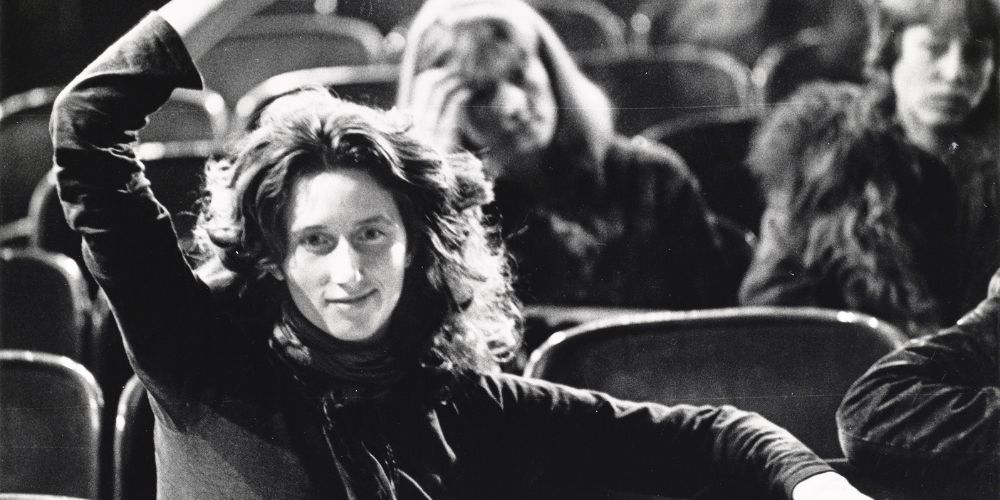
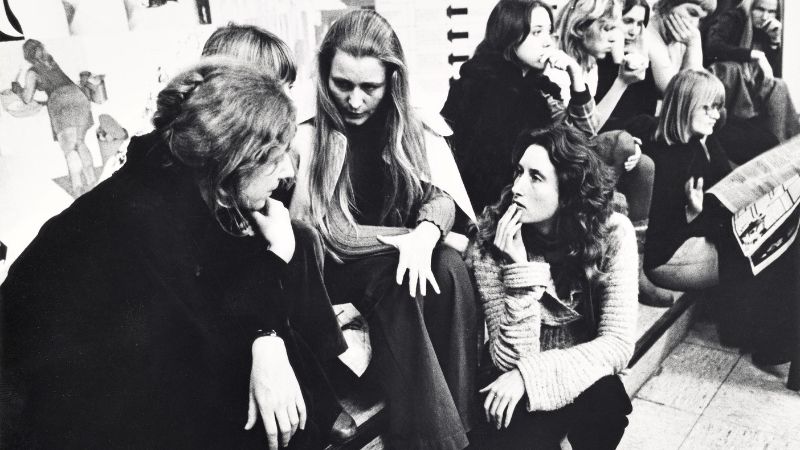
When Vibeke Løkkeberg’s The Long Road to the Director’s Chair premiered in the Forum section at this year’s #Berlinale, it felt like more than a rediscovered archival film. It was a time capsule cracked open after fifty years, sending urgent echoes into the present. Shot in November 1973 at the first International Women’s Film Seminar at Arsenal Cinema in #West Berlin#, the footage had been left unedited, shelved, and nearly forgotten—until it resurfaced in the archives of the Norwegian National Library and was restored in 2023. Edited with care by Mina Nybakke and enriched by a subtle, respectful score supervised by Jenny Aubert and Suri Lien, the material has now been shaped into a full-length documentary that speaks both to history and to our own unfinished struggles.
Frustrations and solidarity
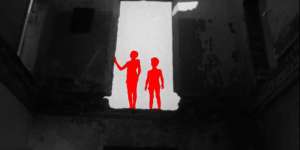
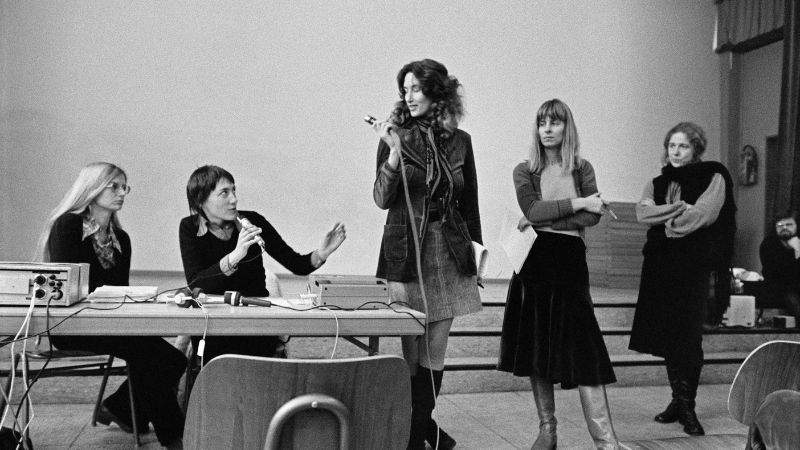
The 16mm images, stark and monochrome, show rows of women—directors, journalists, writers—speaking about their craft, their frustrations, and their solidarity. The framing is simple, the rhythm sometimes mechanical, yet the editing finds poetry within the constraints: when the film reel runs out, the screen turns black, but the sound continues, conversations unfolding in darkness. This choice, rather than being a limitation, becomes a powerful aesthetic gesture.
Formally, the film succeeds in elevating raw material into something engaging. The explanatory intertitles, which place the footage in 1973, are elegantly written and never condescending. As a cinematic experience, The Long Road to the Director’s Chair is neither flashy nor conventionally dramatic. It is talkative, essayistic, and sometimes dry. Yet it is precisely in its refusal to entertain that it acquires authority. The women’s words, stripped of embellishment, confront us directly.
The music, composed and chosen in post-production, adds an emotional layer that makes the long series of static interviews more bearable, even captivating. Nybakke’s editing deserves special praise for maintaining the footage’s integrity while creating rhythm and variation. At times, the film seems to drift into monotony—until a voice breaks through with startling relevance, or an unexpected silence causes us to listen more intently.
Løkkeberg, herself a key figure in Norwegian film as both actress and director, was an active presence at the seminar. Just a few years earlier, she had made Abortion (1971), and later, she directed Hud (Skin, 1986), an ambitious, taboo-breaking Norwegian drama screened at #Cannes. Her most recent film, Tears of Gaza (2010), is a powerful anti-war documentary praised as «the ultimate anti-war film.» Her career has involved challenging silences and breaking through cultural complacency. The Long Road to the Director’s Chair continues this work, albeit belatedly, by demonstrating how women in 1973 sought to redefine cinematic authority—not as authoritarian control, but as collaboration.
The women’s words, stripped of embellishment, confront us directly.
Collapsing the divide
That is perhaps the film’s most unsettling achievement: it collapses the divide between then and now. Watching in 2025, one can’t help but notice the resonance with today’s public sphere. Among them are figures like Ariel Maria Dougherty from the U.S., talking about the fragile right to #abortion, and German journalist Claudia von Alemann, describing the double bind of female authority: a woman director is either dismissed as a charming but passive presence or vilified as an «aggressive bitch.» The testimonies are painfully familiar. Their words don’t feel half a century old—they feel current.
A recently published report, commissioned by the Fritt Ord Foundation—also a funder of Løkkeberg’s film—underscores this continuity, highlights ongoing #gender inequality# in Norwegian media. The study found that men still dominate the public debate in Norway, with 61 percent of voices quoted in news coverage being male and only 39 percent female. Women are more often cited as private individuals or in caregiving roles, whereas men are usually portrayed as experts, leaders, or politicians. Even in opinion sections, where more balance might be expected, 72 percent of columns are written by men, and 98 percent of commentators have Nordic names. There is a notable lack of diversity in name origin—92 percent of those quoted in Norwegian media have Nordic surnames, making individuals with family from foreign countries vastly underrepresented. This continuously excludes second- and third-generation immigrants from the public debate, regardless of how Norwegian they may perceive themselves.
These numbers read like a footnote to Løkkeberg’s film, or perhaps its sequel. The women at the Berlin seminar in 1973 were painfully aware of how the cultural industries diminished their authority. Fifty years later, we can quantify the same tendencies across #media as a whole. The continuity is both depressing and galvanising. The Long Road to the Director’s Chair, therefore, functions not only as an archival recovery but also as a mirror held up to today’s institutions. It exposes the stubborn inertia of structures that continue to privilege certain voices over others.
Some critics have called this film a «time capsule,» but that implies it’s a relic. In reality, the footage seems as if it’s been waiting for exactly this moment—when debates about diversity, representation, and gender equity have regained urgency. Against the backdrop of the Fritt Ord findings, the film feels almost prophetic. The struggles expressed in 1973 were not resolved; they were simply postponed.
The long road
In 2025, women and minorities in Norway and elsewhere still struggle to gain recognition in media and public debate, still receive less funding for projects, and still face systemic barriers to leadership roles. The path to the director’s chair remains long, uneven, and obstructed. But films like Løkkeberg’s remind us that the journey itself is worth documenting—and that every rediscovered voice adds weight to the call for change.