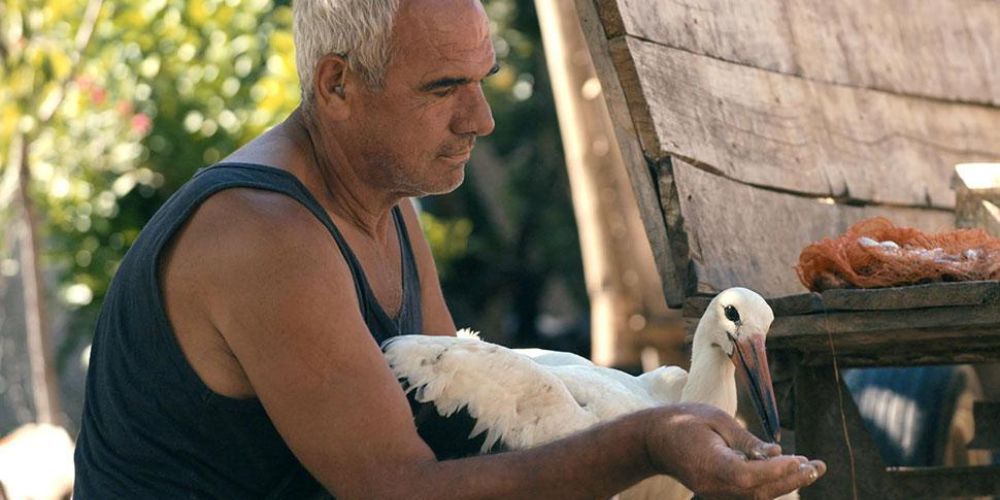
North Macedonia, once fertile with rich soils and diverse crops, now faces a severe agricultural decline. Farmers grapple with rising costs, cheap imports, and climate shocks, their matter of life gradually erased from the country’s oldest practice — a tragedy embodied most clearly in the fate of Nikola and his family. Instead of retiring with pride in a lifetime of harvests, Nikola is watching his crops thrown into refuse heaps — half a century of his labour stripped of its very purpose as sustenance. Therefore, his family is forced to emigrate to Germany, while Nikola, left behind in his empty house on disused fields, becomes a stark emblem of how swiftly fate can turn under the volatility of market trends. This layer of the film could have stood alone as a potent documentary on #ecology, #capitalism, and human loss, but instead, Tamara Kotevska turns to experimental form, unfolding a parallel fable of creatures that carry the spirit of folk life fragility like no other. Filming in the South of North Macedonia, a home to one of the largest populations of storks in the world, she opens the film with an ancient Macedonian fairytale about a farmer who curses his son, who wanted to travel abroad. He turns him into a stork, thereby condemning him to eternal wanderings, always remaining a stranger among people and animals.
The film’s grandiose opening, delivered in a stern male narration, might initially appear only loosely connected to the story, offering a symbolic meditation on migration. Yet the life cycle of the storks and Nikola’s fate trajectory offered Kotevska an extraordinary story to follow over two years. Once nourished by fertile fields, storks now forage in lethal landfills — the same grim terrain where Nikola drives a garbage collection vehicle. A physically and emotionally wounded stork seeks shelter near Nikola, as it also finds itself in a place where it does not belong, yet has no other choice but to stay. Over the course of their extraordinary rapprochement, it becomes clear that they share this legend and tragedy equally. The Tale of Silyan tells a bittersweet story of fractured identity set against the pressures of Macedonia’s socio-economic crisis, where at its heart lies the evocative folk tale that shapes the film’s title and its artistic premise.
Pure Fiction
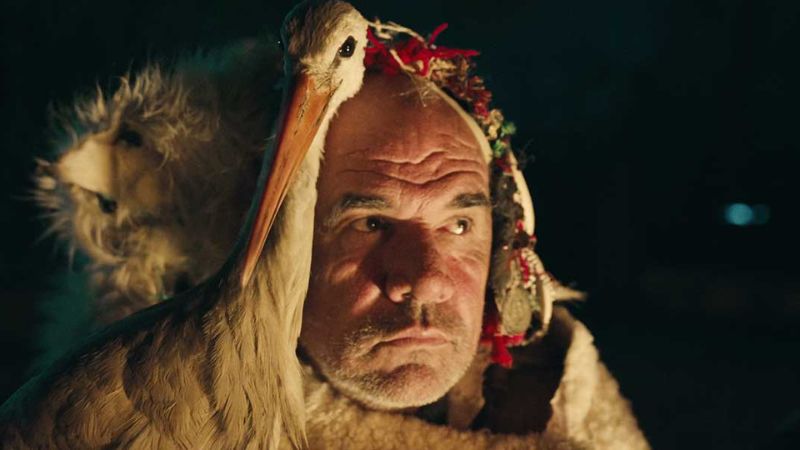
Breaking with conventional forms of documentary filmmaking on ecology and migration, Kotevska seamlessly blends fiction with reality, using her singular formal inventiveness to ease the weight of brutal reality. While her visual stylisation has often been deliberately perfected, here it serves a deeper purpose as she tells a fable. Through its metaphorical resonance and virtuoso cinematic language, she channels the pain of history into a communal emotional register—achieving, perhaps, a greater potency.
Through its metaphorical resonance and virtuoso cinematic language, she channels the pain of history into a communal emotional register
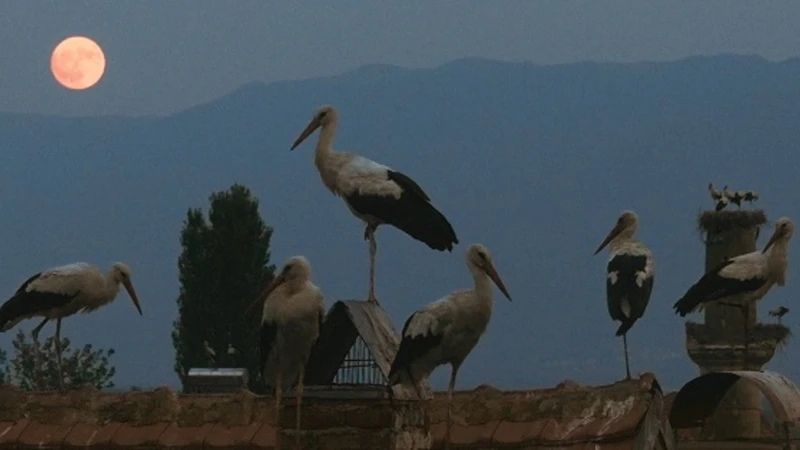
This persistent sense that we are witnessing pure fiction is made possible by a rare combination of a meticulously honed audiovisual form applied to a dreamlike story of human-animal friendship, which is already hard to believe regardless of any directorial manipulations. Kotevska approaches the boundaries of documentary fictionalisation with utmost seriousness. The result is a spellbinding fusion of folk-like soundscape, heavily edited colour correction, and expansive panoramas, lingering over stork nests and Nikola’s land. She once again skilfully works with rural picturesque, alternating between a static and flying camera, combining a classic observational approach that captures intimacy within Nikola’s household with wide, hovering drone shots over nests, fields, and villages. In a way, she successfully performs the functions of something closer to a wildlife camerawoman, presenting shots that indeed required a lot of patience and waiting to get them. Equally remarkable is the trust her camera elicits: a simple man lays bare his emotions before the lens, while the stork may return the gaze directly to the lens.
She is particularly generous with sequences of nocturnal storms and raging elements, which serve as visual ornaments, just like a multitude of adjectives in a written fairytale, bringing the essential immersion into the atmosphere: storms erupt over nests, silver lightning slicing the distant sky while a solitary stork occupies the frame’s exact centre. These images possess an almost painterly force, transfiguring harsh reality into myth and sustaining the feeling of witnessing pure fiction. Yet, Kotevska’s commanding presence over her subjects continually roots the narrative in the wounded land that remains palpably real.
Hope for Social Creatures
There is something strikingly inventive in the way Kotevska allows the psychology of the animal at the story’s centre to shape the very architecture of her films. In Honeyland, her protagonist emerged as a kind of queen bee, embodying both tireless #labour and the impossibility of abandoning the hive. In The Tale of Silyan, the stork becomes a comparable emblem: like the bees, it conjures a sense of sociality, a species that deeply depends not only on ecology but also on a trusted community, a shared order that reflects Nikola’s own existence and purpose.
The film sustains its fairytale register, drawing to a close with an elliptical structure that circles back to its beginnings, casting light and hope anew. In this cyclical movement, Kotevska speaks in the idiom of nature itself. Just as Dmytro Hreshko’s war-ecocide fable Divia resolved in the regeneration of the landscape, The Tale of Silyan concludes with a thaw and a quiet homecoming. Perhaps for this reason, she adopts the form of the «documentary fable» — to process the wounds of her homeland through a medium of delicacy, foregrounding beauty and optimism, while embellishing the truth as the authentic fable demands.