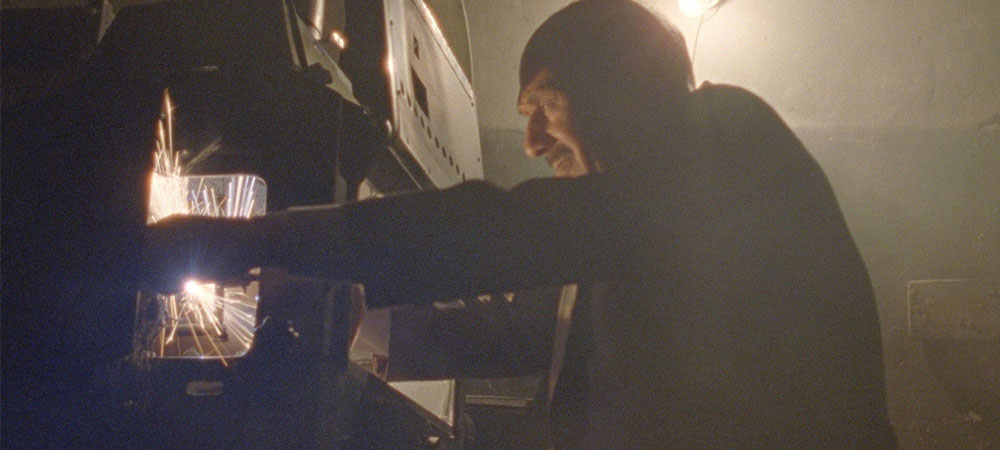
Who in the Western world would risk their lives to save a national film archive? The first answer may very well be nobody, as we tend to live in our «comfort zones». But we have to imagine a situation where all the cinematographic treasures, the unique traces of complex cultural and political realities in times of radical historical change are only documented at one time, in one place.
In terms of Afghanistan, the country at the center of #The Forbidden Reel#, we also have to imagine a country, which, not only, has suffered radical changes, but also a barbaric will of systematic destructive forces. The 2001 destruction of large Buddha statues and of all non-Islamic artworks in the archaeological museum in Kabul are but the well-known surface of this disaster.
Systematically destroyed, raised or forgotten
The US-based artist, writer, and filmmaker #Mariam Ghani# recalls to us just how many aspects of Afghan culture have been systematically destroyed, raised or forgotten. But by an unbelievable fluke, the Afghan film archive has remained almost entirely intact. Ghani reminds us, that in the public perception of Afghanistan, intellectual, leftist, and modernist historical tendencies are completely absent, almost exclusively accessible through its film archive.
Who in the Western world would risk their lives to save a national film archive?
There was a time when violence in Afghanistan was not a normality. In those days, a small and personal film scene grew, far away from an actual industry. Even in the first days of the communist invasion of April 1978, which had been mostly welcomed as liberation from a corrupt dynasty, this scene was supported by funds and offered a space for personal expression within fictional film creation. At the same time, more women could take recognised positions, as actresses in film or at the governmental level. Later, during communist times, cinema production became more and more censured. It became an instrument of ideology propaganda. In this phase, executions were set in scene and «traitors,» including families, were persecuted. The uprising population filled the already overloaded prisons. The Mujahedeen, which at the beginning had not been an organised group, started to coordinate their activities and won power as a military force.
But still much harder times arrived
Even the Mujahedeen, especially under the leadership of Massoud, respected cinema as a tool of necessary documentation and transmission of knowledge. However, the upcoming Taliban wanted to wipe it out. If one woman would appear on TV, or one cinema was reopened, they announced they would destroy Kabul.
There was a time when Afghanistan’s violence was not normality.
The really surprising information in Ariel Nasr’s well-detailed documentary is the fact that amongst the Taliban there were also those who cherished the history of their homeland. It was the head of the radio and television ministry during the Taliban regime who warned his colleagues from the archive to hide their treasures, at least the most important ones. This astonishing man, who Nasr succeeds in presenting in front of his camera, felt – in his own words – sadness, that «we have fallen so low». Still, it was a huge risk creating false walls inside the archive to hide the larger parts of the national film history and, on the other side of the coin, setting up a fireplace where (mostly) imported films were melted down as a faked destruction simulation. Still, 2500 films were lost in the fire.
Only recently, Mariam Ghani resumes, is it possible to speak with honesty about Afghanistan’s communist period, but still not about the Mujahedeen or Taliban occupations. But, still today, such talk does not come without risk.
Cultural diversity
Key figures of Afghani film history: the filmmakers Ibrahim Arify, Yussuf Jannesar, Engineer Latif Ahmadi, who have temporarily forced to leave the country, and Siddiq Barmak, who later became the head of the Afghan film archive, provide their very personal approaches to cinema, their fist experiences with film, and putting a camera in heir hands. At the same time, they refer to the specifics of early Afghan cinema, which had presented all the aspects of national cultural diversity.
Today, the archive is not out of risk. It can always be the victim of a bomb attack. Furthermore, it has been difficult to technically save the films given circumstances without electricity or the adequate equipment to do so. The aim today is to digitise and archive the films, which is an expensive, time-consuming task with the necessary funds missing.
The Forbidden Reel begins to offer an inside view on the still nearly unknown treasures of Afghan cinema and, at the same time, on Afghanistan’s rich cultures.