
How can film represent the perspective of a forest? In Sammy Baloji’s The Tree of Authenticity, the titular forest giant is a witness to three centuries of colonial violence and environmental destruction in the Congo Basin. The basin acts as one of the world’s largest carbon sinks, second only to the #Amazon rainforest, removing billions of tonnes of #carbon dioxide# belched out annually by global industry. Winner of the Tiger Competition at #IFFR, the essay film probes the entanglements of scientific research and colonialism in the Congo with an uncompromising gaze that decentres the anthropic to speculate on the agency of the natural world.

Colonial spillage
Baloji first embarked on the project over lockdown after reading an article on the discovery of notebooks kept between 1937 and 1958 in a research station in the Congo Basin. The records contained weekly observations of over 2000 trees, and hundreds of volunteers were recruited to transcribe these handwritten notes for digitisation. Using this story as a point of departure, the film excavates the history of scientific research into the basin by narrating the journals of scientists.
Archival images are used sparingly. Instead, the voiceovers are coupled with footage Baloji captured in present-day Congo, with wide static shots of the rainforest and dilapidated colonial buildings. The film refuses to keep the past contained in the past, revealing its spillage into the present and the colonial spectres haunting the land. Baloji uses sonic worldbuilding to evoke the rainforest, amplifying the sounds of birdsong, crawling insects, and even the drip of latex from a rubber tree. Through the chorus of an ecosystem, the basin manifests as its own autonomous entity, not one defined by human activity.
Through the chorus of an ecosystem, the basin manifests as its own autonomous entity, not one defined by human activity.
Echoes of off-screen violence
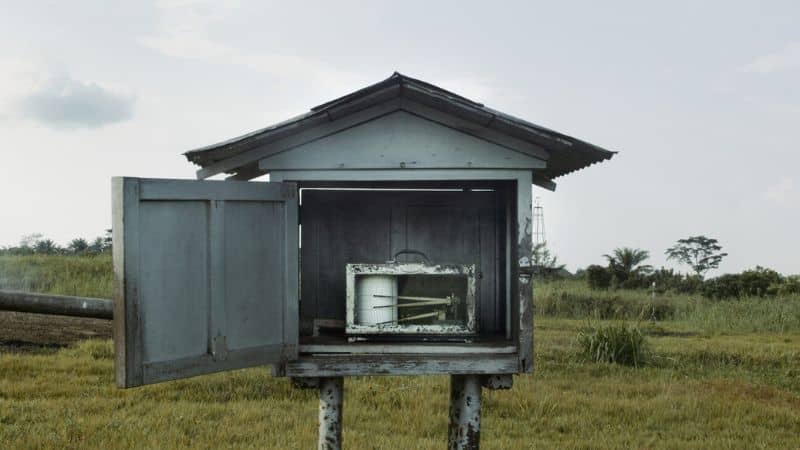
The camera moves into the interior of a colonial research facility, lingering on dusty glassware and decrepit scientific apparatus. The meditative shots silently dispute the apparent objectivity and neutrality of these tools. Institutional science, such as evolutionary theory and eugenics, has long been used to justify racism and give it a rational basis. Similarly, the film reveals the violence behind the taxonomic processes of naming and categorising, systems of destructive knowledge production subordinate to the demands of production and profit. The voiceover details research into engineering a hybrid palm oil plant with the highest yields, enforcing monoculture and eradicating the diversity of native plants.
While the film does not directly address the DRC’s current humanitarian crisis, the echoes of off-screen violence are felt deeply within each frame. Every year, M23 rebels smuggle out hundreds of tonnes of cobalt, a key component in mobile phone batteries, leaving a trail of destruction in their wake. While minerals are not the only reason behind the conflict, the Congo’s instability has benefited those seeking to exploit its resources. The Congolese people and the land become collateral damage in these systemic processes of extraction and domination.
Giving voice
The soundscapes that reverberate throughout the film culminate in the titular Tree of Authenticity speaking for itself. From the statues of Mati Diop’s Dahomey (2024) to the hippo of Nelson Carlo de Los Santos’ Pepe (2024), recent nonfiction filmmaking has experimented with giving a speaking voice to nonhuman subjects. Rather than a voiceover, the tree communicates through the deep rumbling of its roots and the polyphonic rainforest, with onscreen text expressing how it has been utilised as symbols of both Belgian colonial plunder and Congolese nation-building. It rejects these interpretations, lamenting the trees’ latest co-optation as workers in the new #climate economy# to suck up human emissions, «their breath monitored, their services appropriated.» In creating cinematic space for the rainforest to breathe, the film dismantles the anthropocentric ideologies underpinning capitalist extraction and calls for alternative ways of structuring our relationship with nature.