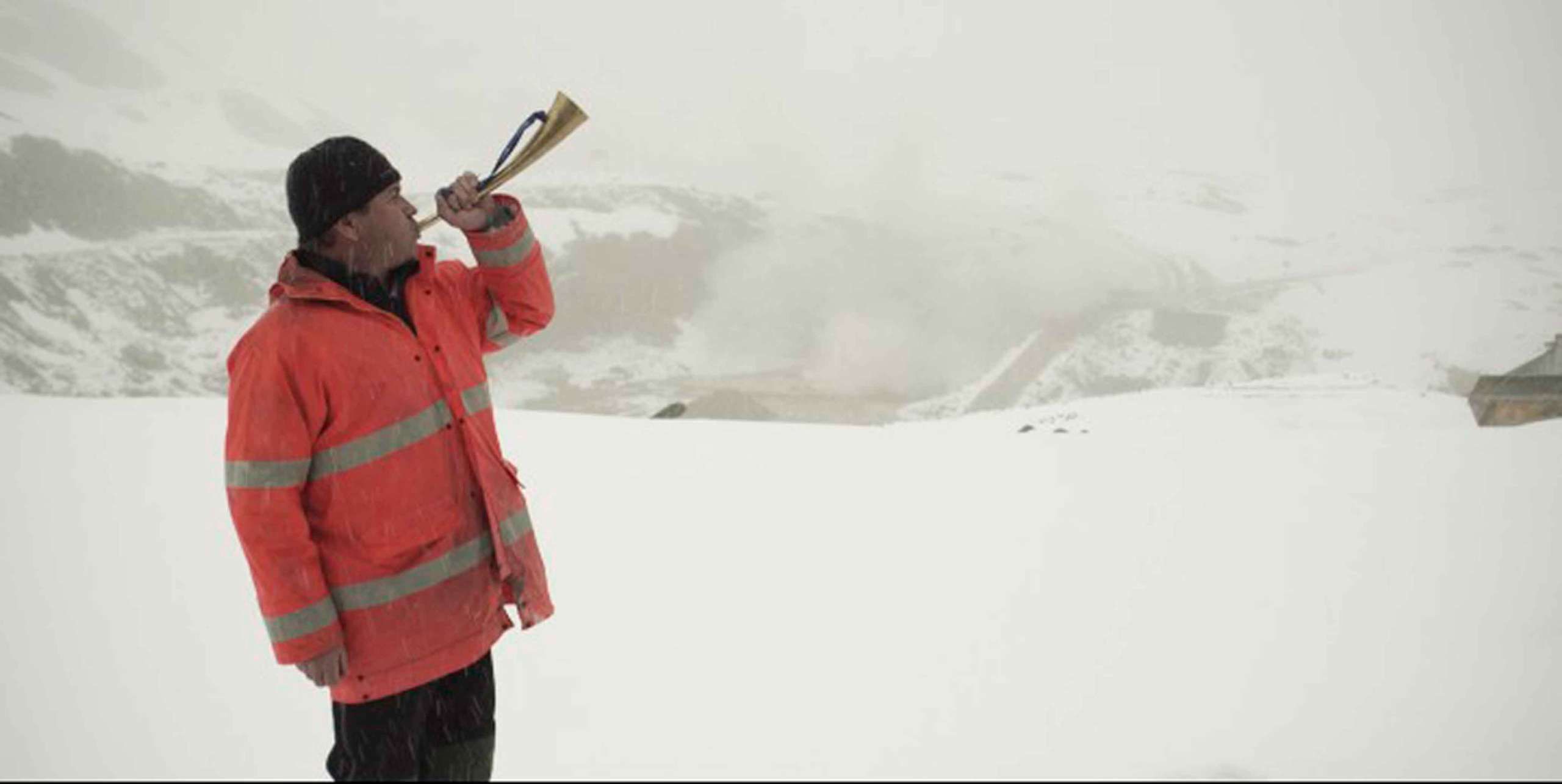
Over the course of a year, Peak observes this production process in the Alps and uncovers what is usually hidden from the winter tourists beneath a thick blanket of artificial snow. The film shows the landscapes’ modifications and the inextinguishable traces that these invasions leave behind. Peak questions the relationship between nature and technology. How artificial is a landscape allowed to be? Or – to put it differently – how artificial must it look in order to fulfil and justify our archaic desire for paradise on earth?

Peak opens with giant tableaus and wide panoramas. Majestic mountain tops and valleys as far as any eye can see. Nature in all its grandeur. Then suddenly from nowhere people emerge. Skiers. Tourists. And the following images show humans using great and strange machines to transform nature. Some humans use nature for recreational purposes, others as a means of production. The interaction with nature is beyond understanding. Three tons of explosives are used to blow away rocks from the mountains. Snow guns are developed and modified to create a growing demand for tons of artificial snow. A re-creation of a nature that is vanishing.
Of course the film has a political ring to it. One cannot see Peak without thinking of the ongoing climate debate and the positions in this debate. Most notably, the controversial scientist Bjørn Lomborg, author of The Sceptical Environmentalist comes to mind. Unlike what many people believe about him, Lomborg does actually agree that global warming is occurring and we need to do something about it. Lomborg’s position is that instead of talking about a need for behavioural changes, he believes in research and development as a means to solve the problems. We need to invest and develop technology that allows us to live with and minimise the challenges global warming brings, says Lomborg in the book; pretty much the same position as the people on the mountain in Peak who, armed with ski guns and big machinery, take on Mother Nature. The problem is though that you cannot cover the entire glacier with fake snow. Even modern technology seems to have trouble keeping up the fight.

As said, Peak does not itself take a position – which is quite appreciative in this kind of film. However, the film is not without problems. One of the main issues I have with the film is its eagerness to be slow. Most of the scenes in Peak are made using either a static camera which holds the image for a very long time or using slow tracking shots. Some scenes really deserve this aesthetic. For example the great mountain views where the camera slowly starts to move and reveals people working in the mountain like small ants in a large nest. But many of the scenes cannot cope with the slowness. Eventually you start to ignore the depiction of many everyday things. An old man cooking. A woman taking out the trash. The wind blowing in the trees. The ski lift moving and emptying out people just like a giant snake spitting out human beings one by one. The slowness becomes an attitude and feels somewhat self-appreciative in a way not always appropriate for the film. Also the film seems to become staccato near the end. It dwells and repeats the main themes over and over again and could probably benefit from a second editing.