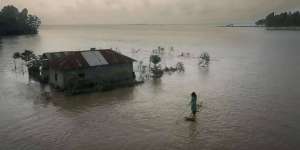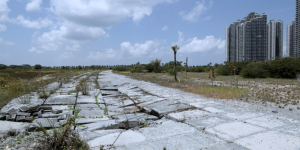
Last weekend, the south of Italy was devastated by a raging climate event named Cyclone Harry. Waves up to ten meters high, stormy winds that blew for days, and heavy, persistent rains have literally torn apart some of the most beautiful parts of the world. Not only has the coastline been destroyed. Under heavy rain, the clayey soils below Nischemi, an ancient Sicilian town rich in baroque and neoclassical monuments, resting at 332 m above sea level, lost their mechanical resistance and collapsed. The landslide destroyed about 4 km of the road around Niscemi, a considerable part of the city’s historical core, and left several buildings on the verge of the cliff above a 25-meter-deep void. The avalanche has moved an estimated 350 million cubic meters of land, and as I write this, the earth below the town is still moving. The authorities had to extend the danger zone, and voices about relocating the whole city can already be heard. The world of the day is «adaptation» – media and politicians in one voice ponder the changes needed to make life better suited to the new climate conditions, one prominent example being the mobile barrier system protecting the Venice lagoon from rising sea levels.

Whatever happened to the 1.5 C limit
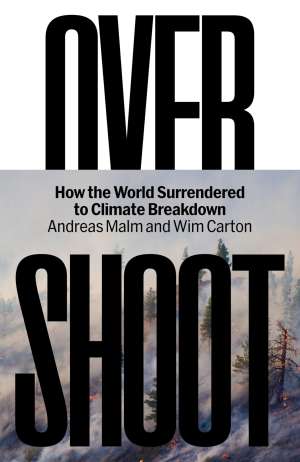
So the danger of global warming is all gone? Not even close. The sinister feeling about the silence on global warming is more than just a hunch. I have just finished reading Overshoot, a thoroughly researched and documented study written by two researchers and environmental activists from Lund University, and believe me, we should be dead scared. Combining historical analysis, political economy, philosophy, and environmental sociology, Malm and Carton showed how, and why, the urge to stop climate warming by replacing fossil fuels with renewables has been swept away by the now dominant climate ideology – the overshoot. The 1.5°C global heating limit was introduced by the Paris Agreement in 2015 at the initiative of the most vulnerable nations, such as small island states, whose survival depended on its respect. In 2018, the Intergovernmental Panel on Climate Change (IPCC) released its Special Report on Global Warming, clearly confirming the claim that warming in excess of 1.5 «would be too unsafe to live with» (page x). In the years that followed, the renewables became cheaper and easily available, and as a by-product of measures for slowing down the virus during the Covid 19 epidemics, the global CO2 emissions fell – a tangible proof that abandoning fossil fuels does reduce global warming. Nevertheless, the need to avoid the heating of the Earth atmosphere at all costs was abandoned in favour of idea that we can let the heating go on, even beyond the limits of 1.5 °C, 2 °C or even higher, and count on the fact that when the atmosphere gets too hot, the technology will be able to intervene and make the situation return to the acceptable conditions—the ideology of overshoot.
The world of the day is «adaptation»
Magical thinking
The computer models used to test the idea of overshoot, the s.c. Integrated assessment models (IAMs) were constructed on a series of bad premises, starting with the assumption that «an economy of distinctly human making (can) be captured in the same model as something like glaciers» (p. 56). The key strategies of the overshoot are, apart from the adaptation measures discussed after the recent climate catastrophe in Italy, geoengineering and removal. The former is represented by ideas such as putting «some substances or objects into the stratosphere» to block sunlight or «shoot out material to cool the Earth» (p. 93). The latter would be the possibility of removing carbon from the air by special devices, or «to remove carbon dioxide from the atmosphere by running combustion in reverse» (p. 80) as suggested by Nobel laureate William Nordhaus. The overshoot not only assumes that it is possible to control the Earth’s atmosphere as one controls a room’s climate. The bottom line is that all these technologies were imaginary; they existed only in the minds of modellers and had no proven efficiency. The BECCS (Bio-Energy Carbon Capture and Storage) plants, for example, had the status of «carbon unicorns, they were brandished like a light sabre, incredible but not real, and, as a viable solution to global warming, represented «a kind of magical thinking» (p. 79).
As we know from Althusser, any ideology, however imaginary, exists in the material actions of those who believe in it. The role of climate action and world summits, claim the authors of Overshoot, became exactly this: they became the prime materialisation of the overshoot ideology, keeping «the continuous transmission of positive signals» the main obligation (p. 89). In this way, US President Obama could do both: praise the Paris agreement and make the USA the world’s third-largest oil exporter.

Material effect
The climate movement in the North, the rising opposition to oil companies in countries of the South with their demand to «Keep it in the ground!”, along the first «local victories» such as cancellations of pipelines and decommissioning of coal mines all contributed to a particular atmosphere in which «a cloud of uncertainty was hung above fossil fuel properties» (p. 104). Multiple industry interconnections made the cost estimates for the eventual decision to abandon fossil fuels to stop global warming uncertain. In 2020, one guess was that «big oil and gas companies would lose one third of their value (…) if the carbon budget for 1.5°C were to be respected,» another study found that the stranding of reserves for keeping the same temperature limit «would directly rob the producers of fossil fuels of between 13 and 17 trillion dollars» (p. 141). In any case, this would mean the end of «the oil and gas companies in their current form». Innovation is an intrinsic element of the capitalist economy: steam, electricity, cars, and mass production; IT and AI; each of these made previous technologies redundant. The authors thoroughly explain why the stranding of fossil fuel assets would be much more radical, comparable only to the abolition of slavery and to the October Revolution. Only much larger, because it would not stop at the state borders.
Overshoot prevented this from taking place. It rested on magical thinking, but it has achieved its material effect in full. The gas and oil companies not only reported the largest cash flows in a decade in 2021, but also the largest profits in their histories in 2022 (p. 11). They returned to business as usual, developing new oil and gas pipelines, opening new coal mines and plants, even if not one could be added «if the world were to avert warming by more than 1.5°C» (p. 13).
The gas and oil companies not only reported the largest cash flows in a decade in 2021, but also the largest profits in their histories in 2022
The price to be paid
Only one year later, the temperature limit was exceeded. September 2023, the warmest month ever, was 1.75°C warmer than the pre-industrial average. In the same month, the deadliest climate disaster of the decade so far took place. A cyclone named Storm Daniel raged from the Balkans over Greece to Libya, where it killed some 11.300 people (p. 251). This was not the only disaster that year. In February and March, Cyclone Freddy hit two of the poorest countries in the world, Mozambique and Malawi, where around one thousand people died. In Tunis, temperatures reached 50°C, causing unbearable suffering of migrants with no tents to stay in. The Hawaiian island of Maui was caught in the country’s worst wildfire, with 97 lives lost. The number of private jets sold also set records that year. Confirming the authors’ conclusion that «the worst mass killers in this rapidly warming world are the billionaires, merely by dint of their lifestyle» (p. 226).
2023 was also the year the authors wrote this book. It is a bitter and angry book, but theirs is an optimistic anger, meant to stimulate the search for a solution. The authors themselves consider plenty of options, with the same precision and dedication as other arguments, taking into consideration the texts from revolutionaries such as Rosa Luxemburg and Antonio Gramsci, as well as contemporary solutions, such as the policy of Rafael Correa who became president of Ecuador in 2007, regarding the Yasuní, a biodiversity hotspot on top of the second largest oil reserve in Ecuador.
In short, everybody should read this book. It is wonderfully written, offers comprehensive information, and has a thriller-like narrative, meaning you will enjoy it regardless of the often unpleasant revelations. These might make you angry and ready to do something about it, but this is also the point.